Every few months the world appears to discover another race. There was the space race, the nuclear arms race and the race for control of the internet. Today, we are witnessing what may become one of the most important technological competitions of our lifetime – the race for artificial intelligence.
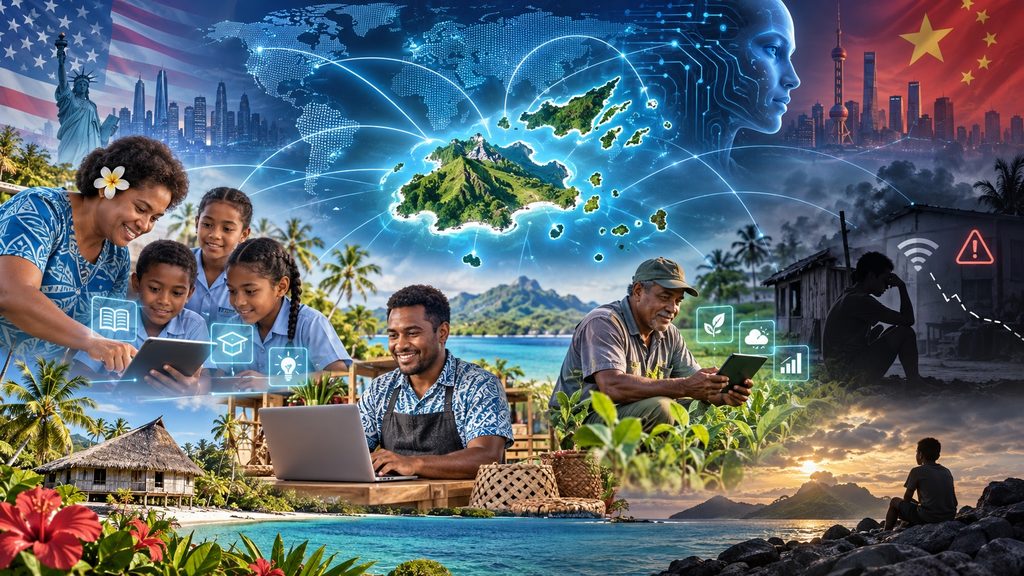
The headlines mostly focus on the United States and China. American companies such as OpenAI, Google and Anthropic are pushing the capabilities of AI forward, while Chinese companies are developing increasingly competitive systems of their own. At the same time, enormous amounts of money are being invested in computer chips, data centres, energy and research.
BUT while the giants race, I believe small countries such as Fiji need to ask a different question.
We are unlikely to build the world’s most powerful AI model or manufacture the advanced computer chips on which these systems depend. That does not mean we have to remain spectators. The real competition for Fiji is not against America or China. It is a race against our own lack of preparedness.
There are already encouraging signs that Fiji is paying greater attention to digital transformation and emerging technologies. But the bigger opportunity lies among ordinary Fijians.
As a teacher, I can already see what AI can do. Work that previously took hours can sometimes be completed in minutes. A teacher can prepare differentiated learning activities, develop reading materials, analyse results and create resources much faster. A small business owner can prepare advertisements, business plans and customer communications. A farmer could increasingly use AI-supported information for weather, crops and markets. Government departments can reduce paperwork, analyse information and make services easier to access.
For a small economy like ours, productivity matters enormously. We do not have the population or resources of the world’s major economies. Technology therefore gives us an opportunity to do more with what we have.
Fiji already has a significant level of internet use, which gives us a foundation for wider digital participation. At the same time, not everyone has the same quality of connectivity, devices or digital skills. That brings us to the danger.
AI could reduce inequality, but it could just as easily increase it.
A student with good internet access, a laptop and knowledge of AI may suddenly have something resembling a personal tutor available day and night.
Another child without reliable connectivity or a suitable device may fall further behind. Businesses that understand AI may become more productive, while others struggle to compete. Workers whose jobs involve repetitive administrative tasks may discover that some of those duties can now be automated.
This is why I do not believe Fiji’s response should simply be to purchase more technology.
We need to develop people.
Digital literacy and AI literacy should become part of education, beginning at an appropriate level in schools and continuing through tertiary education, vocational training and professional development. Teachers themselves need training. Students must learn not only how to obtain an answer from AI, but how to question that answer, check facts, recognise misinformation and think independently.
That last point is crucial.
AI should strengthen human intelligence, not replace it.
If a student simply asks a machine to write every assignment, we have gained technology but lost education. If an employee accepts every AI-generated answer without checking it, we have exchanged efficiency for dependency. The most valuable skill in an AI world may therefore not be typing prompts. It may be critical thinking.
There are also security risks. Artificial intelligence can assist scammers, produce convincing fake images and voices and increase the sophistication of cybercrime. Fiji must continue treating cybersecurity and digital safety as national priorities as more services and personal information move online.
There is another issue that deserves more discussion: Dependence.
Most of the AI systems Fijians use will probably be owned by companies overseas. Our information may be processed through foreign platforms, and decisions about pricing, access and technology will largely be made outside Fiji. We therefore need strong rules around privacy, data protection and responsible AI use.
My view is that Fiji should neither fear the AI revolution nor blindly celebrate it.
We should adopt it with our eyes open.
The United States and China may be racing to build the world’s most powerful artificial intelligence. Fiji’s race is different. Ours is a race to educate our people quickly enough, protect them adequately and make sure this extraordinary technology improves lives rather than leaving part of our population behind. We may be a small island nation, but technological revolutions have an interesting habit of reducing the importance of physical size.
The question is no longer whether artificial intelligence is coming to Fiji.
It is already here.
The question now is whether we will simply consume what others create – or learn how to use it intelligently to build a stronger Fiji.
n DINESH PRASAD is a school teacher with a strong interest in artificial intelligence and its responsible use in education and national development.
dinesh