Today, the encyclopedia, library, typewriter, camera, television, map, newspaper, calculator and telephone can all exist inside one device in a child’s hand. Homework can be assigned online, research can happen in seconds, relatives can video-call across oceans, and a student can learn almost anything from a screen. Technology has not simply become more available. It has become embedded in childhood itself.
MY first mobile phone came when I was 16. It was a basic button phone that cost about $39. Even then, my friends and I had developed our own economy. Instead of calling one another and wasting credit, we would send missed calls. One missed call could mean, “I’m here.” Two might mean, “call me.” Sometimes it probably meant nothing at all. We understood the value of every cent because phone credit disappeared quickly.
When accessible internet finally entered our lives, it did not arrive as unlimited fibre or generous data packages. I remember the little internet stick that plugged into the computer. It had to be recharged, so every minute online felt as though it had a cost attached to it. I would connect, frantically type up a letter-to-the-editor piece, send it off, make sure the email had gone through and log out. There was no endless scrolling because endless scrolling would have cost money.
Facebook, when it became part of our lives, also felt different. For many of us in Fiji, it was a way of finding cousins overseas, messaging relatives in Australia, New Zealand, Canada or America, sharing photographs and seeing what family members who had migrated were doing. It helped collapse the distance that migration had created.
So yes, those of us who grew up in the late 1990s and early 2000s survived without constant internet access. But that observation proves very little about what children need in 2026.
The world has changed too much.
That is why Fiji’s current discussion about restricting social-media access for children aged 16 and under deserves more than the easy argument that “we grew up without it and we were fine”. The Government has begun consulting children aged 13 to 17, and a taskforce is preparing recommendations and draft legislation. Officials have also said Fiji may not simply copy Australia’s model; options under discussion include restrictions during certain times or tighter controls during school hours. The stated concerns include grooming, exploitation, inappropriate content and other online harms.
Those concerns are not imaginary. Children can encounter cyberbullying, sexual content, scams, predatory behaviour and humiliation at a speed previous generations never experienced. A cruel comment in my teenage years might have travelled through a classroom. Today, a humiliating photograph can move through a school, a community and beyond before a parent even knows it exists. Protecting children from that environment is a legitimate public concern.
But another question deserves equal attention: What exactly does a ban solve?
Australia’s experience is already showing why the answer is complicated. Its social-media minimum-age law took effect in December 2025 and requires designated platforms to take reasonable steps to stop under-16s from holding accounts. Early official research found that the proportion of under-16s with social-media accounts fell from 52.4 per cent to 42.1 per cent after implementation. That is a measurable decline. But it is not disappearance. A substantial number of children remained on restricted platforms, and Australian authorities are conducting a two-year study involving more than 4000 children and families because the longer-term effects are not yet known.
That distinction matters for Fiji.
If children simply migrate from one platform to another, borrow an adult’s account, change their age, use a VPN or move to less visible online spaces, then restricting access may alter behaviour without necessarily removing risk. Australia itself has had to confront compliance problems, and its regulator has reported concerns about whether some major platforms are doing enough to keep underage users off their services.
The issue therefore cannot be reduced to whether social media is good or bad. It is both. It can connect a child to family, knowledge, communities and creativity. It can also expose that same child to manipulation, bullying and exploitation. The device is not the moral actor. The environment built around it matters, the platform design matters, the adult supervision matters, and the child’s ability to recognise danger matters.
That is where I struggle with the language of banning.
Are we responding to research showing that 16 is the clearest developmental threshold? Are we looking at evidence from Fiji specifically: How children here use TikTok, Facebook, Instagram, YouTube and messaging platforms, what harms they actually experience, and at what ages those harms are most common? Or are we borrowing a politically attractive solution because another country has already made it visible?
Those are not accusations. They are questions that should accompany any serious policy discussion.
Fiji’s own debate already contains competing views. Earlier, the Online Safety Commission warned that simply banning social media would not address the root causes of online harm and emphasised digital literacy, parental guidance and stronger safety systems. More recently, the national discussion has shifted towards age deferment, with consultations now underway and legislation being developed. That evolution may ultimately produce a different model from Australia’s, but it makes the evidence behind whatever Fiji adopts especially important.
Because teaching children to live without social media until 16 is one thing. Teaching them how to live with it after 16 is another.
A sixteen-year-old who receives access on a birthday does not suddenly understand grooming, misinformation, privacy, permanence, algorithms, body-image manipulation or how to respond when an intimate photograph is shared without consent. Age can create a legal boundary. It cannot manufacture judgment.
And this is where nostalgia becomes dangerous. My generation can laugh about Encarta, missed calls, $39 phones and internet sticks because those memories belong to a slower technological world. Children today are not growing up in that world. Their classrooms, friendships, entertainment and future workplaces are digital. The question is no longer simply how long we can keep them away from technology. It is what kind of relationship with technology prepares them for adulthood.
Perhaps restrictions will form part of that answer. Education, parental responsibility, platform accountability and stronger enforcement are also part of the debate. The evidence from Australia is still developing, while Fiji is only beginning to decide what its own model would look like. That uncertainty should be acknowledged rather than replaced by slogans.
We survived without the internet. Our children will not inherit a world without it. So the real question is not whether they can survive without social media until they are 16.
It is whether, by the time they are allowed into the digital world, we have actually taught them how to survive inside it.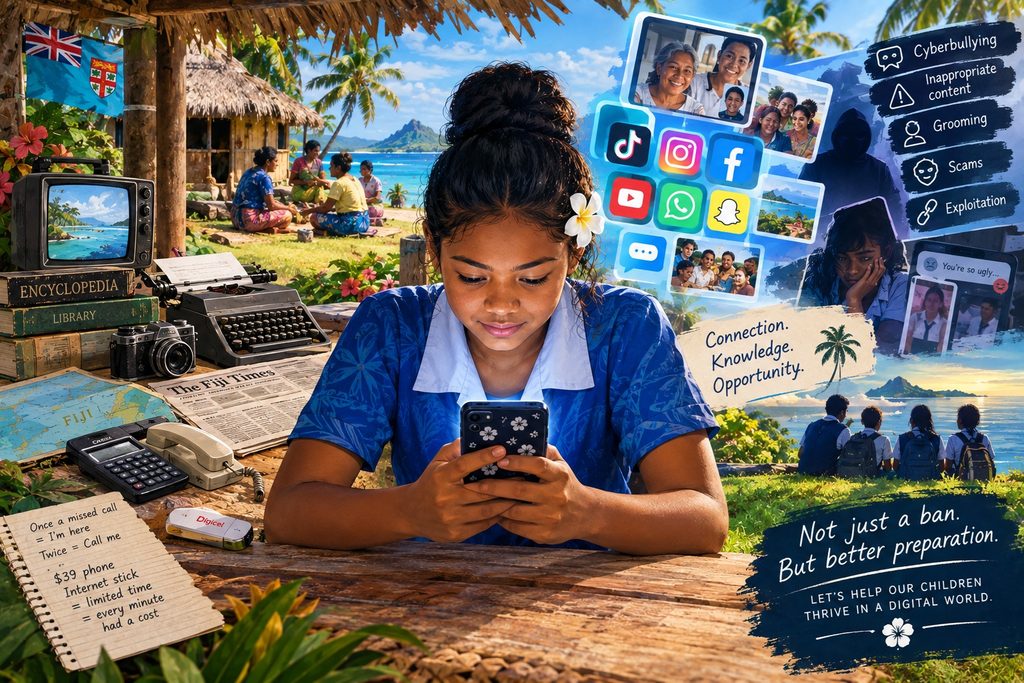
The author says perhaps restrictions will form part of that answer. Education, parental responsibility, platform accountability and stronger enforcement are also part of the debate. Picture: AI GENERATED IMAGE