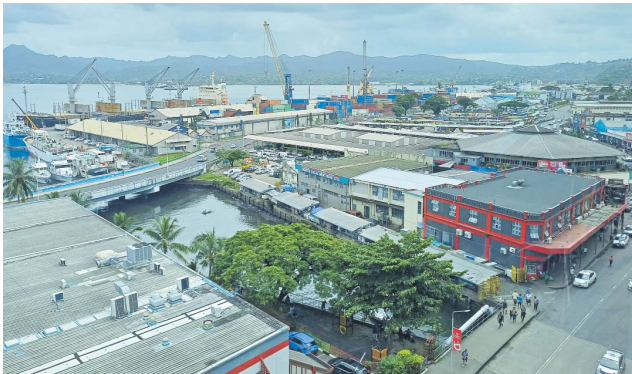
Fiji’s import bill never stops arriving. Every month, ships dock in Suva and Lautoka carrying the basics of Fijian life—rice, flour, chicken, fuel—then leave with Fijian dollars that never come back. In 2024, Fiji spent about $F1.6 billion on refined petroleum and $F1.1b on food and agricultural imports—more than $F2.7b a year leaking out for essential goods. With nominal GDP at $13.5b in 2024, that represents roughly 20 per cent of GDP. This is more than ordinary trade; it is a structural drain that keeps households vulnerable, businesses exposed and the nation dependent on global shocks. When families struggle with fuel and food prices, governments scramble to cushion price spikes and local producers cannot compete with imports, the underlying problem is the same: an economy built increasingly on consumption rather than production.
The import ledger: What exactly are we buying?
The big-ticket items tell the story. Refined petroleum was Fiji’s top import in 2024, costing around $F1.6b. Food and agricultural imports added another $F1.1b, including rice ($F86.6 million in 2024 alone), flour, chicken, beef, dairy and processed foods. Processed foods and beverages arrive from South Korea, the US, China, Vietnam and Australia, filling supermarket shelves and restaurant menus.
In 2023, Fiji imported $1.106b in crops and livestock while exporting only $343.4m—a 3:1 imbalance.
This is a national balance-sheet problem: billions leave every year for goods that could, at least partly, be grown, raised or processed here.
Rice and flour: Staples we could grow ourselves
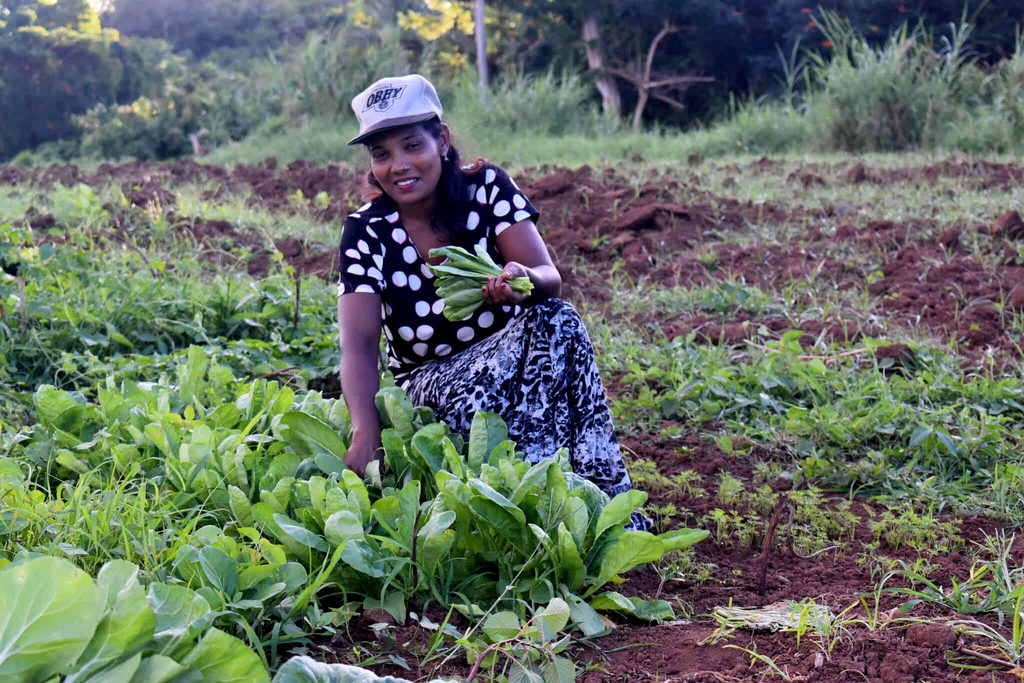
Rice illustrates the missed opportunity. In 2024, Fiji produced only 8598 metric tonnes of rice but imported $F86.6m worth, demonstrating how far local supply falls short of demand. The Northern Division leads production, with 969 farmers on 1301 hectares, but yields and cultivated areas remain too small. Better irrigation, mechanisation and seed varieties could potentially double or triple output on existing idle land in Ba, Ra and Macuata.
Wheat cannot be grown commercially here, but cassava, dalo and taro flours can substitute for some imported wheat flour in baking and food processing. This is not nostalgia for subsistence farming; it is about food security, jobs and foreign exchange. Every tonne produced locally is one less tonne requiring imported dollars and one more tonne supporting Fijian farmers and millers.
Meat and dairy: From frozen containers to local farms
Fiji imports substantial quantities of chicken, beef, lamb and dairy products, with reduced duties on beef, ducks, corned mutton and canned mackerel helping keep prices down.
Yet local production already exists: dairy (15,731 tonnes), beef (4193 tonnes), alongside poultry, pigs, goats and sheep. New initiatives include a sheep and goat farming push to reduce meat imports and strengthen rural livelihoods.
The 2026–27 Budget allocates $F10.7m for livestock development and dairy production.
Better breeding, feed—including potential insect-based feed from agricultural by-products—and cold-chain infrastructure could allow Fiji to replace a meaningful share of frozen and canned imports with fresh local meat and milk.
That would reduce the import bill while improving nutrition, rural incomes, processing and employment.
Fruit, vegetables and processed foods: The low-hanging fruit
Fiji imports apples, carrots, grapes, oranges, pears, celery, capsicums, mushrooms, kiwifruit, cauliflower, broccoli and nuts, many at zero duty because they are not grown locally. Yet Fiji already produces tomatoes, cabbage, lettuce, cucumber, eggplant, pumpkin, bananas, avocados, pawpaw and watermelons—often simply without sufficient scale or consistency.
Private-sector initiatives show what is possible. Grace Road is establishing a juice factory using local fruit rather than imported beverages. Contract farming, aggregation hubs and basic processing—juices, frozen vegetables and dried fruit—could displace many imported products, particularly for hotels, schools and supermarkets.
This is low-hanging fruit in every sense: crops that can grow here, markets that already exist and value that can be captured locally.
Fuel and energy: The biggest leak of all
Energy is the single largest leak. Fiji spent $US730m on refined petroleum in 2024, equivalent to about 12 per cent of GDP. More than 85 per cent of final energy comes from petroleum imports, while about 40 per cent of electricity still comes from diesel and heavy fuel oil.
The alternative is clear: a $2b renewable plan aims for 100 per cent renewable electricity by 2035, including 165 MW of solar, new hydro, biomass, wind and geothermal. Each 1 MW of solar in places such as Nadi can cut diesel consumption by more than 300,000 litres a year. This is not merely an environmental issue; it is economic and national security policy.
Every megawatt of renewable energy reduces dependence on imported fuel, while every dollar saved on diesel can instead support schools, clinics and roads.
Regional view: Fiji among Pacific import-dependent states
Fiji is not alone. Pacific ministers have repeatedly noted the region’s exposure to global shocks because of dependence on imported fuel, food and essential goods.
By 2024, at least eight Pacific nations relied on oil for more than half their electricity, with Solomon Islands, Tonga and Nauru even more dependent than Fiji. Fiji also redistributes fuel to smaller neighbours such as Tonga, Tuvalu and the Cook Islands, giving it a regional role while increasing its exposure.
But Fiji has more arable land, a larger labour force and greater policy space than many neighbours. Its continued reliance on imports is therefore not simply a vulnerability imposed by geography; it is also a policy choice—and one that can be changed.
Global parallels: Small states that reduced import leakage
Small island and coastal states have faced similar challenges and chosen different paths.
Some Caribbean countries invested in regional agriculture to reduce food-import bills. Iceland and Costa Rica shifted heavily towards renewable energy—hydro, geothermal and wind—to reduce fuel dependence.
Others developed local processing industries, including dairy, juices and canned fish, to replace imported packaged goods.
Countries that remained trapped in high-import, low-production models repeatedly suffered when global prices surged. Fiji has land, water, labour and policy space to move in the opposite direction. It can prioritise production over consumption and local value over cheap imports.
The question is not whether substitution is possible, but whether policymakers, businesses and consumers are prepared to make the necessary short-term adjustments for greater long-term resilience.s
A practical substitution agenda: What can Fiji make or grow?
A practical import-substitution agenda is within reach. For rice, expand irrigated production in the North while supporting mechanisation and milling.
For flour, develop cassava, dalo and taro flour for bakeries and processors. For meat and dairy, scale up sheep, goats, cattle and dairy through better breeding, feed and cold-chain systems.
For fruit and vegetables, promote contract farming for hotels and supermarkets while supporting small-scale processing of juices and frozen produce.
For energy, accelerate solar, hydro, biomass and wind to reduce diesel use in electricity and transport.
This should be treated as a national project.
Every item shifted from import to local production creates employment, keeps money circulating domestically and reduces vulnerability.
The blueprint already exists in budget allocations, strategic plans and private-sector initiatives; what is missing is sustained coordination and execution.
Plugging the leak, rebuilding resilience
Every time those ships dock, Fiji faces a choice: remain a high-import, high-leakage economy or use its land, labour and resources to produce more of what it consumes.
The $F2.7b annual leakage is not inevitable; it reflects decades of policy and investment choices.
Farmers, businesses and policymakers must begin treating import dependence as a strategic weakness and local production as a national economic-security priority.
The future of Fiji’s economy—and the affordability of life for ordinary Fijians—depends on how quickly that leak can be converted into local value.
When the next ship arrives, the goal should not simply be to unload more imports, but to send fewer ships away empty of Fijian value—because more of what Fijians need is grown, made and powered here at home.
Dr Sushil K Sharma BA MA MEng (RMIT) PhD (Melbourne) — World Meteorological Organisation (WMO) Accredited Class 1 Professional Meteorologist is a former Associate Professor of Meteorology, Fiji National University, and Operational Meteorologist and Manager, Climate Research and Services Division, Fiji Meteorological Services. The views expressed are his and not necessarily shared by this newspaper.