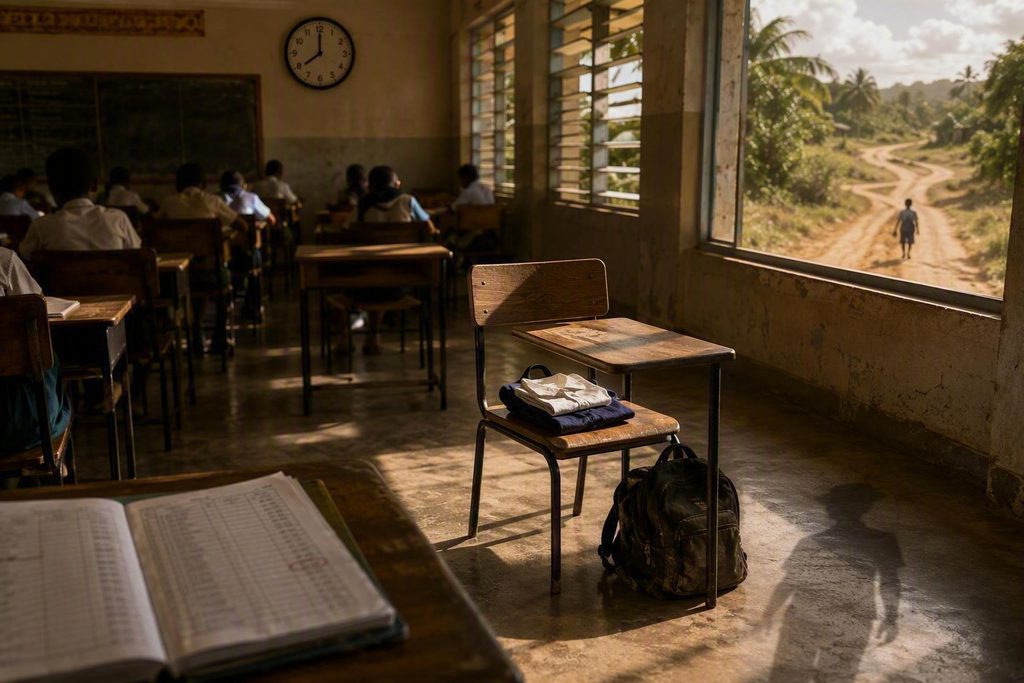
Somewhere in Fiji this morning, a child woke up and did not put on a school uniform. There was no frantic search for the other sock, no half-finished breakfast, no schoolbag dragged across the floor and no voice shouting that the bus was coming. Perhaps it was the first morning the child stayed home, or perhaps nobody remembers exactly when staying home became permanent. Somewhere in a classroom, there may still be a chair with that child’s name on a roll. The frightening thing about dropping out is that there is rarely a dramatic moment when childhood officially ends; a child simply stops turning up.
EARLIER this year, Fiji’s Education Minister revealed that around 13,000 upper-secondary-aged young people were out of school, while the dropout rate between Year 8 and Year 12 was reported at 39 per cent. Numbers like that become easy to file away as statistics. But imagine 13,000 empty chairs instead. Imagine 13,000 school uniforms hanging at home, slowly becoming too small for the children who no longer wear them.
Growing up in Lautoka, my parents had two words that followed me everywhere: Study hard. Before school, after school, during holidays, before exams: Study hard. I became irritated by it, as children often do when parents repeat something until the words lose their meaning. It took me years to understand they were never really talking about marks.
They were talking about escape routes.
My family was lower middle class: not destitute, but always aware that money had edges. If I wanted to study further, I understood that I had better be good enough to win a scholarship because there was no hidden pile of money waiting for me. As a child, I did not really see that. I remember ordinary Lautoka life: roads, shops, school, relatives, food, the radio playing at home. If there was food on the table and enough for an occasional small pleasure, you assumed everything was fine. What I did not see were the calculations adults were making quietly around us.
My father knew those calculations intimately. He left Vatukoula, Tavua when he was barely 18 and moved to Lautoka, where he drove a Viti Mini. Education had not been his strength, so he made another road with whatever was available. At 18 I was still trying to understand who I was; at roughly the same age, my father was trying to survive. When I later corrected his English or became impatient with things he did not know, I did not yet understand the arrogance of judging a man’s education without understanding the life that interrupted it.
My mother spent years working at Gimli Garment Factory. She did not come home discussing career progression or whether her work fulfilled some grand ambition. She worked because the family needed the wage. You got up, went where the work was, came home and did it again.
My older brother’s road was different, but no easier. After high school he worked various jobs, including at Lautoka’s Rups Big Bear, while saving for an IT diploma. He did not have the luxury of waiting for the perfect opportunity. He worked, saved, paid his fees and earned his certificate. We never called that resilience. It was simply life. Perhaps that is why I am wary when we tell young people to “work hard” without acknowledging how much harder some must work merely to reach the same starting line.
Somewhere along the way, education worked for me. I studied, became a teacher and eventually taught in New Zealand, the UAE, Kuwait and now Japan. I worked hard, yes, but plenty of people work hard and never receive the opportunities that came my way. The older I become, the less comfortable I am with the neat equation that effort always produces reward.
That is why I struggle with how quickly we judge children who leave school. We reduce complicated lives to easy sentences: He was lazy, she was not interested, the parents did not care. Sometimes those claims may contain a fragment of truth, but rarely the whole truth. A child may be failing, bullied, pregnant, hungry, working, caring for siblings, ashamed of being behind, living with violence at home or simply unable to see any connection between the classroom and the life waiting outside it. By the time the child stops coming, the real story may have begun years earlier.
As a teacher, I am not romantic about this. Young people need boundaries, discipline, attendance, persistence and adults willing to tell them when they are making destructive choices. Compassion without expectation can become another kind of failure. But there is a difference between holding a child accountable and deciding we already know what is wrong with them. Before asking why a child dropped out, we should ask what happened before the empty chair appeared.
Then comes the question that bothers me most: Where do they go?
Some will find work, learn a trade, enter training later, start businesses or build lives that never required a university lecture theatre, and there is nothing lesser about that. My own father is proof that qualifications do not measure intelligence, dignity or worth. But thousands of young people outside education, employment or training still need money, belonging, purpose and somewhere to place their energy. If schools, families, employers and communities do not offer those things, something else will.
That “something else” is not always kind. A teenager with no work and nowhere to go still wakes up with an entire day to fill, and boredom can become dangerous when it meets poverty, hopelessness and people offering quick money or quick escape. Drugs do not ask for school reports. Crime does not require a scholarship application. Exploitation knows how to find young people who feel legitimate society has no place for them. Too often, we become interested only when they appear in a police report, a hospital, a courtroom or a tragic headline. By then, the empty school chair is years behind them.
I hear my parents’ “study hard” differently now. I hear my father leaving Vatukoula as a teenager to drive a Viti Mini, my mother going to the garment factory and my brother working behind a counter while saving for an IT certificate. None of them were telling me education would make me better than them. They were telling me they wanted my life to contain choices they had not been given.
Perhaps that is the real promise of education. It does not guarantee wealth, happiness or even employment, and we should stop pretending it does. What it can do is widen the road: Another qualification, another skill, another job, another chance to begin again when the first plan collapses. My parents wanted those exits for me because they understood what it feels like when life gives you only one road and tells you to walk it. Every child deserves to reach adulthood with more than one road still open.
So when we hear that thousands of young Fijians are no longer in school, the question cannot end with, “why did they leave?” We should ask who noticed when their attendance began slipping, who asked what was happening at home, who went looking when they stopped coming and what road was waiting when the school gate finally disappeared behind them.
Somewhere tomorrow morning, another child may wake up and leave the uniform hanging in the cupboard. Nobody may realise it yet, but that quiet morning could divide an entire life into a before and an after. Years from now, when we ask where that young person went wrong, the more haunting question may be why so many of us were there when they disappeared and still failed to notice.