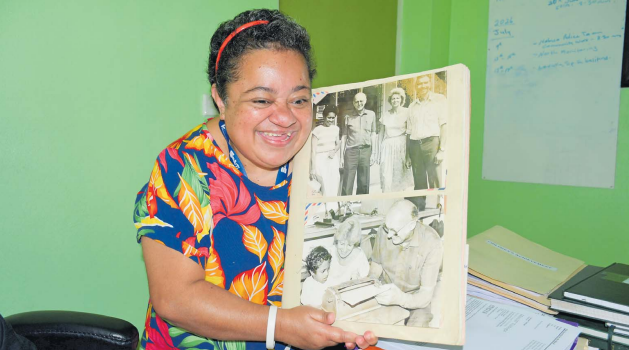
WHEN Veronica Angeline Narayan first arrived at the Fiji Society for the Blind (FSB) in 1985, she was a young girl from Somosomo, Naqara, Taveuni, unsure of what the future held.
Today, four decades later, she is helping shape the futures of other visually impaired students as a braillist, producing Braille textbooks and examination papers while pursuing a Diploma in Special Education at Fiji National University.
Her story is one of many that reflects the transformation the Fiji Society for the Blind has achieved over the past 56 years.
Executive director Barbara Farouk said the organisation’s greatest achievement had been helping blind and partially sighted students move beyond special education and into mainstream schools, universities and the workforce.
“As a result, our former students were able to continue their education into high schools under our integration program, which opened doors for them to pursue tertiary education at various universities in Fiji,” she said.
“In the last 10 years some 12 of our former students were able to complete their degree program and most of them are now in permanent employments.
“At the moment we have about 15 students pursuing further education at different universities in Fiji.”
For Ms Farouk, these milestones are proof that a vision established more than half a century ago is becoming reality.
“Our organisation’s vision and mission which were set 56 years ago are now in sight.
“We are now competing and moving alongside the sighted world.”
The journey, however, has not been without obstacles.
“Obviously we’ve had challenges as we all do in life but some of our biggest challenges have been funding and finding employment for our graduates and those who drop out of school.
“Our aim is to help them lead independent and productive lives.”
Ms Farouk said the organisation’s work extended far beyond its Vatuwaqa campus.
“FSB is far more than a school.
“We have a Community Based Outreach Program with a field officer in each region to identify, train, rehabilitate and help infants, children and their families on a regular basis.”
She said the outreach program was becoming increasingly important as more younger adults lost their sight because of preventable health conditions.
“Due to uncontrolled diabetes by individuals, there are heaps of new blind and partially sighted people in their 30s.”
The community-based rehabilitation program was once funded by the Australian Government but is now entirely self-funded.
“We welcome any new donor as we provide full acquittals, are transparent and all the books are audited and up to date.”
Ms Farouk acknowledged the long list of organisations that have sustained the society over the years, including the QBE Foundation, Vodafone Fiji, Autocare, Rotary Club of Suva, Vinod Patel Foundation, Fiji Water Foundation and Brijlal.
She also thanked the people and governments of Great Britain, New Zealand, Australia, Canada, Japan and Germany for their assistance, noting that Japan donated the society’s 38-seater bus about a decade ago to transport students.
“All governments have helped FSB these past 50 years.
“Big vinaka vakalevu to all our past and current donors. There’s no way we would be here without their support.”
For Veronica Narayan, that support changed the course of her life.
“I was brought up by my grandparents,” she recalled.
“When I was identified by the Society for the Blind in 1985, I came here to learn Braille and was integrated to Saint Marcellin Primary School for my primary education, and attended Cathedral Secondary School, now known as Sacred Heart College.”
After secondary school, she returned to FSB for pre-vocational studies, learning computer skills alongside cooking, sewing, baking and other daily living skills.
An opportunity to undertake leadership training in Japan further broadened her horizons.
“I mentioned that I wanted to learn massage,” she said.
She spent 10 months in Japan, learning the language before completing practical training at a residential care facility.
When she returned to Fiji, she completed her studies and set her sights on becoming a braillist.
“I wanted to be a braillist. I waited at home for four years, and at the end of 2007, the Society for the Blind came home to me.
“They wanted to test my knowledge on Braille skills. I told them I cannot forget Braille because Braille is my pen and paper forever.
“Even though technology will be on, I don’t care, Braille is there for me.”
Ms Narayan passed the assessment and has since dedicated her career to producing Braille learning materials for visually impaired students across Fiji.
“I am working here in the Braille Production Unit… producing Braille booklets and papers for internal and external exams.”
Now in her third year studying special education at Fiji National University, Ms Narayan hopes to continue serving the blind community that shaped her life.
“I thank the Society for all it has done for me.
“The Society for the Blind is like my homeland. I have good parents in here and I would like to thank them all wholeheartedly.”
For Ms Farouk, stories like Veronica’s are the true measure of the organisation’s success.
They demonstrate that blindness is not a barrier to education, employment or independence when people are given the opportunity, training and support they deserve.
After 56 years, the Fiji Society for the Blind continues to prove that its greatest achievement is not simply restoring confidence to those without sight — it is helping them see a future filled with possibility.