THE Great Council of Chiefs already exists in law.
The iTaukei Affairs (Amendment) Act 2023 re-established the GCC in the iTaukei Affairs Act. Section 3 provides that there “must be” a Great Council of Chiefs, with functions including making recommendations for the benefit of the iTaukei people and considering questions concerning their good governance and wellbeing.
The amendments also restored a role for the GCC in considering certain proposed legislation affecting important iTaukei rights and interests, while consequential amendments to the iTaukei Trust Fund Act provided for financial independence and autonomy in its operations and administration.
So if the institution already exists again in statute, a more precise question follows:
What exactly remains to be restored? Because:
Existence ≠ Recognition ≠ Independence ≠ Constitutional Political Power
Cabinet has now endorsed a stand-alone legislative process to establish the BLV “under the Constitution and in law”, with further consultation required before the Bill returns for final Cabinet consideration and introduction in Parliament.
Before debating how quickly that process should proceed, we should establish what exactly is being proposed.
What was the mistake?
Deputy Prime Minister Manoa Kamikamica has described the proposed legislation as an opportunity to correct a past “mistake” and return the BLV to its “rightful place” in Fijian society.
But what exactly was the mistake?
Abolition? Loss of Statutory Recognition? Loss of Constitutional Status? g Loss of Political Powers? Loss of Independence?
These are different problems requiring different remedies.
Under the 1997 Constitution, for example, the GCC exercised concrete constitutional powers. It appointed the President and Vice-President after consultation with the Prime Minister, while 14 of the 32 senators were appointed by the President on its advice.
Those senators also had specific protective powers over amendments to certain laws concerning iTaukei institutions and land: such legislation could not pass its third reading in the Senate without the support of at least nine of the 14.
So before correcting the mistake, we should define:
Which loss constitutes the mistake requiring remedy?
Which GCC are we restoring?
Another distinction is easily lost:
Vanua ≠ Chiefly Leadership ≠ Institutional GCC
The vanua and chiefly authority long predate British colonial rule.
The enduring Fiji-wide Council of Chiefs, however, was institutionalised within the colonial system. At Waikava in 1876, Governor Arthur Gordon outlined his plans for indirect rule and established procedures for subsequent Council meetings. The institution later evolved and acquired different functions, including significant constitutional roles after independence.
This does not diminish the vanua or chiefly leadership.
It means that strengthening the vanua, recognising chiefly authority, restoring the institutional GCC and restoring particular constitutional powers previously exercised by the GCC are not necessarily the same project.
That distinction becomes particularly important when restoration is discussed as decolonisation.
We should ask:
What was genuinely indigenous? What did colonial administration formalise or transform? What remains valuable? What should now evolve?
There is no single, timeless constitutional GCC to which Fiji can simply return.
Which historical GCC is our reference point?
What powers are actually being restored?
Consider the spectrum: Cultural Recognition g Advice g Independence g Mandatory Consultation g Concurrence/Approval g Appointment g Veto/Blocking Powers
These are fundamentally different arrangements.
Cultural recognition acknowledges the GCC’s customary and historical importance without transferring national political authority. Advisory powers allow it to speak while another institution retains the final decision. Mandatory consultation requires engagement before action.
Concurrence, appointment, blocking or veto powers go further because they can alter how constitutional political authority is distributed and exercised.
Hence the critical distinction: Customary Recognition ≠ Constitutional Political Power
The GCC has said it wants to operate independently of Government and wants its authority grounded in its traditional governance role rather than limited to an advisory or oversight role of the State.
But that does not establish what powers the eventual legislation or constitutional arrangements will contain.
That is precisely why those powers need to be defined.
Restoration—or Creation?
There is a simple test:
Did the GCC previously possess the proposed power under an earlier constitutional or legal arrangement?
If yes: Previous Power g Proposed Return = Restoration
If no: No Previous Power g Proposed Authority = Creation
Apply that test to whatever ultimately emerges:
Presidential appointment powers? Senate or other nominations? Mandatory consultation? Concurrence over legislation? Special constitutional protections? Blocking or veto powers?
For each, ask: Did it previously exist? Under which Constitution or law? What was its scope? Is the proposed power substantially the same?
If so, Fiji can debate whether to restore it.
If not, we are considering whether to create a new power.
That distinction does not tell us whether a proposal should ultimately be accepted or rejected.
It tells us what Fiji is actually being asked to consider.
Clarity before speed
The GCC has welcomed Cabinet’s decision but wants the process fast-tracked, saying the iTaukei have waited long enough.
The issue need not be framed as: Fast versus Slow
The more important distinction is: Ambiguity versus Clarity
An institution intended to endure beyond one government, one Parliament or one generation requires careful architecture. Ambiguous language about “restoration” today can become contested constitutional interpretation tomorrow.
Clarity is not an obstacle to institutional durability. It is one of its foundations.
The sequence should therefore be straightforward:
Define the Mistake g Identify the Historical Baseline g Publish the Powers g Separate Restoration from Creation g Consult g Legislate
This does not prejudge whether the GCC should receive greater constitutional recognition or particular powers.
It establishes what Fiji is actually being asked to decide.
Before debating how quickly the GCC should be restored, we should know exactly what is being restored.
If a proposed power existed previously, Fiji can debate whether to restore it.
But if it never existed before, then we are not restoring it.
We are deciding whether to create it.
And that leads to the harder question in Part 2:
If constitutional political power is to be exercised in the name of the iTaukei people, who gets to exercise it, whom do they represent—and how are they held accountable?
SUNIL CHAND is an engineer and reform strategist with over 30 years of senior leadership experience across manufacturing, regulation and higher education, including strategic and operational roles at Fiji Industries Ltd/Pacific Cement (1994–2003), FCCC (2007–2009) and USP (2010–2019). He holds a BSc, MSc, MBA and numerous additional professional qualifications. The views expressed herein are his own and not those of this newspaper.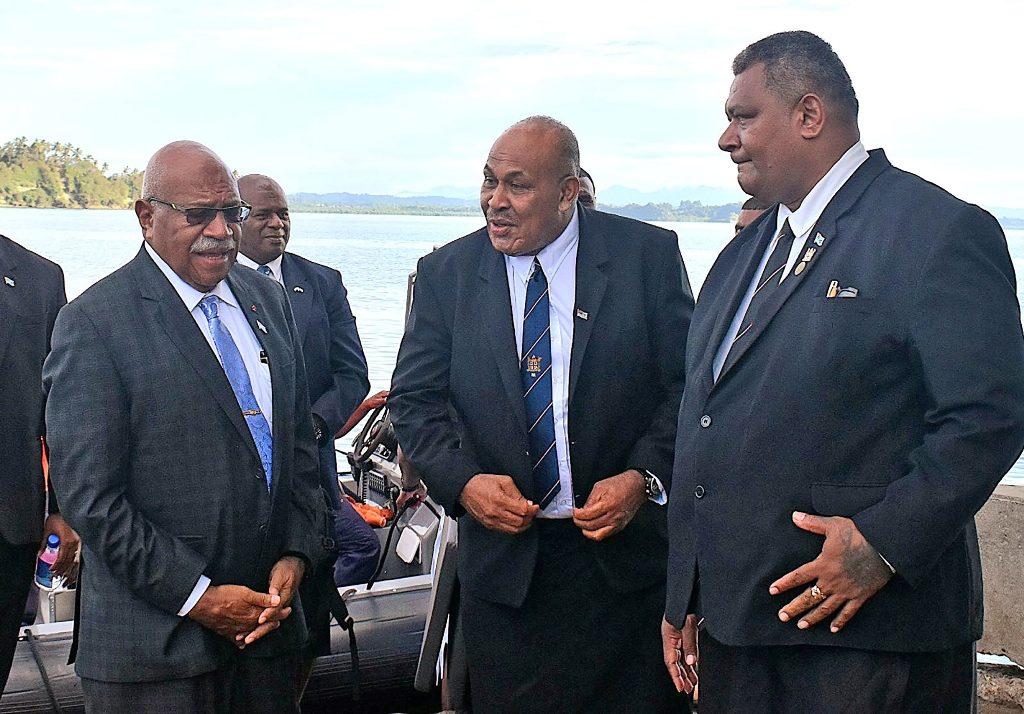
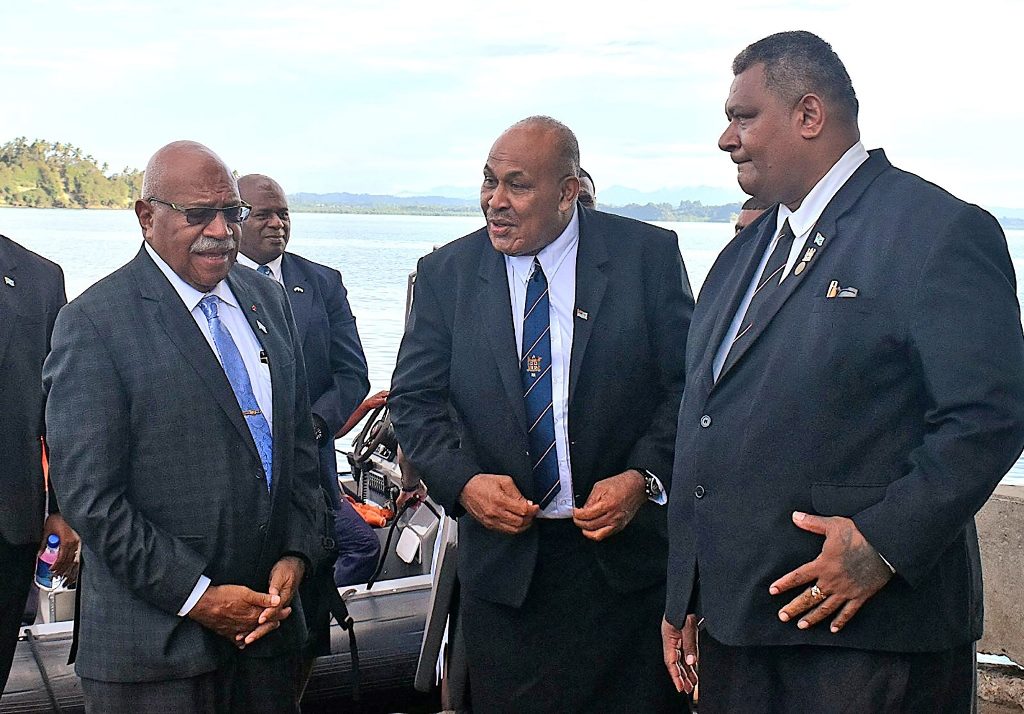
Prime Minister Sitiveni Rabuka, Minister for i-Taukei Affairs, Culture, Heritage and Arts, Ifereimi Vasu and Assistant Minister for i-Taukei Affairs, Isikeli Tuiwailevu arrive for the official opening of the Great Council of Chiefs meeting on Bau Island on Wednesday, May 24, 2023. Picture: SOPHIE RALULU