Sometimes I look at the way we are raising children today and wonder whether, somewhere between wanting to protect them and wanting to understand them, we became frightened of allowing them to struggle. We intervene before they fall, negotiate consequences before they feel them, solve problems before they have properly wrestled with them, and hand over a screen the moment boredom arrives. We call much of this love. Some of it certainly is. But there is a point where protection stops preparing a child for life and starts protecting them from life itself.
I grew up in Kashmir, Lautoka, in a Fiji-Indian household, and my childhood was not organised around adults constantly entertaining me. Like most children of my generation, we went outside. We ran around, climbed things we probably should not have climbed, played until we were sweaty and dirty, argued with each other, made up again and came home with scratches on our legs. Sometimes we fell badly enough to cry. Nobody rushed ahead of us clearing every thorn from the path so our feet would never be pricked; eventually we learnt to look where we were walking.
That sounds almost primitive now, but something was happening inside those ordinary experiences. We were learning that pain passed. We were learning that losing did not kill us, that being left out once did not mean our lives were over, that falling off something meant deciding whether we would climb it again. Nobody called it resilience or perseverance because those words had not yet become educational buzzwords plastered across classroom walls. We simply lived through situations that forced us to develop them.
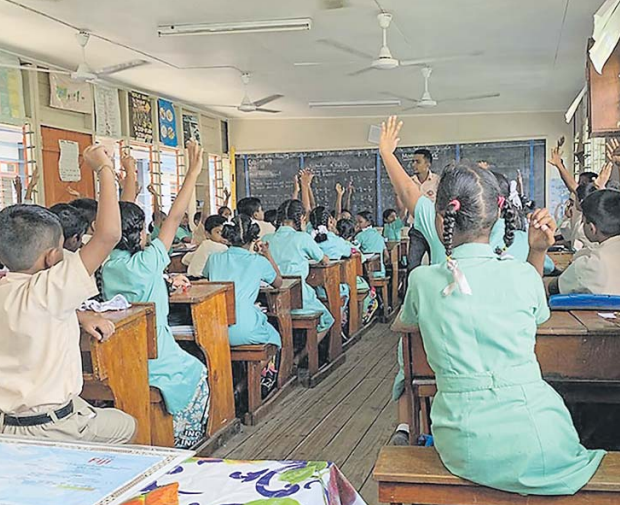
I remember school in Lautoka too, and the relationship between home and school was completely different. When a teacher told us off, the teacher’s word was usually final. If I got into trouble at school, going home and announcing that the teacher had disciplined me was not some clever strategy for getting the teacher into trouble. Quite the opposite. Many of us kept our mouths shut because there was every possibility our parents would ask, “What did you do?” and we would end up in even more trouble at home.
There was something powerful in that partnership. The child was not automatically assumed to be right simply because the child was upset. Parents could love their children fiercely while still accepting that their child might have behaved badly, been lazy, lied, forgotten something or deserved a consequence. Teachers were not treated like customer-service employees whose professional decisions could be overturned because a parent did not like hearing that their child had done something wrong. Somewhere along the way, that balance has shifted, and in too many schools today any sufficiently angry parent can walk all over a teacher.
I say this now from the other side of the classroom door. I have taught children in New Zealand, the United Arab Emirates, Kuwait and now Japan, and I have watched education change as much through parents as through students. Teachers increasingly find themselves explaining perfectly ordinary boundaries as though they are standing in court defending a crime. A child receives a consequence and an email arrives. A child performs poorly and suddenly the conversation becomes about what the teacher should have done differently rather than what the child might need to change.
This is where we are beginning to do children a terrible disservice. Failure has become something adults rush to erase rather than something children need to experience in manageable doses. A disappointing mark must be challenged, a lost game needs explaining away, a forgotten responsibility needs rescuing, and an uncomfortable emotion must be fixed immediately. Yet adulthood is full of things nobody will fix for them. The university will not call Mum when an assignment is late, the employer will not rewrite expectations because criticism feels unpleasant, and life itself will not restore every opportunity we waste.
And before somebody romanticises the past, no, I do not want everything from my school days back. Some things deserved to disappear. Bullying was often brushed aside with “toughen up” when a child was genuinely suffering. Humiliation could be passed off as discipline, and corporal punishment could frighten children into obedience without teaching them anything except fear. There were teachers who crossed lines, and children who had no language, power or adults willing to listen to them.
We should never return to that. A child should not be beaten into compliance, publicly shamed or made afraid to enter a classroom. But rejecting cruelty does not mean abandoning discipline. There is a vast space between hitting a child and allowing a child to do whatever they want. Somehow we have allowed those two ideas to become confused, as though the only alternatives are harshness or surrender.
A child can be loved and still be told no. A child can be emotionally safe and still receive a poor grade. A child can be listened to and still discover that their explanation does not remove the consequence. A student can be respected while being told to redo careless work, apologise sincerely, sit out an activity or accept that somebody else earned the prize. Those moments are not failures of parenting or teaching; often, they are where the real teaching begins.
Then there is the iPad. The device itself is not the enemy, and pretending technology has no value would be ridiculous. I use technology as a teacher, and today’s children have access to knowledge and creativity that would have amazed us when I was at primary school. But there is a difference between using technology and surrendering childhood to it. When every meal, car ride, restaurant visit, moment of boredom and emotional outburst requires a screen, we should stop pretending that nothing is being lost.
Boredom was once where we invented things. Outside, we had to negotiate with other children because there was no algorithm instantly delivering exactly what we wanted. We learnt to wait our turn, change the rules of a game, argue, compromise and sometimes go home annoyed. Those interactions could be messy, but so is human life. A screen can occupy a child brilliantly while requiring almost nothing from them socially, emotionally or physically.
This matters in Fiji because our children are inheriting a country that will not be easy to navigate. They will face competition for jobs, migration decisions, rising costs, family obligations, climate pressures and technologies that will keep changing faster than schools can rewrite curricula. Fiji does not need a generation that collapses whenever something feels unfair, difficult or boring. We need young people who can think, adapt, wait, work through discomfort and keep going after disappointment.
I think particularly about this through the eyes of a Fiji-Indian child who grew up in a community where responsibility was woven into ordinary life. We were expected to greet elders properly, respect teachers, help at home, listen when adults spoke and understand that being part of a family meant obligations as well as affection. Some of those expectations could become suffocating, especially when children were never allowed a voice. But throwing away everything because some parts were unhealthy would be foolish.
The answer is not to raise frightened children like some generations before us were raised. The answer is to raise capable ones. Give them tenderness, but give them boundaries. Listen to them, but do not automatically believe that every uncomfortable experience is an injustice. Stand up for them when somebody truly humiliates, bullies or harms them, but do not storm into a school because a teacher had the audacity to say your child was wrong.
Parents and teachers are supposed to be on the same side, and that side is not the side of keeping a child happy every minute. It is the side of raising a human being who can eventually function without us. That requires allowing children to make small mistakes while the stakes are still small. Let them forget the homework once, lose the game, hear a firm no, struggle with the maths problem, sit with boredom, apologise when they are wrong and discover that they can survive embarrassment.
Maybe that is what my generation received without anybody deliberately designing it for us. Nobody cleared every thorn in front of our feet. Sometimes we stepped on one, cried, pulled it out and kept walking. I would never wish every hardship of my childhood on the children I teach today, because progress should mean leaving cruelty behind. But if we remove every thorn, every fall and every failure from their path, one day they will reach adulthood barefoot and completely unprepared for the road.
ASHNEEL JAYNESH PRASAD is a Fiji-born New Zealand citizen currently working as a teacher in Shinagawa-ku, Tokyo, Japan. The views expressed in this article are his and do not reflect the views of this newspaper.