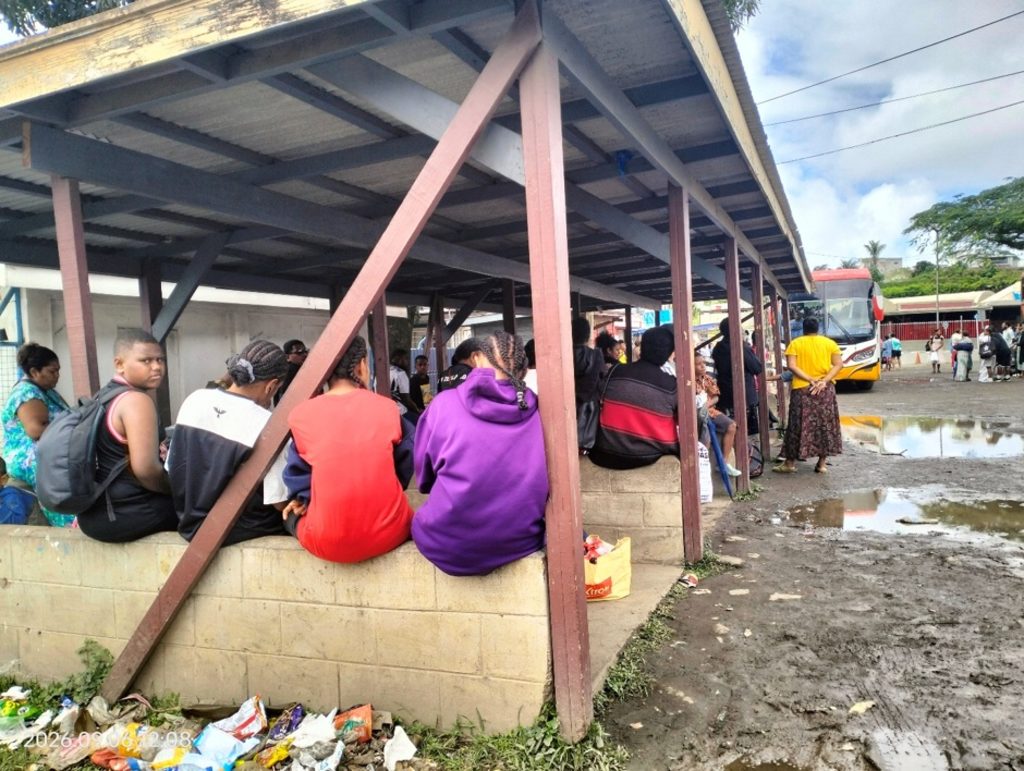
Boarding facility for Levuka passengers
THERE has been numerous letters written to highlight the substandard condition of the boarding facilities for the Levuka-bound passengers at the Suva bus stand parking, which is also shared by the market vendors, bus and general parking. The current condition of this facility is highly unsatisfactory and poses significant inconvenience and discomfort to the travelling public. The shed was initially a five-space car park for the ministry which operates next door. The parking space are separated by a two feet concrete wall build around it and is now used as seating while waiting for the bus. The condition of the bus stand adversely affects all categories of passengers, including children, the elderly, persons with disabilities, the sick, and daily commuters. These groups deserve safe, hygienic, and accessible facilities. The shed is frequently waterlogged during wet weather, leaving passengers exposed to unsafe and unhygienic conditions. Furthermore, there are no seating facilities provided, forcing elderly, disabled, and tired passengers to stand for long periods while waiting for transport. The Levuka passengers deserve a safe, clean, and functional waiting area at the Suva bus stand. I trust the council will treat this matter with priority and implement corrective measures without delay. SATISH NAKCHED Suva
A call for clarity
I have been following the recent debate over the proposed new Constitution and the suggested date of December 24, 2026 for it to come into force, on fijivillage.com 17/09/26. The concerns raised by the Centre for Democracy and Dialogue Centre CEO Nilesh Lal deserves to be heard. In particular, the timing deserves careful examination because December 24 is also being identified as the last date for the writ of elections to be issued, with the next general election required to be held by February 6, 2027. That is certainly a legitimate question for the Government to answer. However, I am not completely convinced that the proposed commencement date, by itself, means Fiji is heading towards “undemocratic rule” or an “autogolpe”. There is a difference between identifying a constitutional risk and concluding that the Government intends to undermine democracy. If the new Constitution changes electoral boundaries, nomination requirements, political party rules or other electoral arrangements, then obviously there must be clear transitional provisions. We need to know exactly what happens to the existing Parliament, the Government, the electoral laws and the election timetable when the new Constitution comes into force. That is where I believe the public discussion should concentrate. Instead of assuming the worst, why not ask the Government a very simple question: If the new Constitution comes into force on December 24, 2026, how exactly will the 2027 General Election proceed within the legally required timeframe? If the Government can provide a clear legal and constitutional answer, including transitional arrangements that guarantee the election will proceed on time, then much of the concern can be addressed. But if there is no clear answer, then the public has every right to ask further questions. Changing a Constitution is a serious matter. It should not create a legal vacuum, confusion over Parliament’s mandate or uncertainty over the people’s right to elect their representatives. At the same time, we should be careful with words such as “autogolpe”. Such a serious description should be based on evidence of an actual attempt to extend political power beyond a democratic mandate, rather than on what might happen under a future constitutional arrangement. Fiji has experienced periods when political power was transferred outside the normal democratic process. That history should make all of us cautious about protecting democratic institutions. But protecting democracy also means having a balanced discussion — asking difficult questions without reaching conclusions before the facts are established. For me, the central issue is therefore not whether Fiji should have constitutional reform. It is whether the reform process can be completed while fully protecting the people’s right to choose their next government through an election held within the required timeframe. That guarantee should be given clearly and publicly. The Constitution belongs to the people. So does the right to vote. Neither should be placed in uncertainty. PECELI ALISTIR Waitolu, Naitasiri
Tier one dreams
WHILE rugby fans across the Pacific eagerly await the outcome of the Pacific Nations Cup final, there is much more at stake than the title itself. In my view, this match presents an opportunity for either Japan or Fiji to further cement its status as a Tier 1 rugby nation. Based on recent performances and consistency, Japan appears to have the upper hand. The Cherry Blossoms have displayed confidence, discipline, and purpose typically associated with established Tier 1 nations. However, rugby is known for its unpredictability. Can the Flying Fijians rise to the occasion and deliver an upset victory, or will the men from the Land of the Rising Sun prevail? Only time will tell. In the meantime, the sweetness of the kava and the spirit of the talanoa sessions will undoubtedly depend on our favorite teams’ performance. FLOYD RONINSON Micronesia
Fiji Airways breakfast
IF I only knew that I would be served egg fried rice from a local Chinese takeaway shop for breakfast, I would definitely have carried chopped green chillies from my garden with me to add to the taste. BOBBY RANIGA Main St, Nadi
Another MH fire
HERE we go again! Another fire at a MH now Max-Value supermarket complex. Is it because of: Laxity in preventative measures; poor risk management; or possibly something else? Has there been no remedial lessons learnt from their previous cases? EDWARD BLAKELOCK Admirals Circle, Pacific Harbour
Where’s the ‘coke’
SURELY this has to qualify as Fiji’s Joke of the Year! NISHANT SINGH Lautoka
Master puppeteers
ARE we all being played, by the master puppeteers?
What we think is reality everyday, maybe just its superficial veneer.
The reality is not really,
what we plainly see and perceive,
all around us daily,
while not knowing we’re being deceived.
Truth has its protective layers,
and we’re just scrapping the surface,
The master puppeteers are the players.
behind the fake reality we all face.
Need to peel back the many layers,
to the truth and the actual reality, hidden by the players,
using false flags and lots of fakery.
Be aware of deceptions and untruths, there’s a lot of it out there.
Don’t take things for granted as truths,
be alert, discern and be forever aware. EDWARD BLAKELOCK Admirals Circle, Pacific Harbour
It does exist
THERE are many things that I can’t afford or don’t want and on top of that list is an armour-plated golf cart, and yes it does exist, President Trump has one. I searched on ebay and Google shopping to find out how much a second hand one would cost, but no luck, nothing was available. Google suggests it might cost about $200,000, a lot more than my new car, although admittedly I didn’t inquire about the armour plating option. There is also little information on its fuel costs either. Sometimes I think the world has gone mad, sometimes I am more confident of our future, but this vehicle is making me swing back to the mad option. DENNIS FITZGERALD Landale St, Box Hill, Vic, Australia
Tight battle
THE Fiji Water Flying Fijians beat Canada 45-29 in the Asahi Super Dry Pacific Nations Cup semi-final. The side will meet Japan’s Brave Blossoms, who thrashed the United States 63-14 in a dominant performance, in the final at the Prince Chichibu Memorial Stadium. The battle against Japan will be a tough one. We allowed Canada to score 29 points, but we can’t allow Japan to dominate play against us. If we do so, then we are in for a hiding. On paper, Japan has a strong forward pack which will set the platform in a bid to win their first PNC title since 2019. In the 2025 PNC final, Fiji came out on top 33-27 against the Brave Blossoms at America First Field in Salt Lake City, Utah. Japan has only beaten Fiji four times in 21 matches, while the Flying Fijians have won seven times on Japanese soil. Senirusi Seruvakula, who has been under the radar following Fiji’s losses in the first round of the Nations Championship, has named a solid team. Japan’s head coach Eddie Jones’ is nurturing the Brave Blossoms quite well, and he will look up to the likes of Faulua Makisi, Michael Stolberg, Tomoki Osada and the think tanks, Naoto Saito and Ryunosuke Ito to lead the charge. The Brave Blossoms will rise three places to ninth if they beat Fiji to be crowned the champions, while Fiji will fall one place to 10th. Hence, not only the PNC title, but our ranking is at risk. The boys must settle for nothing else but a win by playing their hearts out. All the best, the Flying Fijians! RAJNESH ISHWAR LINGAM Nadawa, Nasinu
Better roads for vehicle owners
LIKE elsewhere, motorists in Fiji pay various taxes and fees related to vehicle ownership, including those hidden in fuel prices. However, there’s an important question: Are we getting good value for the money collected for our roads? Around the country, drivers deal with issues like potholes, faded road markings, damaged shoulders, poor drainage, and temporary fixes. I understand that maintaining roads is expensive and comes with challenges, but taxpayers and motorists deserve proper planning, effective maintenance, and a good return on their investment. It might be time to increase transparency about how much money is collected from road-related taxes and how it’s spent. If a road is fixed only to break down again soon, should we keep making temporary repairs, or find a lasting solution to the problem? Roads are vital for Fiji’s economy and the daily lives of its residents. The question isn’t about whether money is being spent on roads, but whether these investments lead to good infrastructure. As taxpayers and road users, we have every right to question the value of these expenditures. SURESH CHAND Nadi
The unsolved case of Salesh Chand
THE Fiji Times shared an emotional account of the unsolved murder of Salesh Chand in its Saturday, January 14, 2026, edition. It tells a poignant story that unfolds as follows: The widow of Salesh Chand, believed to have been murdered, remains steadfast in her pursuit of updates from the police regarding her husband’s death. Her determination to identify those responsible and understand their motives remains strong, yet despite years of persistence, there has been little progress. In June 2016, her husband’s charred remains were found near the Fiji Sugar Corporation compound, with the incident classified as murder. Ranjni Devi, 46, from Muanikoso Housing in Nasinu, has expressed deep frustration over the decade-long lack of advancement. Despite consistently seeking updates, she receives the same response — the investigation is ongoing. For a decade, she has sought answers, only to be met with repeated assurances and no resolution. Ms Devi has also raised concerns about missing evidence. She claims her husband’s gold chain and pendant, taken as evidence by an officer, have not been returned. According to her, there is definitive proof that the chain was taken from his neck for the investigation, yet there seems to be no record of the jewelry now. In her quest for clarity, she has reached out to various authorities, including the Police Commissioner, but remains without answers. Faced with continuous frustrations, she questions how such a serious case could remain unresolved in a relatively small country. Having lost faith in the process, she still awaits justice. Meanwhile, the police have assured her that they will revisit the case and provide updates in due time. It is difficult to understand why events unfolded this way. SURESH CHAND Nadi
Water shortage
WITH an imminent drought looming and many parts of the country already experiencing water shortages, reservoirs and dams drying up, can the Lautoka City Council please explain why it continues to water gardens and plants around the city using huge water tanks mounted on trucks as witnessed on 17/09/? The ongoing dry spell, which is predicted to persist into early next year, poses a serious threat not only to our vital water supplies, but also to staple food sources such as vegetables. We are constantly reminded by authorities to conserve water for drinking and other essential purposes. Apparently, the Lautoka City Council did not receive that memo. At a time when ordinary citizens are being urged to conserve every precious drop, watching truckloads of water being used to keep roadside gardens and decorative plants looking lush hardly sends the right message. Perhaps it is time for the Government to step in and introduce a temporary and strictly enforced nationwide ban on unnecessary water use, including watering of gardens, washing vehicles, buildings and driveways. Those who deliberately ignore such restrictions should face substantial fines, or even some jail time. The severe drought of 1998 should still be a grim reminder of just how critical life becomes when water is no longer readily available. We should not wait until our taps run dry before taking the situation seriously. Water is not a luxury, nor is it an unlimited resource. It is a basic necessity of life. The Lautoka City Council can certainly find better uses for its water than keeping ornamental gardens green simply for the sake of beautification. What good is beautification when there is no water left to drink? Please apply some degree of common sense LCC. Save this precious commodity now before your beautifully watered gardens and flowers are the only things left standing in a city desperately searching for a drop to drink. NISHANT SINGH Lautoka
Exhibits of shame
THE disappearance of seven cocaine bars from the High Court exhibit room is not a minor scandal to be brushed aside. It is a national crisis that strikes at the heart of Fiji’s justice system. Chief Justice Salesi Temo himself admitted that “even the courtroom is not spared of rotten apples,” acknowledging corruption within the judiciary. That such a breach was concealed for months, only reluctantly confirmed by police, compounds the outrage. Fred Wesley’s editorial (FT 18/09) rightly asked why the drugs were not destroyed after conviction. Prosecutors failed to act, leaving temptation in plain sight. This negligence joins a long list of missing exhibits:
One kilogram of cocaine vanished from police custody in 2017;
marijuana disappeared from Nadi Magistrate’s Court in 2020;
2kg of cocaine was stolen from Namaka Police Station the same year; and
methamphetamine exhibits were interfered with at Totogo Police Station in 2024, leading to charges against police officers and civilians. Auditor–General reports have chronicled break–ins at Lautoka Magistrate’s Court in 2003 and 2007, where jewellery, cash, and electronics were stolen. The pattern is undeniable: Fiji’s justice system cannot safeguard its own evidence. The implications are devastating. If exhibits can be stolen from the High Court itself, what confidence can citizens have in FICAC, in police, or in the wider machinery of justice? The wealthy and well–connected already exploit appeals, procedural loopholes, and influence to gridlock prosecutions for years. Now even physical evidence is not safe. The result is a two–tier system:
one for those with resources to bend the rules;
another for ordinary Fijians left powerless.
Police corruption compounds the crisis. In 2025, leaked Viber chats exposed senior officers discussing drug shipments, payoffs, and concealment of weapons. Between 2023 and 2025, at least 27 officers were implicated in drug–related misconduct. In 2024, three officers were charged with interfering with methamphetamine evidence. FICAC, meanwhile, closed a complaint against senior legal figures, citing insufficient evidence. Each failure reinforces public suspicion that elites are shielded from scrutiny, while ordinary citizens face swift punishment. This is not merely about missing cocaine. It is about the collapse of institutional integrity. Fiji faces a cancer of corruption that demands radical surgery. Independent audits of all court exhibits, lawful destruction of drug evidence post–conviction, and external oversight of police are urgent. FICAC must expand its remit to confront systemic misconduct, not retreat behind narrow evidentiary thresholds. Citizens deserve a justice system that protects evidence, punishes offenders, and restores faith in the rule of law. Until accountability is enforced, Fiji’s courts will remain exhibits of shame, and justice itself will remain on trial. DR SUSHIL K SHARMA Lautoka
A fervent appeal for Fr Law Home
I WRITE to express my sincere thanks to Donald Singh of Nausori (FT 17/09). Thank you for enlightening the public on the real plight of Fr Law Home located in Wailekutu, just outside the Lami boundary, and Capital City, Suva. I am reliably informed the Home houses some 30 elderly citizens from all walks of life, and religious backgrounds. I am also reliably informed, the Home is run by the Catholic Church and a board of generous trustees, who commit their all to ensure the elderly are well cared for. I also understand it costs about $300,000 per annum to run the Home. I am reliably informed, though subject to confirmation, the Coalition Government commits about $25,000 towards this annual cost of operation. Founded in 1954, by the then president of the St Vincent de Paul Society, a Catholic charitable trust, Bing Shim Seeto and a group of the Chinese community throughout Fiji, the Home today needs much financial help to stay afloat. As I strive to be a little advocate from Nadi, I make this fervent and desperate appeal to all caring younger, better educated and well employed women, men, generous business organisations and corporate entities, who have the ability to assist in some small way. To the younger set, please try to commit an hour’s wage per month. ANZ Banking details of the Home are available on line or contact the trustees. To the various generous donor countries, whose embassies are based in the Capital City, Suva, I make you this fervent appeal, in good faith. There are generous overseas donors around. Please lend a helping hand. In memories of the founding fathers, and Rev Fr Hugh Law, the Australian Catholic priest, the Home is named after, I spread this message in the sincere hope the Home receives the help it generously and deservedly needs to care for the elderly. Our sincere thanks must go to all who labour hard, day and night, at Fr Law Home to care for the deprived elderly. As a betrayed senior FNPF pensioner, I share my thoughts on Fr Law Home. The elderly in Fiji deserve far better than the festering betrayal. A caring society must not look the other way. Empathy, compassion and a generous heart, are all we seek. God is watching, intently. RONNIE CHANG Nadi
When policy and reality collide
NEW Zealand’s Parent Visa pathway allows parents to join their children and live in New Zealand. On paper, this appears to be a positive immigration pathway. But what happens when these parents arrive and try to access their own legitimate savings from Fiji to support themselves? This is where the reality becomes frustrating. New Zealand banks can provide banking facilities to parents who are legally residing in New Zealand under the appropriate visa. However, transferring their own funds from a Fiji bank account into their New Zealand account can become a major hurdle. The issue appears to be the disconnect between immigration requirements and Fiji’s financial regulatory framework. If a parent has legitimately accumulated savings in Fiji and is now legally living in New Zealand, why should accessing those funds become such a complicated process? I understand the need for foreign exchange controls, regulatory oversight and measures to prevent financial abuse. But there must also be a practical mechanism for genuine cases. It seems that unless a person meets certain residency or passport requirements, families can find themselves going through a regulatory process simply to transfer their own money overseas. This raises a bigger question: Have our regulators and financial institutions kept pace with the changing circumstances of Fijians and their families living overseas? The relevant authorities in Fiji should engage directly with New Zealand Immigration, the New Zealand High Commission and financial institutions on both sides to develop clear guidelines for parents living in New Zealand under the Parent Visa pathway. We cannot have immigration authorities saying, “yes, you can live here”, while financial regulations effectively say, “but getting access to your own money is another matter”. This is not about bypassing regulations. It is about making regulations fit for purpose. Our regulators need to talk to each other, our banks need clearer processes, and families need certainty. Otherwise, we will continue with the classic Fijian bureaucratic situation: The right hand doesn’t know what the left hand is doing. Surely, in 2026, we can do better than this. RAHUL KRISHNA New Zealand
Why Phuket outshines Fiji
I HAVE just returned from a week-long family holiday in Phuket, Thailand – my third visit to the island. There is always something new to see or do, with an almost endless variety of activities. This trip’s highlights were a Muay Thai kickboxing match and swimming with elephants. Phuket attracts visitors from the Middle East, India, China, Japan, Russia and Australia. Hotels, food and transport are all reasonably priced, and I never tire of Thai cuisine. The nightlife is legendary, and I felt safe walking through the streets at any time of day or night. The range of airlines and affordable fares from Australia is remarkable. The Thai people I met were friendly, welcoming and well presented. I did not see a single pothole or any dumped rubbish. The public beaches were pristine and offered plenty of activities. My point is this: Why would travelers choose Fiji if they face high costs, poorly maintained roads, littered or substandard public beaches, and concerns about safety and dishonest operators? These issues deserve attention if Fiji is to remain competitive as a tourist destination. JAN NISSAR Sydney, NSW
BRICS Summit
PRESIDENT Xi Jinping went to Delhi with a delegation of 400 businessmen and bureaucrats in search of more trade with India. But India has restricted Chinese investments in India due to trust factors. Indian companies in joint ventures with Chinese have to own 51 per cent controlling shares. India’s 700 to 800 million people have very strong purchasing power. World’s big tech companies are rushing to invest in India. India’s defeat in the 1962 Aksai Chin war was due to its first PM J L Nehru not believing in arming Indian Army. He believed in “Hindu Chini bhai bhai” (brothers). In the 2020 Galwan Valley clash, 45 Chinese soldiers (CIA Figures Google) and 20 Indian soldiers had died. Many Chinese soldiers had died crossing the dark, icy river. It is a fact that Xi Jinping had to stoop before PM Modi considering the state of Chinese economy. As usual, I believe Reuters reports on the BRICS Summit are biased towards Chinese. RAKESH CHAND SHARMA Nadi
FijiFirst’s low-hanging fruit
ON December 12, 2018, Fiji witnessed one of the most extraordinary “strategic meetings” in its political history. FijiFirst parliamentarians spent about 48 hours on Level 9 of Suvavou House while court bailiffs and opposition representatives waited outside, attempting to serve them with documents challenging the 2018 election results. The official explanation from Aiyaz Sayed-Khaiyum was that this was an urgent strategic meeting to create “synergies,” identify “low-hanging fruits,” decide the Government’s deliverables and plan Fiji’s future for the next four, five, 10, 15 and 20 years. What tremendous sacrifice! Forty-eight hours away from their homes and beds, with bedding reportedly carried into Suvavou House, all in search of these mysterious low-hanging fruits. Nearly eight years later, I must ask: have those fruits finally ripened? How low were they hanging that an entire government needed two days, two nights and Level 9 to locate them? The nation saw bailiffs waiting outside. The ministers apparently saw mangoes, papayas and economic “synergies” hanging from the ceiling. Perhaps the elevator was prevented from reaching Level 9 because it might have disturbed the fruit-picking operation or, worse, delivered the court documents. Considering the age of some of those gathered, perhaps the only things genuinely hanging low after 48 hours were loose underwear and exhausted waistbands. Level 9 must surely hold the historical record for the greatest concentration of bedding, political excuses and unwashed underwear ever assembled inside a government office. All jokes aside, the hypocrisy was breathtaking. This was a government that constantly preached accountability, transparency and respect for the law, yet its members remained behind closed doors while court officers waited outside. Sayed-Khaiyum explained the supposed purpose of the meeting, but reportedly left unanswered questions about why ministers had to sleep there and why the documents could not simply be received. Years later, FijiFirst itself ended up in balance-sheet insolvency, carrying substantial unpaid liabilities before eventually being deregistered. Apparently, after all that strategic thinking, the lowest-hanging fruit they failed to pick was paying their own creditors and properly maintaining their own political party. Yet some people still call for FijiFirst to return. How quickly a nation forgets. Voreqe Bainimarama and Aiyaz Sayed-Khaiyum must answer for the political culture and economic legacy they left behind. In my personal view, Bainimarama was a dictator, a coup-maker and a leader whose actions caused lasting damage to my beloved Fiji. Fiji may forgive, but Fiji must never forget Level 9: Forty-eight hours, one extraordinary excuse and not a single low-hanging fruit ever produced for public inspection. ROBERT R KANT Sydney, NSW, Australia
Parking metres in Nausori
ONE issue I would like to raise is the ongoing problem of non-functioning parking meters in Nausori Town. I have noticed parking meter machines displayed in town, yet they are not working. When parking meters are out of order, motorists effectively receive free parking, and naturally, people are more likely to take advantage of it by leaving their vehicles parked for two or three hours, or even longer. If the parking meters were functioning properly, motorists would know that parking comes at a cost. They would be more likely to complete their shopping or business and move on, allowing other genuine motorists to use the available spaces. The current situation is contributing to congestion in Nausori Town. Many parking spaces remain occupied for extended periods, while people who genuinely need to visit the town centre for shopping, appointments or business struggle to find somewhere to park. There is also a financial aspect that should not be overlooked. Every hour that a parking meter remains out of service represents potential revenue that the council is not collecting. I hope the relevant authorities will consider reviewing the current situation and ensuring that parking meters are maintained and kept operational wherever possible. A reliable parking system would help improve parking turnover, support local businesses and make visiting Nausori Town centre more convenient for everyone. I believe this is an issue that can be addressed positively, and I hope the relevant authorities will give it due consideration in the interests of motorists, local businesses and the wider Nausori community. SHAMAL CHAND Kuku Village, Nausori
Emergency Department
RECENTLY I was called to the Emergency Department in Lautoka Hospital for the review only. It was in the evening at 9pm. The Emergency Department was extremely full even at that time of the night. Obviously, there were patients for different reasons and symptoms. There were also heart patients who were told to wait while having their names called. A lady who was suffering in pain sobbing away and I could see she was not able to tolerate and was in serious need of attention A man probably having flu lying down most of the time on the bench as he was not able to stand or sit for long and was very pale. I had to wait till 1.30am to be called inside that too after asking various time to the front desk staff as I was just there for the review. I reached home by 2.20am. Those observations and experiences makes me ask: Why aren’t the general outpatient departments open at that time for the not so emergency cases as that can minimise the crowd at the Emergency Department at that time of the night and the serious patients can be noticed and taken into consideration way earlier than those good few hours? Why those suffering patients have to wait that long to be called in although their situations needed dire attention at its earliest? What is the point of giving a specific time to a patient for the review when they are to be seen in accordance to the normal waiting time since their arrival? What is the purpose of attending the Emergency Department at that time of the night when so much waiting is needed? Is this practice serving the meaning of Emergency? While I acknowledge there are few improvements I have noticed in the Women’s Surgical Ward, there’s still a lot to be done that also includes the attitude of certain medical personnel. We do not have to carry on with what has been happening for long time and has become the acceptable way of doing work specially when it comes to our medical departments as lives are at stake. Health is the most paramount and should be a priority. I hope to seek answers for my concerns and also hope for the positive changes ahead. However, I would like to show my appreciation to the good that I have noticed in Lautoka Hospital and the hard working, honest and kind attitude staffs. They deserve the accolades and to tagg all in that concerns raised would be unfair. Let’s hope for the best KIRTI PATEL Lautoka
Missing drugs
IF drug exhibits kept under security can disappear from the custody of the police station and the court, then one begins to wonder if all the drugs found floating in Fiji waters with some washed ashore have been accounted for. With no one watching over them, a lot of things can happen. How do we know for sure that all the drugs have been handed over to the authorities and no “give some keep some” skullduggery was involved? There is absolutely no way of ascertaining as to the exact quantity that was dumped in our waters. While they were destined for the bigger markets in Australia and New Zealand, some of the packets may have already been picked up by the locals before the discovery came to light. The possibility of partial disclosure or collusive seizure cannot be ruled out either. Nor the local consumption of it. It also raises questions about the accountability of the drugs seized or surrendered to the law enforcement agencies. In September last year, four Fijians were among six men jailed in Western Australia for their roles in a failed attempt to smuggle 2.4 tonnes of cocaine. With easy access to drugs, the temptation is always there to make a fast buck. SELWA NANDAN Lautoka
Health system hits rock bottom
FOR three consecutive days, The Fiji Times has carried editorials by Editor–in–Chief Fred Wesley, each sounding the alarm on a different medical crisis. First came the collapse of Aspen Medical’s management and the dysfunction at Colonial War Memorial Hospital (FT 15/09). Then the declaration of HIV as a national emergency, compounded by drug–resistant tuberculosis (FT 16/09). On Thursday, the focus was on breast cancer, where late diagnosis continues to cost lives. The common thread across these warnings is clear: Fiji has been far too complacent, and delayed action has allowed crises to deepen. Whether it is unsafe prescribing practices at Lautoka, HIV prevalence of one in every 60 adults, or women presenting with advanced breast cancer, the lesson is the same — early intervention saves lives, while neglect breeds tragedy. CNN has now reported Fiji’s HIV emergency to the world, highlighting the scale of the crisis in our small Pacific nation. This global attention is not flattering; it is a warning that Fiji’s health failures are no longer hidden. Our reputation as a safe destination is at risk, and our people are paying the price. The latest study from Lautoka Hospital underscores the urgency. Surgical registrar Dr Rahul Krishna Reddy found that 38.3 per cent of breast cancer patients presented with Stage IV disease, with a median survival of just nine months. Most were women aged 51 to 60 — the economically productive years of life. Alarmingly, 53.2 per cent of iTaukei patients presented at Stage IV compared with 20.5 per cent of patients of Indian descent, reflecting disparities in health literacy, cultural beliefs, and access to care (FT 17/09). Nearly one–third of patients reported symptoms for more than two years before seeking medical attention. These delays are costing lives. Health Minister Dr Atonio Lalabalavu has rejected claims that the system is at “rock bottom” (FT 17/09/26). Yet the evidence is overwhelming: CWM theatres closed, Aspen withdrawing medicines, HIV declared a national emergency, TB spreading, and breast cancer patients presenting too late. Acknowledging progress in 200 facilities does not erase the fact that our flagship hospital is failing and our people are dying unnecessarily. Early action must become the guiding principle of health policy. For breast cancer, this means routine mammograms, awareness campaigns that reach rural communities, and ensuring women can access treatment before the disease advances. For HIV, it means scaling up antiretroviral therapy, needle–exchange programs, and breaking stigma through education. For tuberculosis, it means expanding diagnostic sites and strengthening surveillance. And for our hospitals, it means investing in staff, equipment, and accountability before collapse becomes irreversible. Fred Wesley’s editorials have done their duty by warning the nation. The responsibility now lies with the government and communities to act. Chiefs, churches, schools, and families must join hands with health authorities to ensure prevention, early detection, and timely treatment. Fiji is already in a tailspin. If we continue to delay, the crash will be inevitable — in lives lost, in reputational damage, and in the erosion of national pride. Early action is not optional; it is survival. DR SUSHIL K SHARMA LAUTOKA
Democratic sovereignty
ON October 10,1970, Fiji detached itself from British colonial rule and became an independent, democratic island nation. After 55 years, is Fiji sovereign yet? Or is it still “struggling” towards it? What exactly is sovereignty? In fact, I think Fiji hasn’t captured its sovereignty, as it supposed to be. Its internal sovereignty has been manipulatively fractured and as such, the effects have also undermined the external version. It has led Fiji to becoming compliant, predictable and manageable, in my opinion. Ruled by fear, easily broken, easily bought and easily ruled, just as being a “slave”. Chooses safety and buries its capable instinct beneath polite compliance. Nods along the things it despises and swallows its truth, to keep its seat at a comfortable table. Even mistaken surrender for virtue and cowardice for kindness. Above all, lives on permanent probation and asking permission for its existence. Safe, predictable and completely disarmed. And I am certain, Fiji’s sovereignty is only decoration, a “crown”, without a realm. Until Fiji secures its sovereignty, it is still a “refugee”, within. However, I believe, true leadership is not possession, not rule, but sovereignty. Napolean Bonaparte stated, “the sovereignty of the people is inalienable”. SAMU SILATOLU Nakasi
Trump attacks female reporter
WE read in “Unhinged Trump lunges at female reporter over embarrassing question” ( Daily Beast 11/9) that ABC reporter Rachel Scott dared to ask Trump “about his fishy $1.35trillion election bribe” to give every adult American $5000 and President Trump went mental on her. The President “was incensed when asked pertinent questions about what he branded “Trump dividends” . An annoyed Trump pointed at Scott and said ” Your network and you, you’re the worst”. The leader of America’s democracy and world democracy apparently does not understand it is the job of the free press to ask critical questions. What a shame! RAJEND NAIDU Atlantic Blvd, Glenfield, NSW, Australia