Public discussion about the legacy pension issue continues more than a decade after the Fiji National Provident Fund’s pension reforms. While views differ on the impact of those reforms, one principle should guide the conversation: policy decisions should be based on complete and accurate information.
This is not simply a historical debate. It concerns the retirement savings of more than 440,000 FNPF members and the long-term sustainability of Fiji’s retirement system.
Former pensioners affected by the reforms have every right to share their experiences and concerns. Those perspectives are an important part of the national discussion. However, any assessment of the reforms must also consider the interests of current and future members whose retirement savings are entrusted to the fund.
At the centre of the issue is a straightforward question: were the pension arrangements that existed before 2012 financially sustainable, and who ultimately bore the cost of those arrangements?
Understanding the financial reality
Much of the public discussion focuses on what some former pensioners lost following the reforms. However, understanding the issue requires consideration of both the amounts contributed and the amounts received.
Between 1975 and 2011, pensioners affected by the reforms converted approximately $318million into pension arrangements.
By the time the reforms were implemented, those pensioners had already received approximately $468m in pension payments. In addition, approximately $294m in conversion sum refunds were returned through the reform process.
Collectively, this amounted to approximately $762m in payments in relation to conversion sums of $318m.
* Refer to the FNPF pension table 1 below
In aggregate, payments exceeded original conversion sums by approximately $444m. In simple terms, former pensioners collectively put in $318m but received approximately $762m in return. By the time the reforms were introduced, the original funds had long since been exhausted and payments had continued well beyond the amounts originally contributed.
While these figures are simplified and do not include factors such as investment earnings, the time value of money, or certain contribution adjustments, the overall conclusion remains unchanged. Former pensioners collectively received substantial support beyond the value of the conversion sums they originally contributed.
The key point is that these additional payments did not arise solely from the original conversion sums. They were supported by the wider fund and, ultimately, by resources that would otherwise have been available to other members.
A group of former pensioners has received substantially higher levels of benefit.
Preliminary analysis indicates that 36 (out of the 1400) former pensioners who have received taxpayer-funded support since 2024 had, by June 2026, already received more than $500,000 each above the value of the conversion sums originally used to fund their pensions. In addition, these same pensioners have collectively benefited from taxpayer-funded support provided under the Government program.
These figures demonstrate that substantial support has already been provided, with total benefits in many cases significantly exceeding the value of the original conversion sums.
Understanding the Pension Buffer Fund
Some former pensioners argue that the so-called Pension Buffer Fund was money that belonged exclusively to pensioners and that, had investment earnings been credited to it, pre-reform pension rates could have been maintained.
However, there was not a separate fund owned solely by pensioners. The fund’s investments were a single broad pool of assets which was financed largely through contributions made by members across the wider membership, many of whom never received and could never receive the pension benefits it supported.
Some former pensioners argue that any member could have elected a pension. This is simply false. Even if the so-called Pension Buffer Fund contributions had continued indefinitely, they would not have generated enough investment income to support even a modest level of pension take-up, so unsustainable were the pension terms on offer, even in 2011 when the conversion rate had been reduced to 15 per cent. The fact that these contributions ceased hastened the end of the old pension arrangements.
So, the government reduced the rate for new pensions to 8.7 per cent. This move stopped the sustainability problem from getting worse.
Some former pensioners argue that this was all that was needed. They argue that their pre-existing pensions should have been allowed to continue. They argue that the Pension Buffer Fund contributions together with investment income, financed largely by other members, was enough to fund their ongoing pension entitlements. However, there was not enough money to also finance forthcoming statutory solvency requirements for the FNPF. And, had the government chosen this path:
• The forced subsidy from other members to pensioners (capped under the reforms at around $444m as shown above) would have amounted to more than $650m;
• Members who would never get any benefit from the Pension Buffer Fund contributions that they had given up to support pensioners would have had to suffer further reductions in their future credited interest rates as solvency reserves were built up; and
• Members would have continued to be exposed to the performance of the pension system.
The question was, therefore, not whether a Pension Buffer Fund existed. The question was whether pension payments that had already exceeded the value of the resources set aside to support them.
The reforms addressed that issue by limiting and capping once-and-for-all the ongoing reliance on support from the wider membership while returning affected pensioners’ original conversion sums in full.
Viewed in this context, the reforms were not about taking away a fund that belonged to pensioners. They were about ending an arrangement under which pension payments increasingly depended on resources generated by other members of the fund.
Simply put, the financial evidence shows that the monies originally converted into these pension arrangements were exhausted many years ago. Payments continued well beyond the value of those original conversion sums.
Why reform became necessary
The 2012 reforms were implemented following actuarial assessments that identified significant sustainability concerns within the pension system.
Those assessments found that certain pension arrangements were creating obligations that exceeded the assets available to support them. As these obligations grew, they placed increasing pressure on the fund and raised concerns about the long-term protection of members’ retirement savings.
These sustainability concerns are not new. For many years, the fund has consistently explained that the pension arrangements in place before 2012 were paying out more than the underlying funds could sustainably support. Successive actuarial reviews, public statements and stakeholder engagements have all pointed to the same conclusion: without reform, the cost of supporting these arrangements would continue to fall on other members of the fund. Despite this, some former pensioners continue to reject the underlying financial realities that led to the reforms and maintain that the benefits should be restored.
The issue was never whether pensioners deserved support.
The issue was whether those arrangements could continue indefinitely without imposing an increasing burden on the retirement savings of other members.
Every dollar held by FNPF belongs to a member who is working towards their own retirement security. The fund has a fiduciary responsibility to safeguard those savings and to ensure that retirement benefits remain sustainable for current and future generations.
In carrying out this responsibility, the FNPF Board acts as the custodian of members’ retirement savings and is required to operate within the legal framework governing the fund. The board does not have the authority to unilaterally reverse pension reforms, amend legislation, or restore benefits outside the framework established by law. Its responsibility is to administer the fund in accordance with the law while protecting the interests of all members.
The reforms were therefore introduced to protect the long-term integrity of the fund, strengthen its financial position, and ensure that one group’s benefits were not funded indefinitely at the expense of others.
Government program
In August 2024, Government introduced a taxpayer-funded program for eligible legacy pensioners.
As at August 2026, 1371 legacy pensioners have benefited from the program, with approximately $8.1m paid in direct payments.
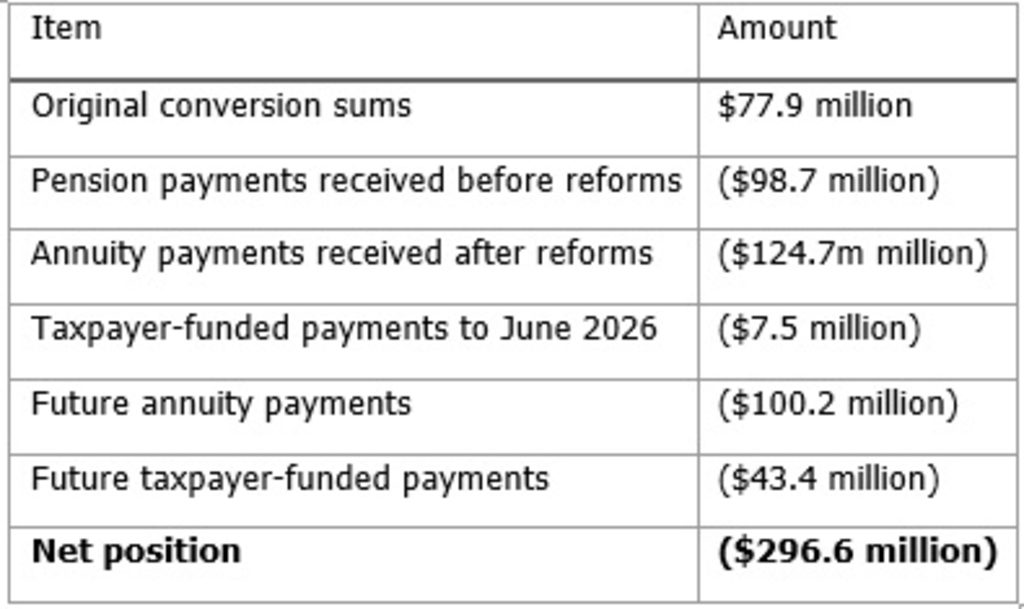
Analysis of this group shows the following:
* Refer to the FNPF pension table 2 below
Based on current projections, this group is expected to receive $297m more than the value of the original conversion sums. This includes more than $50m in taxpayer-funded payments.
The question that cannot be ignored
Much of the debate focuses on what former pensioners should receive.
An equally important question is who should bear the cost.
Before the reforms, a significant portion of pension payments was effectively being supported by the wider membership of the fund. The reforms were introduced to address this imbalance and to protect the retirement savings of all members.
Today, support under the legacy pension program is funded by taxpayers rather than through the retirement savings of current FNPF members. This reflects an important principle: where additional support is provided, the cost should be transparent and should not be borne by the retirement savings of other members.
What would it mean for current and future members?
Any proposal to reverse the reforms, provide retrospective compensation or restore historical pension arrangements must be viewed in terms of its impact on current and future members.
The retirement savings held by FNPF do not belong to the fund. They belong to members. Every dollar represents the accumulated savings of workers who expect those funds to be protected and available when they retire.
If additional legacy pension liabilities were to be funded from member funds, the impact would not be borne by the affected pensioners. It would be borne by current contributors and future retirees whose retirement outcomes could be affected.
Preliminary assessments indicate that fully meeting some of the demands advanced by former pensioners could potentially cost hundreds of millions of dollars and may approach $700m, subject to verification and actuarial assessment.
Regardless of the final amount, the principle remains the same: such funding cannot be created from thin air. It must come either from current members’ retirement savings, taxpayers, or a combination of both.
For current and future members, this is not simply a historical issue. It is a question of whether resources accumulated for their retirement should be redirected to fund additional obligations arising from arrangements that were previously determined to be unsustainable.
The greater the amount directed toward historical liabilities, the less that is available to support member balances, future investment returns and the long-term retirement security of Fijians who continue to contribute to the fund today.
Decisions must be guided by facts
Any discussion about legacy pensions must begin with the facts.
The evidence shows that affected pensioners collectively converted approximately $318m into pension arrangements but received approximately $762m in payments, including pension payments and reform refunds. Collectively, they received approximately $444m more than the value of the conversion sums originally provided.
In addition, eligible legacy pensioners continue to receive support through a taxpayer-funded program introduced in 2024, with further payments projected into the future.
These facts are important because the public debate is often framed as though former pensioners are seeking the return of money that was taken from them. The financial record shows a different reality. The original conversion sums were exhausted many years ago and substantial additional support has already been provided through both the fund and, more recently, through taxpayers.
Yet despite receiving benefits that significantly exceeded the amounts originally contributed, there continue to be calls for further compensation and additional payments.
This raises a question that cannot be avoided: if additional support is to be provided, who should pay for it?
Should the cost be borne by current workers saving for their own retirement? Should it be borne by future generations of FNPF members? Or should it continue to be funded by taxpayers?
These are not emotional questions. They are questions of fairness, financial responsibility and intergenerational equity.
FNPF’s responsibility is not limited to any one group. It extends to more than 440,000 members whose retirement savings have been entrusted to the fund. Those members have a reasonable expectation that their savings will be protected and managed in their best interests.
The pension reforms were implemented because existing arrangements were not sustainable. They were designed to stop an increasing burden from being transferred to other members and future generations of contributors. That responsibility remains unchanged today.
The central issue is not whether support has been provided. The evidence clearly shows that it has. If the full range of demands advanced by some former pensioners were to be implemented, the cost could potentially approach $700m, subject to verification and actuarial assessment. Ultimately, that cost would have to be borne by current members, future members, taxpayers, or some combination of all three.
The question facing policymakers is therefore not whether support has already been provided. The question is whether it is fair to transfer additional costs to more than 440,000 members whose retirement savings must also be protected.
Retirement savings are not an unlimited public resource, nor are they available to meet obligations that exceed the funds originally contributed. They belong to hardworking members who contribute throughout their working lives with the expectation that their savings will be protected and available when they retire.
The lessons of the past are clear. When benefits consistently exceed the resources set aside to fund them, someone else ultimately bears the cost. Before the reforms, that cost fell largely on other FNPF members. Today, it is increasingly being borne by taxpayers.
The facts show that former pensioners collectively received hundreds of millions of dollars more than the conversion sums they originally provided. The facts also show that support continues today through taxpayer-funded assistance. Yet demands remain for additional compensation and further payments.
Any future decisions must therefore be guided not by sentiment or perception, but by fairness, financial sustainability and the interests of all members. Protecting the retirement savings of more than 440,000 Fijians requires nothing less. The fund’s duty is clear: to safeguard members’ savings, uphold equity across generations, and ensure that today’s decisions do not compromise the retirement security of tomorrow’s retirees.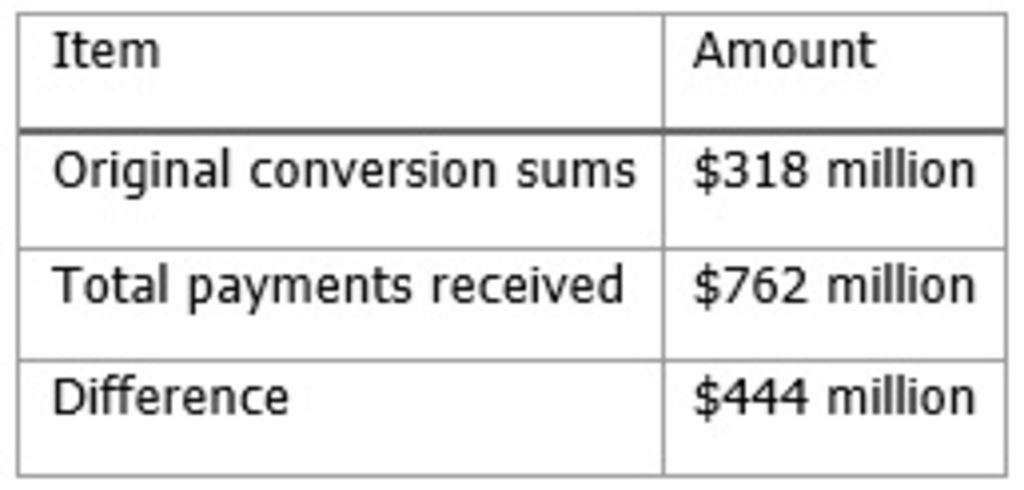
Table 1. Source: FNPF

The FNPF Pension Centre at its headquarters on Ellery St in Suva. Picture: FNPF