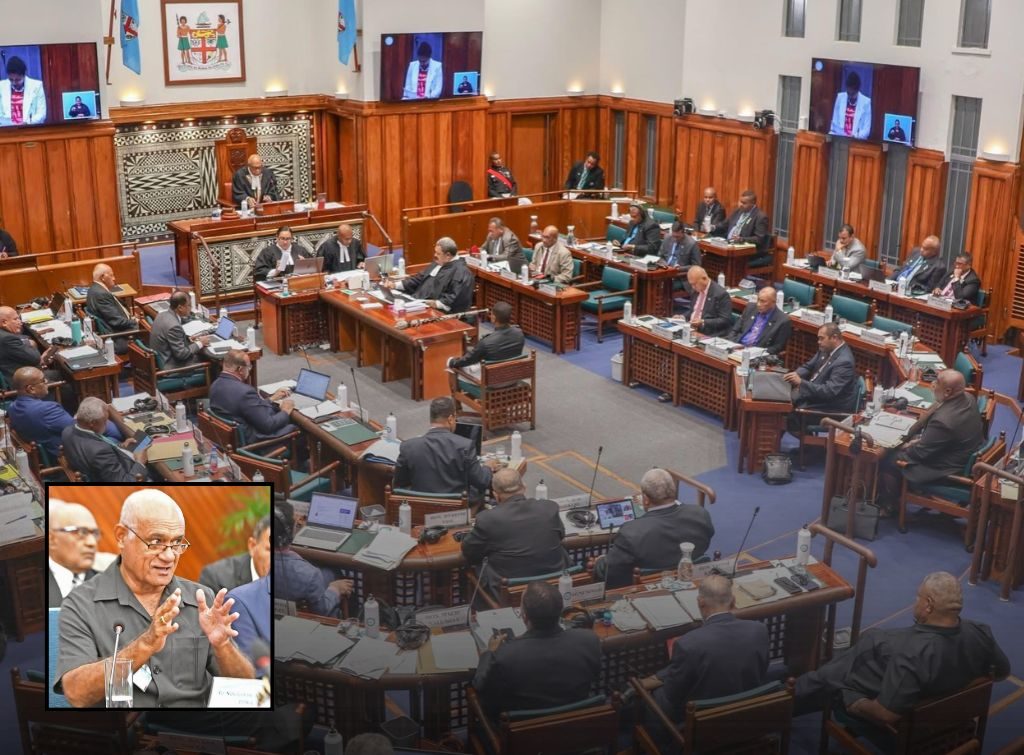
The circulation of an explicit video allegedly associated with former Acting Attorney-General Siromi Turaga’s social media account has exposed more than a political controversy.
It has raised difficult questions about privacy, public morality, gender equality and the standards expected of those entrusted with public office.
In a Facebook post titled The Video Is Not the Scandal. Our Appetite Is, Ro Nauludole Mataitini, the Vunivalu e Nukunitabua of Rewa and a senior member of the Bose Levu Vakaturaga (BLV), challenges Fiji to look beyond the footage and examine the culture that turns intimate material into public entertainment.
His argument is that society’s response to sexual exposure reveals a contradiction between the values it professes and the behaviour it tolerates.
People condemn explicit material while consuming and sharing it, transforming another person’s humiliation into a spectacle.
A provocative argument that deserves consideration alongside another legitimate question about where the boundaries of privacy should end when the individual involved holds public office?
The audience behind the scandal
The online circulation of intimate material creates a distinction between the person whose privacy is exposed and the audience that enables the exposure to spread.
Every act of redistribution, clearly demonstrated by the widespread sharing of screenshots and the video itself, can extend the exposure and deepen the harm.
Ro Naulu’s criticism of this behaviour challenges the assumption that public access to private material creates an assumed public entitlement to consume it.
This is particularly important in Fiji, where intimate images and videos have previously prompted concerns about online abuse, gender-based violence and the victimisation of women in public life.
Minister Lynda Tabuya’s experience in December 2024 illustrated the consequences.
After an explicit video circulated online, Ms Tabuya said it was private material intended for her husband and described its distribution as a serious invasion of privacy.
Police investigated the leak, while Prime Minister Sitiveni Rabuka dismissed her from Cabinet, saying the incident had brought the Government and party into “disrepute”.
The circumstances surrounding Mr Turaga’s case are not established to the same degree.
An explicit video is alleged to have appeared on a Facebook Story associated with his account before being removed.
The available public reporting does not conclusively establish who uploaded it, whether the publication was accidental or whether there was unauthorised access.
Those are critical distinctions to make because the appearance of material on an account does not, by itself, prove who posted it or their intentions.
Nor does the existence of a video automatically establish misconduct.
Fairness requires evidence, an opportunity for those concerned to respond and conclusions proportionate to what can be demonstrated.
Privacy does not remove public accountability
Ro Naulu’s observation that privacy is not immunity from legitimate scrutiny captures the tension at the centre of the controversy.
Public officials retain their fundamental rights to privacy and dignity.
Holding office does not make every aspect of their personal lives a matter of public interest.
However, ministers also exercise public authority and are accountable for their conduct in office.
Where credible evidence raises questions about a minister’s judgement, compliance with applicable standards or the proper use of an official position, the public has a legitimate interest in obtaining answers.
The challenge is distinguishing genuine public interest from public curiosity.
A minister’s private sexual conduct should not automatically become grounds for dismissal simply because it attracts attention.
Equally, the invocation of privacy should not prevent legitimate questions about conduct that may breach established ethical or legal obligations.
It is a fair process that establishes the facts and applies consistent standards.
On October 12, Prime Minister Rabuka told journalists that the same standard applied to male and female ministers, but that Mr Turaga had to be given an opportunity to defend himself.
The following day, the Prime Minister confirmed receiving the Acting Attorney-General’s resignation from Cabinet.
Mr Turaga remains an MP and a member of the People’s Alliance Party.
The Fiji Times reported on October 13 that the circumstances surrounding the resignation had not been fully clarified publicly.
The resignation resolved Mr Turaga’s immediate position in Cabinet, but it did not establish the circumstances surrounding the video or settle the wider questions about ministerial accountability.
The need for a functioning code of conduct
This is where Fiji’s framework for political ethics deserves closer examination.
Section 149(a) of the 2013 Constitution provides for a written law establishing a code of conduct applicable to the Prime Minister, Ministers, MPs and other specified officeholders.
In March, the government moved to withdraw the Code of Conduct Bill 2025 alongside other related governance bills (the Access to Information Bill 2025 and the Accountability and Transparency Commission Bill 2025).
However, the Constitution Review Commission (CRC) has recommended placing an enforceable Code of Conduct directly into the Constitution rather than through a standalone written law.
The distinction between proposing a law and having an enforceable framework is fundamental.
An effective code should do more than state that leaders must behave with integrity.
It should define relevant standards, establish clear procedures for receiving and investigating complaints, provide appropriate safeguards for those accused of wrongdoing and specify proportionate consequences where breaches are established.
It should also clarify the relationship between ministerial standards and parliamentary conduct.
A minister’s departure from Cabinet does not automatically remove that person from Parliament, as both the Tabuya and Turaga cases demonstrate.
Importantly, a code should not become a mechanism for policing consensual private relationships or punishing officeholders merely because their personal lives become controversial.
Its purpose should be to address clearly defined misconduct through fair and transparent procedures.
Without credible standards and consistent enforcement, decisions risk appearing arbitrary or politically selective.
The public may then judge accountability not by the evidence or rules applied, but by the identity, gender or political standing of the individual concerned.
Beyond shame and selective morality, Ro Naulu also places the controversy within a wider discussion about sexual abuse, coercion, consent and the objectification of women.
These issues require sustained attention, but care is needed to distinguish them.
Pornography consumption does not automatically cause abusive behaviour, and an explicit video is not, by itself, evidence of sexual abuse.
The central questions in cases involving intimate material include consent, the circumstances of publication and whether anyone has been harmed or exploited.
Churches, schools, families and community leaders have a role in promoting respect, consent and responsible digital behaviour.
Media organisations also have a responsibility to investigate legitimate public-interest questions without unnecessarily reproducing intimate material or amplifying humiliation.
Ultimately, Fiji must be able to hold public officials accountable without turning private exposure into entertainment.
The country needs a more responsible online culture, but it also needs clear ethical standards for ministers and MPs, credible processes for investigating alleged breaches and consistent consequences when misconduct is established.
The video controversy may eventually recede from public attention.
Whether it produces meaningful reflection will depend on what follows: a renewed commitment to privacy and dignity, and a functioning system of political accountability that does not depend on viral outrage to act.