Fiji is sometimes described as a country where democracy, community participation and open public debate are important parts of national life.
But a new assessment of the country’s civic space paints a more complicated picture.
The latest CIVICUS Monitor report rates Fiji’s civic space as “narrowed” — a classification indicating that people can still organise, speak out, protest and participate in public life, but face “significant restrictions and pressure” when they do so.
The concerns range from restrictions on peaceful protests and pressure on journalists to questions about police accountability and proposed laws that could expand police powers.
The developments have placed Fiji’s record on freedom of expression, peaceful assembly and human rights under renewed scrutiny.
Protests under pressure
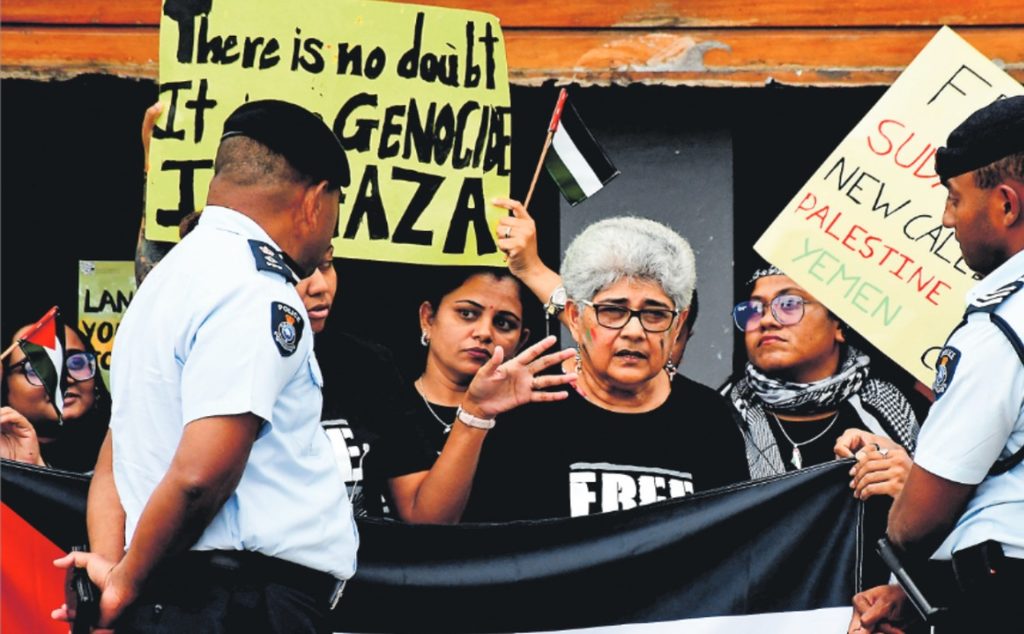
One of the clearest examples highlighted in the report, came in June 2026, when police intervened in a peaceful protest against the establishment of an Israeli diplomatic mission in Fiji.
About 100 civil society representatives and human rights advocates gathered at the Fiji Women’s Crisis Centre (FWCC), opposite FHL Tower, where the new Israeli embassy is located.
Protesters carried banners and placards and expressed opposition to the government’s decision to strengthen diplomatic relations with Israel.
FWCC coordinator and NGO Coalition for Human Rights chairperson Shamima Ali strongly criticised the government’s decision.
Police, however, instructed protesters to stop chanting, citing provisions of the Public Order Act.
Ali questioned the police response, pointing out that the gathering was taking place on private property and was peaceful.
The incident is not an isolated one.
Since November 2023, police have restricted solidarity marches in support of Palestine under the Public Order (Amendment) Act 2014. Activists have consequently had to hold gatherings within the FWCC premises rather than take their protests onto the streets.
For civil society groups, the issue is not simply about one protest or one political cause. It raises a broader question: How much space is available in Fiji for people to publicly disagree with government policy?
Journalists facing scrutiny
Concerns about civic space also extend to the media.
In May 2026, investigative journalist Meri Radinibaravi had her phone seized by police after she made a Facebook post concerning alleged corruption within the police force.
Radinibaravi, an investigative reporting fellow with the Organised Crime and Corruption Reporting Project (OCCRPP), said police contacted her and asked her to answer questions about a post she had subsequently deleted.
She went voluntarily to the Criminal Investigations Department in Suva and provided a statement. Police then required her to surrender her phone.
The incident raised concerns about the treatment of journalists investigating sensitive allegations and the protection of confidential sources.
OCCRP editor-in-chief Miranda Patrucic described the police action as an attack on press freedom and independent journalism.
The case comes at a time when journalists around the world are facing increasing pressure over their reporting, particularly when they investigate corruption, government institutions or powerful individuals.
For Fiji, the concern is whether journalists can continue doing this work without fear of intimidation, surveillance or having their sources exposed.
A court ruling sends a different message
At the same time, Fiji’s courts have demonstrated that constitutional protections remain an important check on state power.
In July 2026, the High Court in Suva permanently stopped criminal proceedings against journalist Charlie Charters.
Justice Pita Bulamainaivalu found that the Fiji Independent Commission Against Corruption (FICAC) had violated Charters’ constitutional rights and abused the court process.
The court found that Charters’ right to remain silent had been breached.
It also found violations of his rights to freedom of speech, expression, thought, opinion and publication. Importantly for journalism, this included protection of his right not to reveal his sources.
Charters had been detained at FICAC headquarters in February after publishing information about the commission and its functions on Facebook.
He had written extensively about FICAC and the Fiji Sports Council, relying on publicly available documents and his own sources.
FICAC officials also prevented him from travelling to Sydney and offered him a deal that involved revealing his sources.
In August, the High Court granted an application for seven electronic devices seized from Charters to be released.
The court’s decisions provide an important reminder that constitutional rights remain a safeguard for journalists and citizens when state institutions exercise their powers.
Questions over police powers
While the courts have provided some protection, proposed changes to policing legislation are creating another area of concern.
The Fiji Police Bill 2026 is intended to replace a police law that dates back to 1965.
But civil society organisations have warned that some provisions could be used to restrict criticism and weaken civic space.
One of the most controversial provisions is Section 148, which creates an offence of “causing disaffection or discontent among police staff.”
Critics fear such a provision could be used to discourage criticism of the police or silence whistleblowers who raise concerns about misconduct.
The Fiji Council of Social Services has also raised concerns about proposed covert surveillance powers contained in Sections 57 to 61.
Without strong independent oversight, civil society groups fear these powers could potentially be used against journalists, political opponents and civil society organisations.
Another concern is that police would be able to investigate complaints against their own officers.
Human rights standards emphasise the importance of independent mechanisms for investigating allegations of police misconduct, particularly when serious human rights violations are involved.
Deaths in custody raise alarm
Concerns have become more serious following the deaths of two people in custody in April 2026.
Sakiasi Radravu died following a police raid over an alleged burglary. His family alleges that he suffered injuries as a result of torture and sexual abuse.
Jone Vakarisi died while in military custody after soldiers took him to the Republic of Fiji Military Forces headquarters in Suva for questioning.
Police have yet to charge anyone over his death.
Human rights organisations have called for reforms to Fiji’s police and military systems and stronger independent oversight.
The cases have renewed questions about what happens when allegations of abuse are made against those entrusted with enforcing the law.
Online safety versus freedom of expression
The report says, another debate is taking place in the digital space.
The Fiji Law Reform Commission is reviewing the Online Safety Act 2018, with Justice Minister and Acting Attorney-General Siromi Turaga saying in August that the review was progressing.
The United Nations human rights office in the Pacific has urged Fiji to ensure that any new online safety legislation complies with international human rights standards.
The UN has stressed that protecting people from online harm must go hand in hand with protecting freedom of expression, privacy and due process.
It has also highlighted the need for particular protection for children, journalists, human rights defenders, people with disabilities and people of diverse sexual orientation, gender identity and expression, and sex characteristics.
Civil society organisations have previously criticised the Online Safety Act’s provision on “causing harm by electronic communication”, arguing that it can be used in ways that threaten legitimate expression.
The challenge for policymakers is therefore a difficult one: how can Fiji address genuine online abuse and harm without creating laws that discourage people from speaking freely?
Political participation also under scrutiny
The proposed National Referendum Bill 2025 is another area attracting attention, according to the report.
The bill is currently being reviewed by the Standing Committee on Justice, Law and Human Rights.
Critics have raised concerns that some provisions could restrict political campaigning and participation.
If enacted without sufficient safeguards, such provisions could affect how citizens and groups participate in important national debates.
For a democracy, the ability of citizens to campaign, organise, criticise and advocate for change is central to meaningful political participation.
Signs of progress
The CIVICUS assessment is not entirely negative.
Twenty-seven years after its establishment, the Fiji Human Rights and Anti-Discrimination Commission has opened its first office in the Northern Division.
The move should improve access to human rights services for people living outside Fiji’s main urban centres.
The High Court’s rulings in favour of journalist Charlie Charters also demonstrate that Fiji’s constitutional framework can provide meaningful protection when state institutions overreach
These developments show that Fiji has institutions capable of defending rights.
The question is whether those protections are strong enough — and consistently applied enough — to prevent civic freedoms from being gradually restricted.
What does “narrowed” mean for Fiji?
The CIVICUS Monitor’s “narrowed” rating does not mean that Fiji has lost its democratic freedoms.
People continue to form organisations, publish information, participate in political debate and hold protests.
But the rating signals that exercising these freedoms can come with restrictions and risks.
The concerns documented in 2026 point to a pattern that extends across several areas: protest rights, journalism, policing, surveillance, online speech and political participation.
The common thread is the balance between state authority and citizens’ rights.
Fiji needs effective laws and institutions to protect public safety, prevent crime and address genuine threats. But those powers also need clear limits, independent oversight and safeguards against abuse.
As Fiji considers new policing and online safety laws, and as citizens continue to challenge government decisions through protests and public debate, the choices made now could shape the country’s civic space for years to come.
The CIVICUS assessment therefore presents Fiji with more than a ranking or label.
It presents a question about the kind of democracy Fiji wants to be — one where citizens are free to speak, organise and challenge authority, or one where those freedoms become increasingly dependent on how the authorities respond.
This article put together using information from CIVICUS Monitor, a research tool and online platform that tracks and shares up-to-date data on the state of civil society and civic freedoms across 197 countries and territorieshe.