In Part 1, I asked: What exactly are we restoring?
The Great Council of Chiefs already exists in law. The harder question is what additional constitutional status or political powers, if any, should now be attached to it.
Once constitutional political power enters the discussion, however, an even more fundamental question follows:
Who speaks for the iTaukei?
And if an institution exercises political authority in their name:
Who gave it that authority, whom does it represent, and how can those it represents hold it accountable?
This is not about whether chiefs should have a voice. It is about distinguishing customary legitimacy from democratic political authority.
Who gets to speak for whom?
The existing GCC framework illustrates the distinction.
Under the 2024 Regulations, provincial representatives are nominated through the Bose Vanua. A nominee must be traditionally installed as a Turaga iTaukei, Marama iTaukei, Liuliu ni Yavusa or Liuliu ni Mataqali and appropriately recorded. Nominees must also possess “exemplary leadership qualities” and have served their province.
The framework therefore recognizes that customary status alone is not sufficient: Lineage/Customary Status g Eligibility g Capability + Service g Qualification
If capability and service matter when authority is acquired, shouldn’t performance, accountability and renewal also matter while it is exercised?
That leads to the larger question of representation.
What exactly does a GCC member represent?
Titleg Mataqali g Yavusa g Vanua g Province g All iTaukei?
These are not automatically the same constituency.
A chief can possess genuine customary legitimacy within a vanua. But one form of legitimacy should not automatically be treated as another: Customary Legitimacy ≠ Democratic Mandate
Ordinary iTaukei are members of customary communities, but they are also citizens who vote and live with the consequences of national political decisions.
So if the GCC is given constitutional political authority to act in the name of the iTaukei collectively: By what mechanism does customary representation become a national political mandate to speak for ordinary iTaukei as a whole?
Independence requires accountability
The GCC has said it wants to operate independently of Government and without political interference, with authority derived from its traditional governance role rather than being limited to an advisory or oversight role of the State.
That is the GCC’s stated position—not necessarily what the eventual legislation will provide.
Institutional independence can protect the GCC from political control. But: Independence ≠ Absence of Accountability
The existing framework retains relationships with Government, including ministerial authority over the time and place of GCC meetings and reporting requirements to the Minister.
If those relationships change, what accountability mechanisms will replace them?
Any proposal for greater independence or constitutional authority should answer: Who Selects? g Who Removes? g Who Scrutinises? g Who Audits? g Who Reviews? g How Is Leadership Renewed?
The principle is straightforward: Constitutional Powerh g Accountability Requirement h
Independence from Government may strengthen an institution.
Independence from meaningful accountability does not.
What happens when the two voices disagree?
Ordinary iTaukei already exercise political authority as citizens through elections: Ordinary iTaukei g Vote g Elected Representatives g Democratic Decision
The GCC derives legitimacy through another pathway: Customary Structures g GCC Representation g GCC Position
Those two forms of authority can coexist.
If the GCC advises, elected institutions retain the final decision.
Mandatory consultation requires engagement but does not necessarily transfer that decision.
Concurrence goes further because another institution may be unable to act without agreement.
And if any future arrangement provides blocking, veto or comparable powers, the constitutional consequences become greater still.
These are tests for whatever powers are eventually proposed—not claims about what the final Bill will contain.
The question is therefore not whether conflict is inevitable.
It is: What happens when the two sources of authority reach incompatible positions on a matter over which both have constitutional roles?
Who ultimately decides?
And according to what constitutional rule?
Those answers should be known before significant constitutional powers are conferred.
When does representation become override?
There is a legitimate case for the GCC providing an institutional voice for the vanua, culture, custom and indigenous interests.
But speaking for people and possessing authority to overrule their democratically expressed choices are fundamentally different things.
Cultural Representation ≠ Democratic Representation
Customary Authority ≠ National Political Mandate
If the GCC advises, different voices can coexist.
But if any future arrangement gives it authority capable of preventing a democratically authorised decision from taking effect:
What mandate justifies that power?
The principle becomes: Power to Constrain Democratic Decisions h g Democratic Legitimacy Requirement h
And this is where the central principle should lie: Protection of the iTaukei voice must never become the power to override the iTaukei voice.
If an institution exercises political authority because it represents ordinary iTaukei, those people should have meaningful ways to influence, scrutinize, renew and constrain that authority.
Who gets consulted?
Cabinet has directed further consultation with relevant iTaukei institutions under section 11 of the iTaukei Affairs Act before the stand-alone BLV Bill returns for final Cabinet consideration and introduction in Parliament.
That consultation is important.
But: Consulting iTaukei Institutions ≠ necessarily Consulting Ordinary iTaukei
If the proposal concerns primarily internal administration, institutional consultation may be sufficient for many purposes.
But if it would alter the distribution of constitutional political authority—particularly powers affecting Parliament, the executive, the presidency or decisions made through elected institutions—ordinary citizens have a direct interest in what is proposed.
The questions become: Who is being consulted? g About which powers? g How will differing iTaukei views be considered?
Consultation should establish not merely what existing institutions think, but whether the eventual arrangements have legitimacy among those in whose name they will operate.
This need not be chiefs versus democracy
The choice need not be:
GCC OR No GCC
Chiefs OR Democracy
Tradition OR Modernity
There is another pathway: Preserve g Examine g Reform g Renew
Preserve the vanua, lineage, chiefly office, customary selection and installation, and traditions communities continue to value.
Strengthen capability, service, community voice, accountability and leadership renewal.
And distinguish: Cultural Authority ≠ Customary Authority ≠ Advisory Authority ≠ Constitutional Political Power
The question is therefore not whether Fiji should weaken chiefs or the vanua.
It is: What institutional design would strengthen the vanua and chiefly leadership while ensuring that political power exercised in the name of the iTaukei remains accountable to the ordinary iTaukei people it exists to serve?
Every ordinary iTaukei should be entitled to ask: If you speak for us, how did we choose you, how do we hold you accountable—and can you use that authority to overrule us?
Because the stronger the constitutional power, the stronger the requirement for legitimacy and accountability.
And ultimately: Protection of the iTaukei voice must never become the power to override the iTaukei voice.
n SUNIL CHAND is an engineer and reform strategist with over 30 years of senior leadership experience across manufacturing, regulation and higher education, including strategic and operational roles at Fiji Industries Ltd/Pacific Cement (1994–2003), FCCC (2007–2009) and USP (2010–2019). He holds a BSc, MSc, MBA and numerous additional professional qualifications. The views expressed in this article are his own and not those of this newspaper. 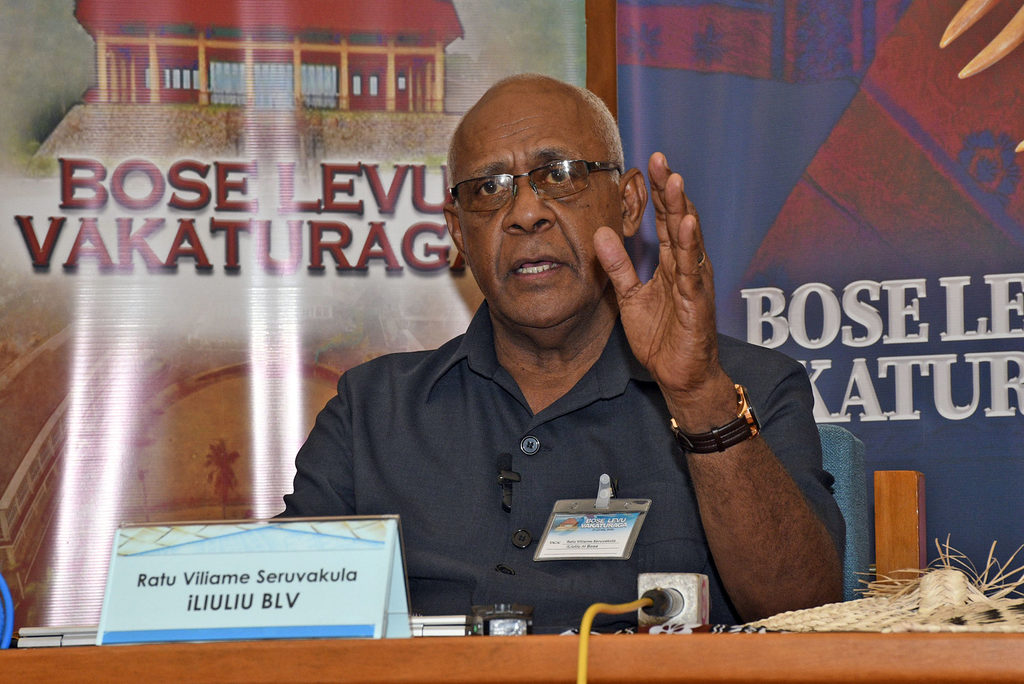
Great Council of Chief (GCC) chairman, Ratu Viliame Seruvakula speaks to the media during a post-meeting press conference at the newly refurbished GCC building in Nasese. Picture: JONACANI LALAKOBAU/FILE