If a robber accosted a law-abiding citizen on the street and violently stole $40 from him, the police would be on him like a tonne of bricks. He would be arrested, charged and fined or jailed (or both) for his obvious crime.
But between 2020 and 2021 (according to FNPF annual reports), the Government, by forcibly reducing the rate of FNPF contribution from 18 per cent to 10 per cent has taken $168 million from the pockets of hardworking, law-abiding employees, and transferred them to employers’ pockets.
Even though the rate of contribution has now been slightly raised to 12 per cent for the 2022 year, my rough estimates suggest that by December 31, 2022, somewhere up to $382 million of employees retirement funds, will instead remain in the hands of employers.
There has been no uproar from the police or the judiciary — or even employees who have been brutally intimidated these last fourteen years. Of course, there will be no protest from employers, who are gaining these massive sums of money without any effort on their part.
But the Fiji public must ask: have any members of the FNPF board expressed any concern whatsoever on the impact of these laws on the future welfare of the FNPF members?
The Fiji public must also ask: do any of the members of the FNPF board have any conflicts of interest with the transfer of this massive amount from employees to employers?
The Fiji public must also ask: has the FNPF board or any of them individually, expressed any concerns whatsoever on the negative impacts of the robbery on FNPF’s own finances?
The employees of Fiji must demand to know why there are no employee representatives on the FNPF board.
What has occurred to the employees’ FNPF retirements funds is truly tragic – as I call it, “legal robbery”.
FNPF contributions are sacred
I remind readers of the legal sacredness of FNPF contributions.
By law, all registered employers have for several years been required to contribute 18 per cent of their wage bill to the FNPF.
They are allowed to deduct up to 8 per cent of the 18 per cent from their employees wages, which they usually do – which is why we say that 10 per cent comes from employers and 8 per cent from employees.
If any employer unilaterally chose not to pay its required FNPF contributions, this would be breaking the law.
This is seen as the employer “stealing” from the employees. Such employers would be prosecuted and punished by the Government (the police and the judiciary) fined (or worse), and forced to pay the required contributions into the employees’ accounts.
Except that the Bainimarama Government has legally allowed the employer to keep a large part of these contributions in his own pockets, and to keep doing so until December 31, 2022.
By doing so, not only has the FNPF been put under financial stress, but the Fiji economy has also been deprived of much-needed development funds.
The facts
The massive reductions in contributions to FNPF are fully documented in the 2021 FNPF annual report which covers the period July 1, 2020 to June 31, 2021.
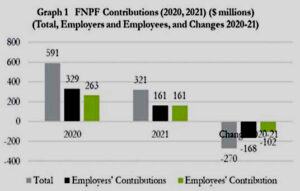
Total Contributions to FNPF over those 12 months alone have declined by a massive $270 million (the grey bars in the graph).
Employers’ contributions (black columns) have declined by $168 million (which they have kept in their pockets). Employees’ contributions have declined by $102 million.
How have these historic reductions come about?
The first reduction
In the 2020 COVID-19 supplementary budget, the Minister for Economy (Aiyaz Sayed-Khaiyum) announced that from April 1, 2020 to December 31, 2020, FNPF contributions would be reduced from 18 per cent to 10 per cent.
The employee contributions to their FNPF would be reduced from 8 per cent to 5 per cent, thereby putting $80 million into their pockets (presumably for spending or saving).
Most sensible economists would be deeply concerned about this.
But of greater concern is that, by law, employers’ contributions would be reduced from 10 per cent to 5 per cent with the minister announcing that “over the next nine months, this will keep $130 million in their accounts”.
What the minister did not say was that, by law, this would move, over those nine months, $130 million from employees’ FNPF retirement funds, into the employers’ pockets, forever: I call it “legal robbery”.
The minister justified it as “helping them sustain their business and cash flow and to minimise job losses and hour reductions”.
Australia also helped many employers maintain their cash flow during COVID, but they used their Jobkeeper Allowances paid for by taxpayers in general.
It was not taken out of employees’ superannuation contributions or retirement funds.
Then, in the July budget speech, that reduction of employers’ FNPF contributions from 10 per cent to 5 per cent was continued from January 1, 2021 to December 31, 2021.
So based on the 2020 figures, that would put another $140 million into employers’ pockets.
Last week, the Bainimarama Government announced an “increase” of contributions to 12 per cent (6 per cent from employers and 6 per cent from employees) to go from January 1, 2022 to December 31, 2022: effectively transferring another $112 million from employees to employers.
Altogether, then, the employees will have forever lost up to $382 million (=130+140+112) into the pockets of employers, by strokes of the pen of the Minister of Economy.
Given the size of these “benefits”, if you were an employer, wouldn’t you want this government to stay in power?
Note also that by December 31, 2022, the FNPF retirement funds will have roughly lost up to $658 million, adding to potential liquidity problems, because of historically high withdrawals by members.
Given that the actual contributions would have been somewhat lower because of the contraction of the economy, the public can call upon FNPF to give far more accurate estimates than my rough numbers here.
FNPF under pressure
It is critical that the FNPF members understand how the nation’s retirement funds have been badly dented by the Bainimarama government policies.
Not only have they massively cut employer contributions (which have gone into their pockets) but they have very unwisely encouraged the FNPF members to draw down their savings.
Graph 2 shows these declines.
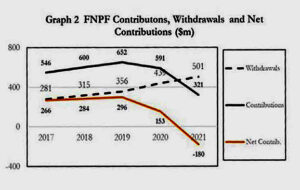
FNPF contributions fell from $652 million per year in 2019 to $321 million in 2021 (solid line in the graph).
Withdrawals rose from $356 million in 2019 to a record $501 million in 2021 (dotted line in the graph).
So, net contributions to the FNPF (that is, contributions minus withdrawals) fell.
The number had been positive $296 million in 2019. It declined to $153 million in 2020 (still positive).
But by 2021 it had become a massive negative $180 million.
I suspect that it will still be negative when the 2022 Annual Report is written.
But FNPF members must ask: who in the FNPF board have been looking after their financial interests while their retirement funds have been raided?
What of the FNPF board members?
One of the fiduciary duties of the FNPF board members is to look after the interests of the FNPF contributors — most of whom are employees in the formal sector of the Fiji economy.
Did any of the current board members (Dakshesh Patel, Sanjay Kaba, Mukhtar Ali, Shiri Gounder, Joel Abraham or Kalpana Lal) make known any concerns about the welfare impact of these FNPF contributions?
Indeed, do they have any conflicts of interest in these adverse developments for employees?
Board members who are themselves employers, or shareholders in employers, would themselves benefit from these changes.
One board member (Shiri Gounder) is permanent secretary in the Economy Ministry.
Another is an executive in a public enterprise, both under the direction of Minister of Economy who made the legislative changes reducing the FNPF contributions.
Workers of Fiji should be actively protesting that since the 2006 Bainimarama coup, all union representatives have been removed from the FNPF board.
This means that, today, there is no board member who employees can ask to speak up for their interests.
The Government, of course, is a major employer. So these changes hand the Government huge cash savings of its own.
So among the employees who have lost large amounts for their retirements are all civil servants of Fiji, including those who work for the RFMF, the police and prisons.
Also adversely affected are journalists in some media companies who have been uncritically pro-Bainimarama Government.
FNPF and development funds
We must also understand that the reduction of FNPF contributions does not just hurt employees, but also the Fiji economy in the long run. One of the massive national benefits of the FNPF is that has more funds to lend out than all the commercial banks put together.
The Fiji Government and many public enterprises are the largest borrowers from the FNPF, largely investing their loans for Fiji’s development (though sometimes mistakes are made in those investments).
There are also many private enterprises which borrow from FNPF and help to grow the Fiji economy.
Reduced contributions to FNPF thereby inevitably reduce the funds available for FNPF to invest into Fiji’s economy and future growth.
The Bainimarama Government has not only betrayed the employees of Fiji, but it has put downward pressure on the Fiji economy into the future. Will these issues have any impact on the next general election?
- Prof WADAN NARSEY is a leading Fiji economist and a regular columnist with The Fiji Times. The views expressed in this article are his and are not necessarily those of this newspaper.