There are long flights and then there are flights that make you question every decision you have ever made about travelling.
My journey from Fiji to China for the 2026 Asia Pacific Media Forum was the latter.
With Fiji Airways’ direct Nadi-Hong Kong service fully booked, I took the scenic and very long – route through Papua New Guinea and Hong Kong before finally arriving in Guangzhou.
Almost 24 hours later, after delays and enough time in airports to qualify for residency, I arrived at 5am Fiji time, or 1am China time on September 1, having left Fiji at 4am on August 31. But the exhaustion quickly disappeared.
GUANGZHOU, formerly known as Canton, is the bustling capital of Guangdong province and one of southern China’s major trading centres. It is big, busy and moving at a pace that makes you realise there is a lot more happening here than what we see from Fiji.
Then came Zhuhai.
If Guangzhou shows you China’s economic muscle, Zhuhai shows you that development can also be beautiful.
The coastal city sits on the Pearl River Delta, directly across from Macau, and is famous for its beaches, greenery and relaxed lifestyle. It has even earned the nickname “romantic garden city”.
And I can understand why.
Along Lovers Rd, we stopped at a lighthouse overlooking a sandy beach, with the enormous Hong Kong-Zhuhai-Macau Bridge stretching across the horizon.
The speed limit? Five kilometres per hour.
At first I thought it was a typo. But no – five.
At that speed, even a Fijian who normally complains about traffic would probably say: “Bula, take your time.”
Zhuhai is also a serious technology hub, with industries spanning semiconductors, artificial intelligence, robotics and software.
That contrast – beautiful coastline alongside cutting-edge technology – is one of the things that has struck me most about China.
The Zhuhai Opera House, known as the Sun-Moon Shells, is another example. Built on an island, its enormous shell-like design rises from the sea and houses concert and opera halls.
It is architecture, engineering and art rolled into one.
But the biggest eye-opener for me has been technology.
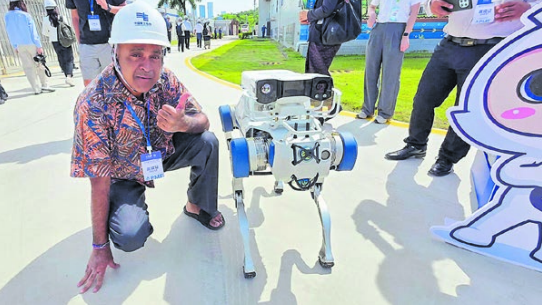
At China Southern Power Grid, we saw robots being used to inspect electricity infrastructure. They can identify abnormal readings, increases in heat and equipment faults. Drones fly along powerlines looking for defects. Find a problem and the people who need to fix it are dispatched.
For Fiji, this deserves serious thought.
Energy Fiji Ltd operates a 132kV network across the country. China Southern Power Grid operates a much larger 220kV network and supplies electricity to about 272 million people.
The lesson isn’t that Fiji needs to copy China, but that we should be asking where technology can make our own systems safer, smarter and more efficient.
We saw the same thinking at Mingyang Group in Zhongshan, a major clean-energy company involved in wind turbines, solar, hydrogen and smart energy.
Even its headquarters was impressive – several huge buildings, with a pond complete with ducks. So, yes, apparently even billion-dollar clean-energy companies need ducks.
Then there was Yakou Village.
Here, traditional farming has not been pushed aside by modernisation. Vast rice fields stretch for kilometres while coffee shops overlook the paddies.
Agriculture, tourism, culture and modern village life have been blended into one experience that attracts huge numbers of visitors. That, too, is a lesson. Modernisation does not necessarily mean abandoning what came before.
And then there was the main Asia Pacific Media Forum. Around 800 delegates attended the Asia Pacific Media Forum, with journalists and media leaders from across the region discussing cooperation, artificial intelligence, technology, connectivity and the future of journalism. The scale was enormous.
One message I have heard repeatedly at the 2026 Asia-Pacific Media Forum in Shenzhen is that the media cannot afford to work in isolation anymore.
Pakistan’s Minister of State for Foreign Affairs, Shezra Kharal, called on media organisations across the Asia-Pacific to strengthen co-operation and work together to address the challenges facing the industry. That message resonates strongly with me.
From Fiji, we sometimes look at the media challenges in larger countries and think they are different from ours. They are not. Whether you are a newsroom in Fiji, Pakistan, China, Australia or somewhere else in the region, the challenges are increasingly connected.
Then came another stark reminder: ‘Misinformation knows no boundaries’.
CNN Senior Vice President Konstantinos Oikonomou stressed the need for media organisations to remain vigilant and tackle misinformation with vigour. And he is right.
A false story does not need a passport. It does not stop at an airport or wait for a border crossing. One misleading Facebook post, video or AI-generated image can travel from one side of the world to the other before a newsroom has finished its morning coffee. That makes co-operation between credible media organisations more important than ever.
I have to admit, I arrived in China with a fairly simple view of Xinhua News Agency. I had always regarded it as a Chinese State media organisation closely aligned with the government.
So I was genuinely surprised to see co-operation between Xinhua and major Western news organisations, CNN. Why would CNN work with Xinhua?
The answer, I suspect, is more practical than political. Media organisations can disagree profoundly on systems, editorial approaches and world views, yet still co-operate on technology, content, journalism and innovation.
Perhaps that is the bigger lesson for us in the Pacific: Co-operation does not necessarily mean agreement.
You can sit across the table from someone whose approach is completely different from yours, learn something from them and still maintain your own editorial independence. In journalism, that may be exactly the conversation we need more of.
For The Fiji Times, this is particularly relevant as we continue our own digital transformation. The speed at which information now moves means journalists have to be faster, but never at the expense of accuracy.
Artificial intelligence will make that challenge even greater. AI can help newsrooms produce content, analyse information, translate material and reach audiences in new ways. However, the technology also gives misinformation a powerful new engine.
The answer is not to fear technology. It is to understand it, use it responsibly and ensure that the fundamentals of journalism – verification, accuracy, context and accountability – remain at the centre of what we do. That is perhaps one of the most valuable conversations that took place in Shenzhen.
We may compete for audiences, clicks and advertising, but when it comes to protecting the credibility of journalism, there should be no competition. There should be co-operation.
For a small Pacific newsroom like The Fiji Times, being part of this conversation was an important reminder that our challenges may be local, but the solutions increasingly need to be regional and sometimes global.
The world is getting smaller. Fiji is much smaller, but we should never think that means we have to think small. The challenge is to combine those strengths with smarter technology and new ideas.
From Fiji to China, the journey may have taken almost 24 hours. However, the bigger journey, understanding what is possible, has only just begun.
ANISH CHAND is the Managing Editor Digital at The Fiji Times