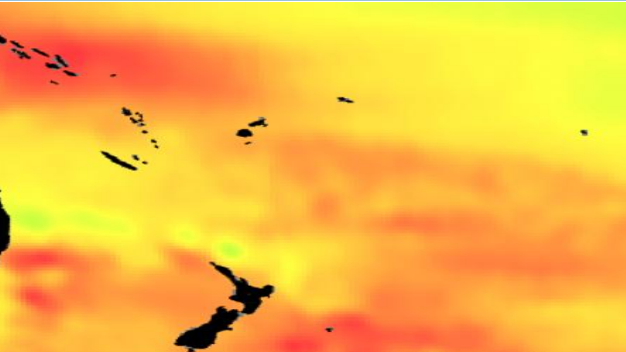
Sea levels around Fiji have been rising by between four and five millimetres annually over the past three decades, according to the Fiji Meteorological Service’s 2025 Annual Climate Summary.
Satellite measurements from 1992 to 2025 revealed the continuing rise, highlighting the growing risks facing Fiji’s coastal communities and infrastructure.
The report also revealed that the sea-level monitoring station at Lautoka Wharf recorded an average relative sea-level rise of 3.7 millimetres per year between 1993 and 2025.
The Fiji Meteorological Service said this represented a statistically significant increasing trend, with a 95 per cent confidence level.
At the recorded rate of 3.7 millimetres annually, the cumulative increase over 32 years would be approximately 11.8 centimetres, assuming a constant rate.
The report noted that Fiji currently has monitoring stations at Lautoka Wharf and Suva Wharf, while a third station previously located at Vatia Wharf in Tavua had been removed because of changes in land ownership.
However, sea-level trends at Suva Wharf and Vatia Wharf could not be analysed because of missing data.
Globally, the report stated that mean sea level at the end of 2025 was approximately 11 centimetres higher than in January 1993, when satellite records began.
More concerning was the acceleration in the rate of global sea-level rise.
Between 1993 and 2011, global sea levels rose at an average rate of 2.65 millimetres annually.
That rate increased to 4.75 millimetres annually between 2012 and 2025, according to the World Meteorological Organization’s State of the Global Climate 2025 report.
The Fiji Meteorological Service warned that sea-level changes around Fiji could differ from the global average because of ocean currents, changes in ocean temperature and circulation, and vertical land movement.
These factors could expose some coastal areas to faster sea-level rise, increasing the risks of coastal erosion, saltwater intrusion, flooding and damage to infrastructure and ecosystems.
Low-lying communities are particularly vulnerable to these impacts.
The report explained that global sea-level rise is primarily driven by warming oceans, which cause seawater to expand, and the melting of glaciers and ice sheets.
It warned that even if greenhouse gas emissions stopped immediately, sea levels would continue rising for centuries because of the climate system’s long-term response.