For thousands of Fijians, keeping their eyesight may depend less on advanced surgery than on something simpler: knowing a problem exists before it is too late to treat. Health authorities and eye-care advocates say that most blindness in Fiji is preventable or treatable – yet too many people still lose their vision simply because it goes undetected until it has progressed too far (The Fiji Times, Dec. 3, 2025 published article). That gap is why awareness and outreach are increasingly discussed alongside hospitals, and eye care practitioner as well as public health activists as tools for protecting sight nationwide.
A preventable crisis
Eye care practitioners and public health professionals report a well-known pattern: patients wait. They wait until it is impossible to read, faces become blurry, and it becomes risky to walk alone. By then, the results are worse and the treatment is more difficult. According to eye care specialists, this delay is the true threat. Since many patients only seek treatment after their vision has already deteriorated, they claim that early detection combined with ongoing public education is the most effective way to combat blindness. They recommend yearly eye exams, which are as routine and serious as a blood pressure check. Their prescription is almost usual in its simplicity. Diabetes makes things much more complicated. Nearly 18 per cent of Fijians suffer from the illness, which is one of the main causes of vision loss in the country. According to the World Diabetes Foundation, which has provided funding for outreach screening in Fiji, the prevalence could reach 16 per cent, or 80,000 people.
Why awareness matters as much as treatment
Public health professionals draw attention to a harsh reality: modern equipment and surgical expertise only benefit those who physically enter the clinic. Many cases of blindness in Fiji trace back not to a lack of treatment options, but to a lack of awareness – people not recognising warning signs, not knowing screening exists, or not understanding that conditions like cataracts and diabetic retinopathy are treatable if caught in time.
That is why awareness campaigns are increasingly seen as a frontline defence, not an afterthought. Fiji’s Ministry of Health and Medical Services has built eye health into national policy, and organisations such as the Pacific Eye Institute, the Fiji Society for the Blind, and international partners have spent recent years training community health workers to serve as the eyes and ears of the health system in villages far from major hospitals.
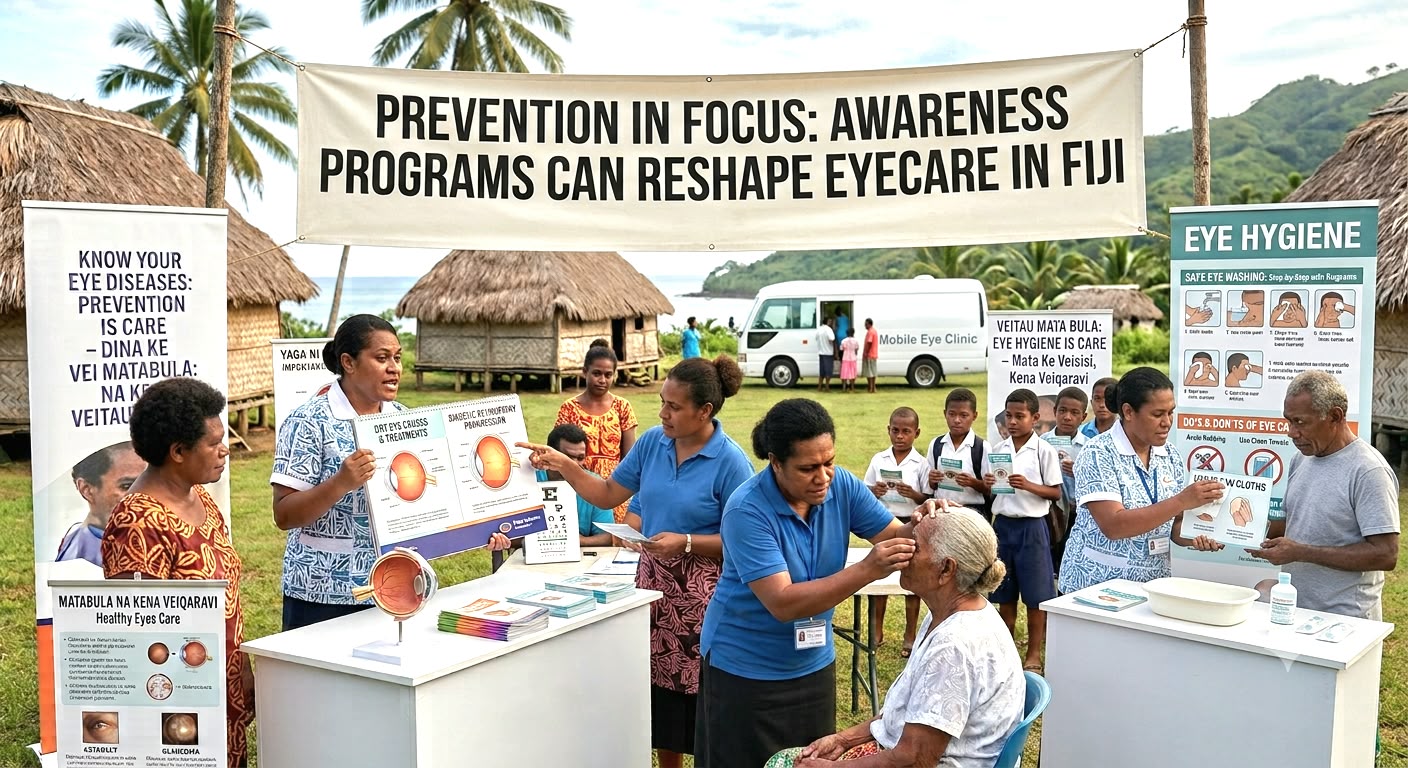
These community health workers now play a central role: educating families about diabetes-related eye disease, identifying people with vision problems early, and referring them for screening before conditions worsen. Village health workers, teachers, and church groups have also become important partners, since they are already trusted, familiar faces in communities that formal healthcare visits may only reach occasionally.
Screening programs reaching the grassroots
Outreach has become a cornerstone of Fiji’s prevention strategy. Mobile screening visits now travel to communities that would otherwise have little or no access to eye care, offering free diagnosis and treatment referrals. Programs specifically targeting diabetic retinopathy have screened thousands of Fijians who might never have visited a clinic on their own, catching disease at a stage when treatment can still preserve sight.
The Fiji Society for the Blind has similarly expanded community-based screening, identifying both children and adults living with treatable eye conditions – including pterygium, a common growth on the eye’s surface linked to sun exposure, which is especially prevalent in Fiji’s tropical climate. Early intervention programs also support visually impaired infants and toddlers, working with families to ensure children get support and treatment as early as possible.
The bigger picture: Sight as an investment
Beyond the personal toll, experts frame eye health as an economic and social issue. Losing one’s sight affects a person’s ability to farm, work, and care for family – activities central to daily life for much of Fiji’s population. Health economists note that interventions like cataract surgery rank among the most cost-effective health investments available in the Pacific region, restoring independence and productivity at relatively low cost compared to the lifelong impact of untreated blindness.
Preventing blindness, advocates argue, is not only about restoring sight – it protects children’s education, family income, and community wellbeing.
What this means for the public
For everyday Fijians, the message from health professionals is consistent: don’t wait for symptoms to become severe before seeking help. People with diabetes are urged to have regular eye screenings, since retinopathy often develops without early warning signs. Parents are encouraged to have children’s vision checked, since undetected vision problems can affect learning and development. And anyone noticing blurred vision, eye pain, or gradual vision loss – however minor it may seem – is encouraged to seek a screening rather than assume it will resolve on its own.
As Fiji continues to invest in training local eye-care professionals and expanding outreach into rural and maritime communities, the underlying lesson is one of prevention: the earlier a problem is caught, the more likely sight can be saved. Awareness, it turns out, may be one of the most powerful tools in Fiji’s fight against avoidable blindness.