After exploring the struggles faced by Bishop Bataillon, Father Breheret, Father Joseph-Francois Roulleaux, Brother Perol, the two Wallisian catechists and the Fijian catechist Mosese Monatavai, as recounted in Father Roulleaux’s letter last week, we turn to another chapter in the story of Catholicism in Fiji – how a beginning in Lakeba led to the establishment of churches and the growth of one of the country’s major Christian denominations.
Before there was a church where the faithful could gather to worship, there was a humble hut on the island of Lakeba.
Inside what was described by the early Catholic records as “badly covered and all in ruins” offering little protection from the rain, the missionaries arranged a small altar and celebrated Mass with the small numbers they had
The catholic recorded that the cramped conditions were so severe that Brother Perol was often forced to sleep beneath the stars.
It was a far cry from the churches that would later become familiar landmarks in Fiji’s Catholic communities.
Yet the significance of that hut lay not in its size or appearance, but in what it represented, a place where the missionaries and the small community of converts could gather to practise their faith.
The dwelling belonged to Mosese Matanavai, the Catholic catechist who had already been sharing his faith on the island before the arrival of the first French Marist missionaries in August 1844.
For the missionaries, the hut was more than shelter.
It became their home and chapel, a place where they could celebrate Mass while facing the uncertainty of establishing a new mission on a land far from their own.
But a mission could not remain in a hut forever.
As the Catholic presence in Lakeba developed, the need for a more permanent place of worship became part of a much larger undertaking — one that depended not only on the determination of the foreign priests, but also on the support and involvement of local people.
The story of the first Catholic chapel at Tubou, therefore, began not with the walls of a church, but with the people who helped make its establishment possible.
A mission built through shared effort
Catholic records wrote that the missionaries resumed work on the little house when conditions allowed, despite threats from their opponents, who warned that they would burn it down once it was completed.
Undeterred, the missionaries worked alongside their converts to gather the materials they needed.
In Father Roulleaux’s letter, which we dug into last week, he recounted the struggles faced by the early missionaries.
But amid those hardships, he also documented how they set about building with the little they had.
“We went with our converts to search in the mountains and among the rocks for big pieces of wood which we carried on our shoulders,” Father Roulleaux wrote.
“Everyone played their part.”
His account offered a rare glimpse into the physical labour involved in establishing the early Catholic mission.
For a small missionary party operating far from its European home, construction depended on what could be found locally, the labour available and the willingness of others to help.
The role of local leadership
Historical scholarship provides another important piece of the story.
In 2015 Ma’afu, Prince of Tonga, Chief of Fiji, published by the Australian National University, historian Deryck Scarr records that Vuetasau, the son of former Tui Nayau Malani and nephew of the incumbent ruler Taliai Tupou, was among the early Fijian converts to Christianity and Catholicism.
Following his baptism in 1846, Vuetasau adopted the Christian name William.
Scarr records that he oversaw the building of a chapel at Tubou and established Lakeba’s first school in his own home in 1850.
The reference places a local chiefly figure at the centre of the chapel’s construction.
It also points to the importance of local involvement in the early development of Catholicism.
The missionaries brought their religious tradition to Lakeba, but the establishment of a place of worship also depended on people who could help organise and sustain the work within the community.
The work marked another step in the establishment of the Catholic mission on Lakeba.
The land had been offered to the missionaries by Tui Nayau, Taliai Tupou, in July 1845, giving them a place to settle and build.
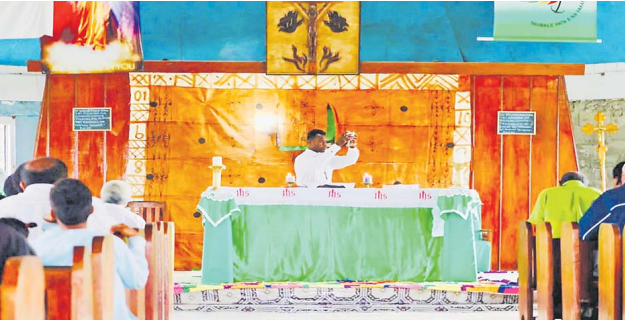
Today, that land remains home to the St Martin de Porres Catholic Parish in Tubou which is the main Catholic church on the island, keeping alive the legacy of the mission’s humble beginnings.
In Part Five next week, we look at life 182 years on, diving into details of the landmark built by the Catholic community in Tubou, Lakeba just beneath the land upon which the Church is built, and the legacy of its Tongan descendants whose contributions helped build its prosperity.