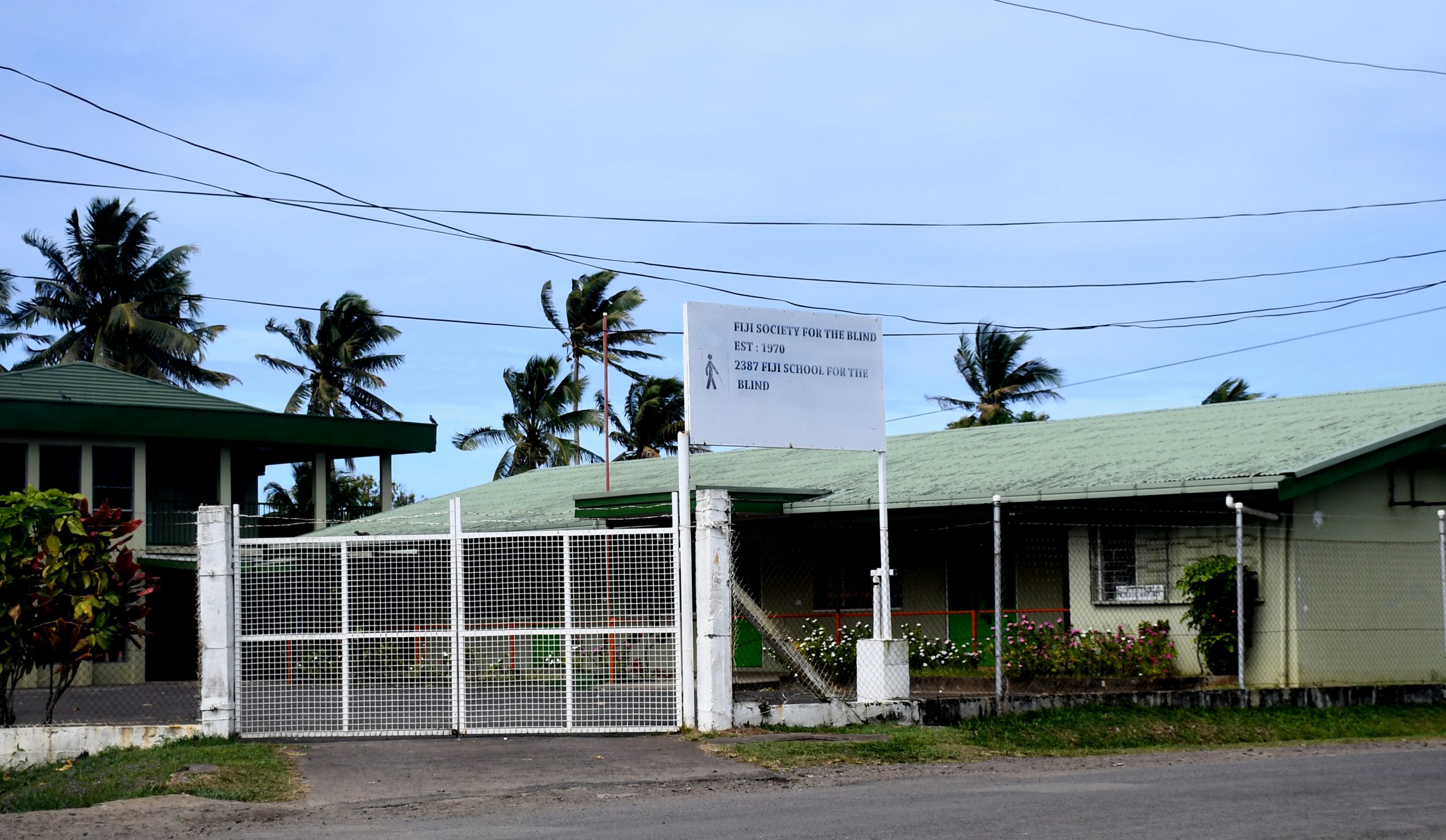
FOR most people, catching a bus, crossing a busy road, reading a sign or walking into a government office are everyday tasks that barely require a second thought.
For a person who is blind or partially sighted, those same routines can become daily tests of courage, independence and determination.
That is the reality the Fiji Society for the Blind (FSB) has been working to change for the past 56 years.
Established through the vision of the late social worker Frank Hilton, the late Dr Asad Ali Asgar and members of the Rotary Club of Suva, the organisation has grown into Fiji’s leading centre for services supporting blind and visually impaired people.
Today, it provides education, rehabilitation, orientation and mobility training, Braille transcription, early intervention, hostel accommodation, community-based rehabilitation and primary eye care — all free of charge.
Its mission is simple but ambitious: to ensure blind and visually impaired people enjoy equality with sighted people and full participation in society.
Executive director Barbara Farouk said that mission had guided every step of the organisation’s journey.
“I am very privileged to be serving the Fiji Society for the Blind as executive director,” she said.
“Twenty-six years ago, when I joined the organisation, apart from an accounting qualification and some leadership experience, I had little or no knowledge of the needs and aspirations of blind and visually impaired persons.”
She said leading the organisation had been one of the greatest privileges of her life.
“I thank the Lord Almighty for giving me the courage to take up the challenge to hold the reins of this august organisation and lead it to greater heights.
“I also wish to thank the former and current board members for having faith in me and guiding and supporting me to steer this very special organisation all these years.”
But Ms Farouk believes understanding blindness begins with a simple exercise.
“Close your eyes and welcome to the land of the blind,” she said.
“Are you different? Has your mind, your hands, legs stopped working?
Any difference in your goals, love for family and friends, desires, anxieties, appearance? No. You have the same love, worries, desires and mind chatter.
“On a higher plane, there’s nothing wrong with you. You see things differently. You have greater challenges but the desire to improve is still there.”
She then asks people to imagine navigating a world that was never designed with blindness in mind.
“Now, still with your eyes closed, consider going home today via public transport without being trained by FSB.
“Imagine going to a public high school for the first time, crossing the road or walking on uneven pavements, going to shops or government departments without any signs in Braille, visiting hospitals with no Braille signage or trying to find a toilet in a new place.
“Imagine being blind or partially sighted and studying for exams without Braille papers, doing external and tertiary examinations, facing the added stress and still not having longer to complete the papers.
“Imagine going to a job interview.
“Now imagine that your child cannot see.”
Those experiences, she said, explain why the society was established more than five decades ago.
“This is why FSB was established 56 years ago by the late Frank Hilton, a group of social workers, the late Dr Asad Ali Asgar and the Rotary Club of Suva, which provided the funding.”
The organisation started modestly after the Government provided land for its operations. Three wooden buildings, originally used during the construction of the Suva-Nadi highway, became its first home.
Ms Farouk said over the years, support from donors transformed the campus.
“Sixteen years later these were updated thanks to donors such as Christoffel Blinden Mission, Rotary Club of Suva, The Fiji Times through the Fiji Sixes Charity and the Bailey Trust.”
She added that the Narseys Plastics family funded the hostels, while Mr and Mrs Hari Punja financed the construction of the administration block.
Despite the progress, she said the society’s vision remains unfinished.
“Our goal is to reach equality with sighted persons and full participation in society through education, rehabilitation, social integration, employment and legislation.
“The mission is a challenge — but not impossible.”
Ms Farouk believes blind and partially sighted people possess qualities many employers overlook.
“Blind and partially sighted people are mentally stronger and more resilient than others.
“Given half a chance of employment they will adapt and be an asset to any government department, corporation or organisation.”
NEXT WEEK: From classroom to career — discover how the Fiji Society for the Blind’s integration program has helped dozens of visually impaired students break barriers, earn university degrees and secure permanent jobs.