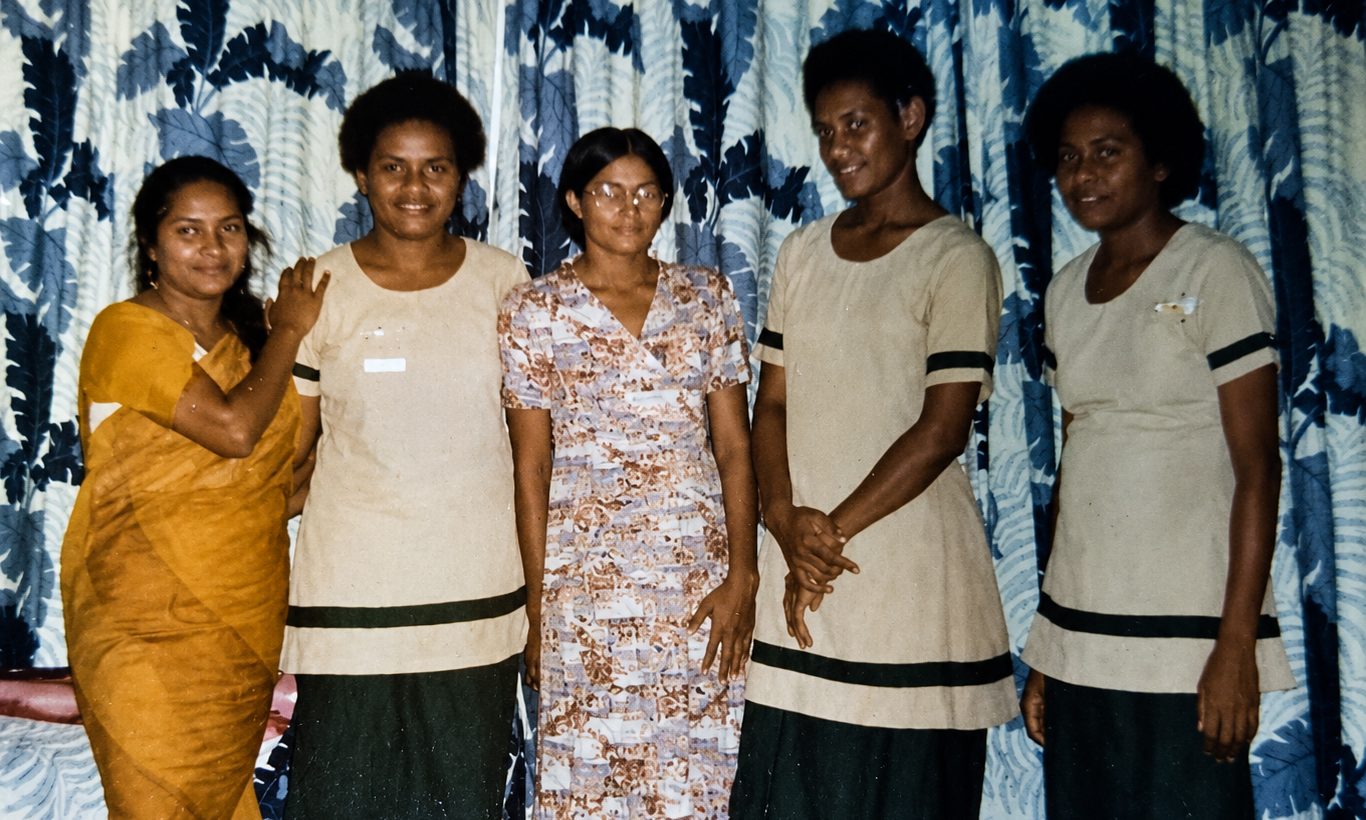
KEOLA Pati’s life has been shaped by work, family, faith and perseverance. From her early working days, when she travelled by speedboat to island resorts to sewing curtains, to raising a family through difficult times and working for decades in Fiji’s furniture and retail industries, she learned to keep going regardless of the circumstances.
She faced fear, financial hardship, loss and uncertainty, but also experienced the kindness of workmates and people who helped her along the way.
Now, 86, and still working, Keola’s story offers a glimpse into a generation shaped by discipline, responsibility and the belief that when there is work to be done, you simply do it.
Early days
The speedboat was moving too fast.
For a young Keola Pati, the water rushing past was frightening. She watched the boat cut across the sea, carrying her towards an unfamiliar island and a job she had agreed to take.
For a moment, fear took over.
She wondered if the boat might tumble.
“I was so frightened,” she remembers.
But she stayed in the boat.
She was going to work on an island in the Mamanuca Group.
That moment, many decades ago, would become one of countless moments in Keola’s life when fear could have stopped her — but did not.
Today, she can look back on a life defined not by the absence of hardship, but by her determination to keep going through it.
Lessons from home
For Keola, the foundation of her life was laid in childhood.
Her parents were her first teachers, teaching her the responsibilities and expectations that shaped the woman she would become.
“The first teacher used to be our parents.”
At home, there was little room for questioning.
“They teach us, you do this, you do that, you do that.”
The lessons were simple.
Work was part of life.
Responsibility was part of life.
You woke up, did what needed to be done and carried on.
When Keola began working, those childhood lessons became reality.
“When I start to work, I wake up in the morning, I go to work, do the job then come back home, then do the cooking, washing, everything.”
There was always something to do but hardship also taught her endurance.
Life beyond the familiar.
When she first started working at Hensher (Fiji) Ltd, – a UK-based household manufacturing company that operated in Fiji during the 1970s and 1980s – her boss asked if she could go to the Reef Hotel for work.
She said yes.
The materials and machines were loaded onto a boat and Keola went with them.
Her job was to measure and sew curtains.
It was the beginning of a working life that would take her to different islands, including Mana Island and Castaway Island.
For a young woman travelling alone for work, it was an experience filled with unfamiliar surroundings and moments of fear.
The first speedboat journey remains vivid in her memory.
She was afraid the boat would overturn.
But she did not ask to go back.
She stayed.
She went to work.
The night she met a snake
Working away from home brought other challenges.
One night, while staying on an island, Keola saw a snake near her door.
She was terrified.
“I was so frightened. I can’t yell, I can’t do anything. I just pray to God, ‘please God, you help me’.”
Eventually, the snake disappeared.
For Keola, the experience reinforced something she had learned from her parents — faith. Prayer became a constant part of her life.
It travelled with her wherever work took her.
“Only prayer can change things. Nothing else.
“Anything you want to do, first you pray to God. You must pray when the sun rise.”
Her faith became a source of strength during the difficult years that followed.
When life tested her
Keola’s working life gave her independence, but adulthood brought responsibilities that were heavier than any journey to an island.
She married.
She had children.
She built a home.
Then came a period of hardship she still remembers clearly.
After the Housing Authority gave her a house, her husband was admitted to St Giles Hospital.
Her second son was just eight months old and she had no money.
“The first day I don’t know how I walk from Raiwaqa to St Giles Hospital to visit him and back because that day I did not have any money.”
She walked to the hospital to visit her husband and then walked back.
Her husband eventually returned home but could no longer work.
The responsibility of providing for the family remained so Keola continued working.
She later spent a decade working in Lautoka with Popular Furniture.
She kept going because there was no other choice.
But perhaps more importantly, she had been taught all her life not to give up.
“You couldn’t tell anybody what bad days you had.”
Others stepped in
Keola’s story is also a reminder that perseverance does not always happen alone.
There were people who noticed when she was struggling.
When she came to her house in Raiwaqa, she had only one suitcase of clothes.
Then the suitcase was stolen and she was left with only one sari.
Her workmates at Harish Store noticed.
“The ladies at work, I used to work in Harish Store, they all put in and buy me sari because I wear sari all the time before, so they buy me sari.”
She remembers those women with gratitude.
“The workers were very good.”
Her boss’s father, Mr Ramchandra, also gave her three dollars.
It was a small gesture, but for Keola, it was meaningful.
At different points in her life, people helped her carry the weight.
A lifetime of work
Keola does not describe herself as a particularly courageous woman.
She does not speak of her life as an extraordinary story.
Instead, she speaks about what she was taught.
Today, at 86, she still walks through the doors of Comfort Home Furnishing.
Her philosophy remains grounded in faith.
“The good and the bad are always with us, but the only thing is to pray to God, just pray to God,” she says.
“I must pray two times a day. In the morning ‘please God everything be good, afternoon, ‘God thank you very much for what you did’.”
Perhaps that is the simplest way to understand Keola Pati’s life.
She learned that faith could carry her through days she could not imagine surviving.