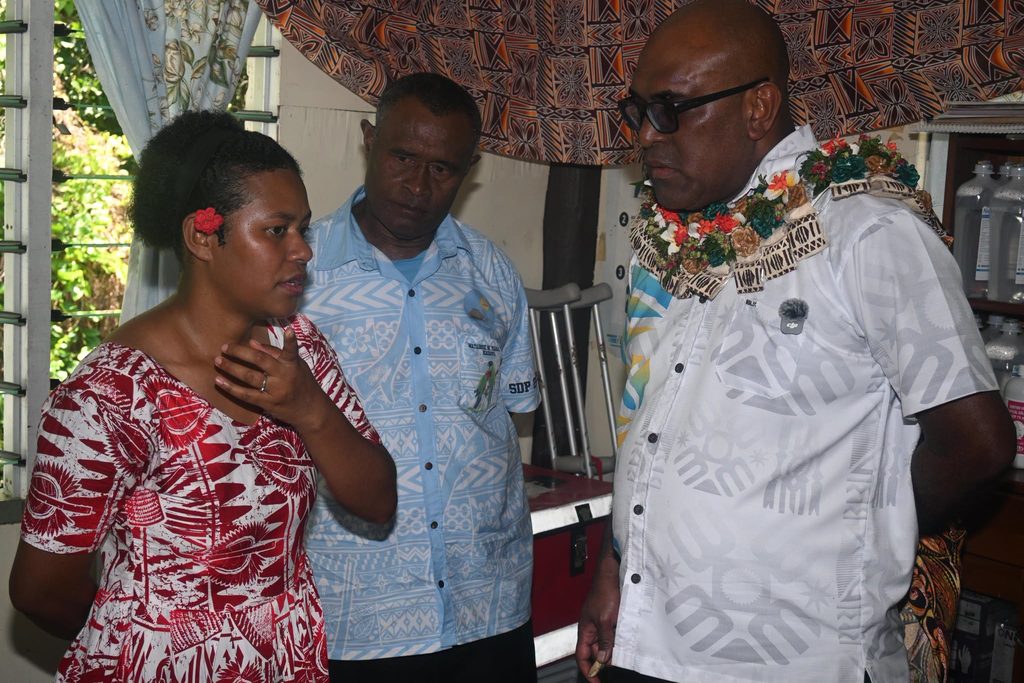
At two o’clock in the morning, when most people are fast asleep, nurse Alowesi Ruci could be found making her way through the darkness with a small rechargeable lamp, responding to a patient in need of medical attention.
In a community where there are no roads and travelling is mostly done on foot and by sea, providing healthcare often means going beyond the walls of a nursing station.
It is part of the responsibility she has embraced over the past three years and six months as the district nurse at Talaulia Nursing Station in Kadavu.
Originally from Lomati Village in Kadavu, with maternal links to Muana-i-Cake, Fulaga, Lau, Ms Ruci looks after four villages with a combined population of 636 people.
Her decision to become a nurse was inspired by her sister, who is also in the profession.
“She motivated me to become a nurse as well. I am grateful to be serving my own community,” she said.
It is a responsibility she does not take lightly, particularly given the challenges of providing medical services in a remote part of the island. Before the recent installation of a solar power system at the nursing station, Ms Ruci depended on small rechargeable Sun King lamps to attend to patients at night.
“It was very difficult, especially when I have to see patients during the night around 2am,” she said.
The solarisation project, delivered under the KOICA-WHO SHAPE Project, has since made a significant difference to her work.
“I am thankful that I have the solar. I am also able to connect my Starlink with this solar system, which makes my work easier. I am also able to provide quality service to all my patients.”
The improved electricity supply has also strengthened communication with medical officers at Vunisea Hospital, allowing her to discuss patient conditions and referrals more easily.
“With the Starlink at hand, it’s very easy, and it also helps to discuss cases with the medical officers,” she said.
But electricity is only one part of the challenge.
With no roads connecting the villages, Ms Ruci often has to walk to patients’ homes or bring them to the nursing station for stabilisation.
Those requiring further medical attention are transported by fibre boat to Vunisea.
Even accessing the nursing station can be difficult because of an unsafe bridge.
“For the last three years, I have cases who fell on the bridge, and even sometimes I have to ask them to crawl,” she said.
The situation has forced her to make difficult decisions, sometimes advising patients to remain at home while she travels to attend to them. She hopes the bridge can be upgraded to make the facility more accessible, particularly for elderly patients and those using wheelchairs.
As she prepares for her next posting at Vuna in Taveuni, Ms Ruci hopes the improvements will also benefit the nurse who takes over her responsibilities.