My last article in this series highlighted changes that were taking place both in the context as well as among key leaders as Fiji embarked on reviewing the “interim” 1990 constitution.
In 1995, when the Constitutional Review Commission that bequeathed Fiji the 1997 constitution was formed, factions had developed hardened positions on a number of issues linked to power and politics in Fiji.
On the Fijian side, Sitiveni Rabuka had his hands full with ethno-nationalists, the Bose Levu Vakaturaga (BLV), the Methodist church, the military and ever-changing new alliances.
His struggles to form government in 1992, the fall of his government in 1994 and subsequent return to power at the 1994 general elections clearly showed that a wider political base was needed in Fiji where, after 1987, the bi-polar political equation that had historically guided Fiji politics had become multi-polar.
Thus, any political party aspiring to take the helms of government needed broad-based support.
On the other side, Mahendra Chaudhry was tenaciously engaged in opposing Jai Ram Reddy’s attempts to participate in the proposed constitutional review process.
To the dismay of watchers who understood the context from the indigenous Fijian perspective, Chaudhry was displaying the very same type of thinking and behaviour that had continually prevented the two major ethnic communities in Fiji from finding common understandings.
This approach might have been advisable at one time, but the context had undergone tremendous change.
Right-thinking leaders at the time needed to acknowledge that the 1990 constitution was born out of political realities and imperatives that existed at that time.
Any review of that constitution had to establish the need for review, the process to be followed and the content of the review or terms of reference.
Rabuka and Reddy had their hands full.
Not surprisingly, Reddy was all for review at that stage while Rabuka was skeptical. In order to understand Reddy’s stance, we have chosen to review some of his more important political pronouncements from that time.
Jai Ram Reddy
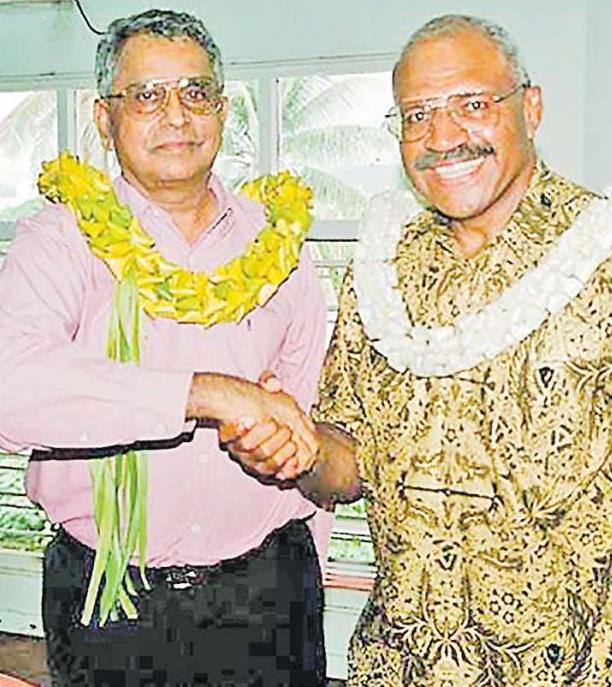
Observers had begun to notice that Reddy was increasingly engaged in enlightening the public on his understandings and proposals for a more inclusive Fiji.
His speeches had an underlying theme and unwavering consistency.
He believed that balanced, inclusive thinking would prevail over shortsighted reactionary politics.
Reddy’s politics had undergone remarkable change as can be seen from the following excerpt from his speech at a GVP meeting in 1993.
“We need a system of government that is based on the consent of the governed, on principles of equality, justice and fair play, that recognises, accepts and reflects the integrity, diversity and richness of the multi-ethnic, multi-religious and multiracial character of our nation,” he said.
“Any other system, that negates the values of tolerance and mutual respect that all our traditions hold dear, is, as history has regularly reminded humankind, doomed to failure.”
In delivering his eulogy at Ratu Sir Penaia Ganilau’s funeral in 1994, Reddy said that during the dark days following the coup of 1987, Ratu Penaia appeared like the only source of authority protecting Indo-Fijians from evil, and dispensing reason, kindliness and compassion.
He added that “it was then, that we began to fully appreciate the breadth of Ratu Sir Penaia’s greatness and his humanity.
He was in a most difficult position himself, torn between his traditional responsibilities and loyalties and the obligations of his office.”
This deep awareness, understanding and acknowledgement was coming from an Indo-Fijian leader who had been immersed in the politics of
adversity and confrontation all his life.
It was coming from an Indo-Fijian leader who had no background in iTaukei culture and traditions.
He had engaged himself in politics with a firm belief in the Westminster system of democracy without seeing the need to contextualise it.
And most importantly, he had come to the realisation that this approach was not only selfdefeating, but detrimental to the socio-political development of the country as a whole.
Using any yardstick, this has to be acknowledged as the emergence of a critical missing piece in the way that Indo-Fijians viewed indigenous Fiji politics.
Ratu Sir Kamisese Mara had walked this tightrope for 17 years.
When he proposed affirmative action for indigenous Fijians in 1973, he was immediately condemned by Indo-Fijians.
When he made concessions to Indo- Fijians in sugar politics, he was vilified by ethno-nationalists.
Here, Reddy was acknowledging Ratu Penaia for having to run the same gauntlet in 1987.
Rabuka also had to reckon with the same throughout his reign until 1999 when he was rejected by the same forces that had propped him up so fervently after the first 1987 coup.
They showed different shades after that, but he was able to retain his precarious hold on power by constantly juggling between the different
interests that hounded him throughout his prime ministership.
Let us now move focus to Rabuka.
Rabuka’s struggles
It has been said before in this series that the Rabuka of 1997 was very different from the Rabuka of 1987.
When the first coup was executed in May 1987, Rabuka was part of a military that was heavily manned by soldiers from rural backgrounds who had very little contact with Indo-Fijians.
The only experience they did have was when they bought things from shops, rode on public transport vehicles or accessed some sort of services such as education or health.
There was no shared language, no meaningful co-existence, interactions were largely transactional.
I know how indigenous Fijian thought because I felt the same when I first visited Suva in 1974.
Indo-Fijians were everywhere!
It was difficult to understand that they were concentrated in commercial centres like towns and cities because their livelihood depended on it.
What was easier to understand was that they outnumbered and overwhelmed us.
The RFMF boys at Delainabua thought the same.
Thus, the coup of 1987 was crucially justified on the basis of this indigenous Fijian fear that Indo-Fijians posed a threat to their very
existence.
After all, the Alliance government had fallen to a coalition dominated by Indo-Fijians.
Any attempts at explaining that this was how democracies worked was doomed to failure. Any attempts at explaining that the 1970 constitution had entrenched provisions that protected the indigenous Fijian heritage was too longwinded.
What was easier and more potent was to stoke the flames of fear.
Fear of a takeover by a foreign community who were supposed to be mere visitors.
After all, they did dominate commerce and the public service, now they had secured political power.
This is what galvanised support for the 1987 coup.
This is what Rabuka carried on his shoulders when he came triumphantly out of that fateful GCC meeting at the Suva Civic Centre.
That was just the beginning of Rabuka’s trials and tribulations.
He ducked and dodged political minefields and attacks consistently until he returned to power in 1994.
That strengthened his hand somewhat, but he still had strident Fijian opposition to contend with both from within the SVT government as well as from outside it.
Indo-Fijian political opposition was not the most important worry he carried at the time.
However, the factional politics that he had been forced to contend with would have matured him tremendously.
Thus in 1994, when Rabuka was tasked with facilitating the constitutionally decreed review of the 1990 constitution, he was faced with
his biggest political hurdle to date.
On the one hand, he had a constitution that already addressed all the concerns of the nationalists and their supporters, while on the other, he presided as prime minister of a multiracial country.
We will focus on his role in the development and promulgation of the acclaimed 1997 constitution in the next article.
• DR SUBHASH APPANNA has been writing occasionally on issues of historical and national significance. This series was triggered by a recent reference to Fijians of Indian Descent as vulagi by an aspiring politician. The views expressed in this article are his alone and not those of The Fiji Times or his employer.