To a family in a remote Papuan village, diplomatic statements made thousands of miles away mean little when the consequences of political conflict are felt every day.
What matters is whether a teacher can reach the classroom, a patient can access medical care, or a community can live without fear.
These concerns lie at the heart of the debate facing the Melanesian Spearhead Group (MSG).
Its leaders must defend the rights and interests of fellow Melanesians while maintaining diplomatic relationships, respecting institutional rules and pursuing outcomes that improve people’s lives.
The issue has gained urgency following the MSG’s August 2026 decisions concerning access for the United Nations High Commissioner for Human Rights to Papua and the possibility of reviewing Indonesia’s associate membership in 2027.
At a special session in Fiji in October, MSG leaders reaffirmed concerns about reported human rights violations and called for stronger political advocacy through constructive engagement and dialogue with Indonesia, while recognising its sovereignty and territorial integrity.
These positions are not necessarily contradictory.
Governments can recognise another state’s sovereignty while demanding accountability for alleged abuses.
The challenge is ensuring regional solidarity produces meaningful results rather than becoming an end in itself.
Solidarity must serve a purpose
The proposed review of Indonesia’s associate membership is a significant diplomatic development.
It signals that concerns about Papua could have institutional consequences if requests for international human rights access remain unresolved.
Supporters of stronger pressure argue that repeated calls for access and accountability must eventually lead to action.
International scrutiny can help establish facts, protect civilians and build confidence in investigations.
However, diplomatic pressure needs a clear purpose.
If the immediate goal is to secure a credible human rights visit, leaders should explain how reviewing Indonesia’s membership would help achieve it and what alternatives remain available.
Maintaining dialogue does not guarantee progress.
Equally, weakening diplomatic relationships does not automatically deliver accountability.
The MSG should judge its options against practical outcomes: access for independent investigators, credible investigations into alleged abuses, protection of civilians and improved conditions for affected communities.
The membership question
The United Liberation Movement for West Papua (ULMWP) presents another challenge.
The ULMWP is a coalition of organisations advocating independence for Papua from Indonesia.
While it has the right to advance the political aspirations of its supporters, its claim to represent the wider Papuan population requires scrutiny.
The movement currently holds observer status within the MSG.
In 2023, its application for full membership was not approved following an assessment by the MSG Secretariat that raised concerns extending beyond administrative requirements.
These included questions about the movement’s representative mandate, institutional capacity and compatibility with the MSG’s principles of sovereignty, territorial integrity and non-interference.
The ULMWP is not an elected representative institution of Papua’s population, whose political views are diverse.
Nor does the existence of the Kanak Socialist National Liberation Front (FLNKS) as a full MSG member automatically establish a precedent for the ULMWP.
New Caledonia remains on the United Nations list of Non-Self-Governing Territories, while Papua is internationally recognised as part of Indonesia.
Before considering any change in the ULMWP’s membership status, MSG leaders should explain how the substantive concerns identified in 2023 have been addressed, what evidence supports the movement’s representative claims, and how such a decision would be consistent with the organisation’s own principles.
History, sovereignty and human rights
Papua’s history remains central to the debate.
The 1962 New York Agreement established arrangements for transferring administration from the Netherlands to Indonesia through a United Nations transitional authority.
The 1969 Act of Free Choice remains controversial, particularly among independence advocates who dispute the extent of Papuan participation.
United Nations General Assembly Resolution 2504 took note of the Secretary-General’s report on the process.
However, that resolution does not mean subsequent human rights allegations can be dismissed.
Equally, historical objections do not mean Papua’s present international status is formally undecided.
Indonesia has a responsibility to protect civilians and investigate credible allegations of abuse by its security personnel.
Human rights reporting has documented allegations of repression, displacement and harmful security operations in Papua, alongside violence attributed to armed separatists.
These claims require careful investigation.
Allegations should not be presented as established findings without evidence, but neither should they be dismissed because they complicate diplomatic relationships.
Armed separatist groups must also be held accountable for attacks affecting civilians.
Violence against teachers, health workers, transport workers and other non-combatants can deprive remote communities of essential services and deepen insecurity.
This requires credible investigations, access to affected communities and accountability for perpetrators, whether they belong to state security forces or armed groups.
Development is not the end of the argument
Indonesia’s record in Papua should also be assessed through evidence rather than political assumptions.
The government has introduced Special Autonomy arrangements and allocated resources for infrastructure, education, healthcare and economic development.
Law No. 2 of 2021 revised the framework, including funding arrangements intended to support public services and community welfare.
Roads, schools, transport links and health facilities can make a significant difference, particularly in geographically isolated communities. But money allocated is not the same as results delivered.
Development efforts should be recognised when they produce practical benefits. At the same time, shortcomings and allegations of harm must be independently examined. Communities need both economic opportunities and protection of their rights.
What should Melanesian leaders do?
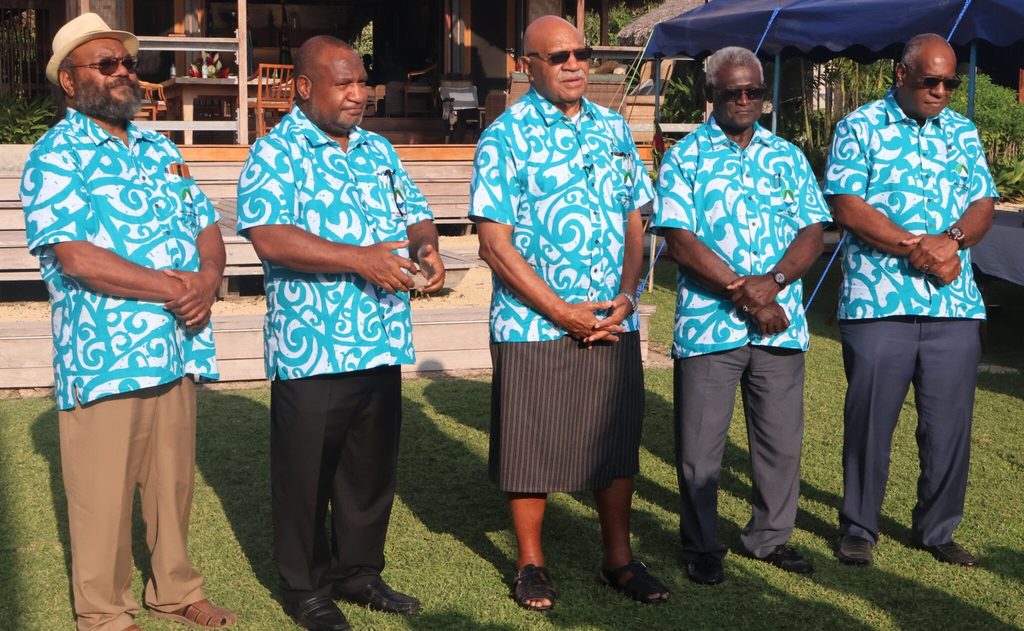
Prime Minister Sitiveni Rabuka, who chaired the October MSG session, faces the challenge of maintaining regional solidarity while protecting the organisation’s credibility and its relationship with Indonesia.
Mr Rabuka brings valuable experience to the task.
As a Commonwealth special envoy, he helped mediate between parties during the Solomon Islands’ ethnic tensions in 1999 and 2000, contributing to peace agreements and ceasefire efforts.
His Ocean of Peace concept, proposed in 2023 and endorsed by Pacific leaders in 2025, offers another framework for Fiji’s contribution.
Built around dialogue, reconciliation, respect for sovereignty and peaceful dispute resolution, it provides an opportunity to translate regional principles into practical diplomacy.
The MSG could draw on Mr Rabuka’s mediation experience to encourage constructive engagement over Papua, without abandoning pressure for human rights accountability.
Papua New Guinea, Solomon Islands and Vanuatu also have important interests in the issue.
The MSG must establish clear objectives, explain its membership decisions and measure progress on human rights access and civilian protection.
The 2027 MSG summit will provide an opportunity to assess whether its approach has delivered results.
Ultimately, the challenge is to ensure regional solidarity and diplomacy serve the people whose interests they are meant to protect.
Sources: Melanesian Spearhead Group Secretariat, official statements on the August 2026 Leaders’ Decisions and October 2026 Special Session; Commonwealth Secretariat, historical records on Prime Minister Sitiveni Rabuka’s appointment as Special Envoy during the Solomon Islands peace process (1999–2000); Fiji Ministry of Foreign Affairs, PM Rabuka’s Ministerial Statement: The Proposal of the Ocean of Peace (August 5, 2024) and Ocean of Peace Declaration Endorsed at Pacific Leaders Meeting in Honiara (September 11, 2025); United Nations General Assembly, Resolution 2504 (XXIV) (November 19, 1969); Human Rights Watch, World Report 2026: Indonesia; Republic of Indonesia, Law No. 2 of 2021; ABC News reporting on the MSG’s 2023 decision concerning the ULMWP membership application; Melanesian Spearhead Group Secretariat, Assessment of the Application for MSG Membership by the United Liberation Movement for West Papua (SOM 02 (23).08, August 19, 2023).