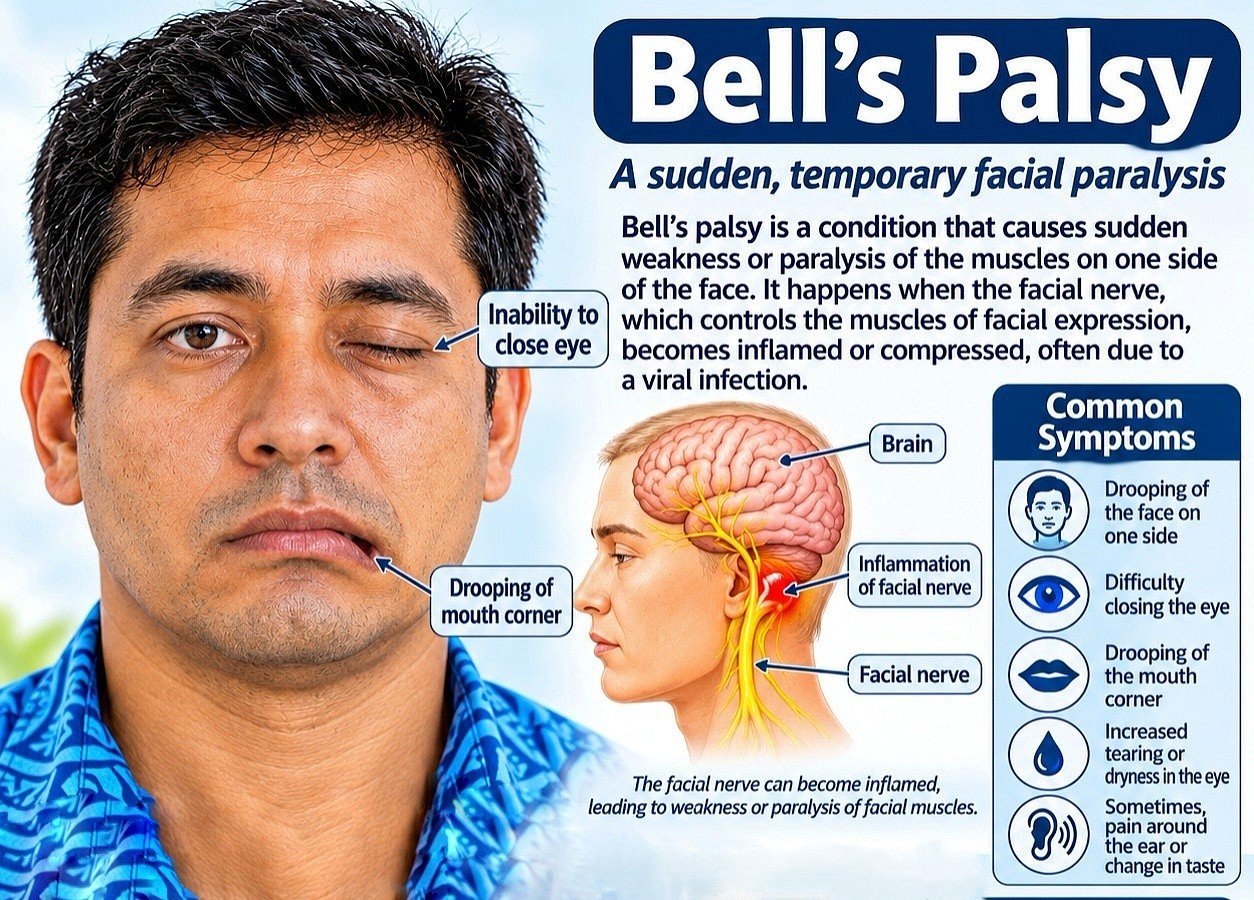
A person may wake up one morning to find one side of the face suddenly different. The smile is uneven, drinking becomes difficult as liquid escapes from one corner of the mouth, the eyebrow may not move normally, and one eye may not close completely.
One possible explanation is Bell’s palsy, a condition caused by dysfunction of the seventh cranial, or facial nerve, resulting in sudden weakness or paralysis of muscles on one side of the face. Bell’s palsy is relatively common internationally, with an estimated annual incidence of around 20–30 cases per 100,000 people. But Bell’s palsy is not only a facial problem. It can become an eye-health problem.
When the facial nerve is affected, the muscles responsible for eyelid closure may also become weak. This can cause lagophthalmos — incomplete closure of the eye. Without adequate protection, the exposed eye may become excessively dry and irritated and in serious cases, develop exposure keratitis, corneal ulceration, scarring and potentially permanent visual impairment. For this reason, a drooping face should never be viewed simply as a cosmetic concern.
The eye can become the vulnerable target
The cornea — the transparent front surface of the eye — depends on a healthy tear film and regular blinking to remain clear and protected. Facial paralysis can interfere with blinking and eyelid closure, leaving the cornea exposed to air for prolonged periods.
Early symptoms may include:
- Dryness or a gritty sensation
- Excessive watering
- Redness
- Burning or irritation
- Sensitivity to light
- Blurred or fluctuating vision
- Difficulty closing the affected eye, particularly during sleep
These symptoms should not simply be dismissed as a normal part of facial weakness. Thus the clinical guidance recommends protecting the eye when Bell’s palsy interferes with eyelid closure.
Protecting the cornea while the facial nerve recovers can prevent a temporary neurological problem from becoming a serious ocular complication.
Why Fiji should pay attention
For Fiji, Bell’s palsy should be considered within the broader goal of improving timely access to eye care.
The World Health Organization has emphasized that eye health should be integrated into health systems rather than treated solely as a specialist service. Its Western Pacific programme highlights comprehensive, people-centred eye care and stronger links between communities, primary care and appropriate referral services. This is particularly important when a condition begins outside an eye clinic but can quickly create an eye complication.
A person with sudden facial weakness may first visit a general practitioner, emergency department, health centre or other primary-care service. While determining the cause of the facial weakness is important, healthcare professionals should also establish whether the affected eye closes completely and whether the cornea is adequately protected.
That simple observation can be clinically important.
In Fiji, where some people may live considerable distances from specialist services, early recognition at the first point of contact can help identify patients who require urgent eye assessment before significant corneal damage develops.
Bell’s palsy is a diagnosis — not a label to apply automatically
Not every case of facial paralysis is Bell’s palsy.
Bell’s palsy is generally suspected when there is acute, one-sided facial weakness involving the forehead without other neurological abnormalities. However, stroke, infections, trauma, tumours and other disorders affecting the facial nerve or nervous system can also cause facial weakness.
This distinction matters.
A sudden facial droop accompanied by symptoms such as weakness or numbness of an arm or leg, difficulty speaking, confusion, severe imbalance, loss of consciousness or other acute neurological changes requires emergency medical assessment rather than assuming it is Bell’s palsy.
Time matters for both the nerve and the eye
Bell’s palsy often improves, and many patients eventually recover substantially or completely. However, recovery is not always immediate, and some patients may experience persistent facial weakness or other long-term effects. Medical assessment is therefore important early in the condition.
Clinical guidelines suggest that corticosteroid therapy is suitable for adults diagnosed with Bell’s palsy, especially when it can be initiated within 72 hours after the symptoms appear. Decisions regarding treatment should always be made by a qualified healthcare professional after evaluating the specific needs of the patient.
At the same time, there is another clock running—the ocular clock.
While the facial nerve is recovering, the cornea still requires protection every day and every night. Eye assessment should therefore not be considered optional when the eyelid does not close properly.
What should patients do?
Anyone who develops sudden facial weakness and cannot fully close one eye should seek medical assessment promptly.
Patients should tell their healthcare professional if:
The eye does not close completely
The eye feels dry, painful or gritty
Redness is increasing
Vision becomes blurred or reduced
Bright light becomes uncomfortable
The eye is watering excessively
Symptoms are worsening rather than improving
Patients should not improvise with non-prescribed eye medicines, particularly steroid-containing eye drops. Appropriate treatment depends on examination of the eye and the underlying diagnosis.
If significant corneal involvement is suspected, timely assessment by an eye-care professional is important.
The night-time problem people often overlook
One of the most overlooked aspects of facial paralysis is what happens during sleep.
During the day, a patient may consciously blink or attempt to close the eyelid. During sleep, however, the affected eyelid may remain partially open for hours, allowing the corneal surface to dry.
Professional guidance for facial nerve palsy emphasizes intensive ocular-surface lubrication and, where appropriate, measures to help the eyelids remain closed during sleep. Some patients may require additional specialist intervention when conservative measures are insufficient.
Therefore, an eye that “looks mostly fine” is not necessarily a safe eye.
The public-health lesson
Bell’s palsy may not always be preventable, and not every patient will develop a serious eye complication. However, damage to an inadequately protected cornea is potentially avoidable when incomplete eye closure is recognized and managed promptly.
The lesson for Fiji is simple:
A face that suddenly becomes weak deserves medical attention. An eye that cannot close deserves immediate attention to eye protection.
As Fiji continues to strengthen integrated and accessible eye-care services, Bell’s palsy reminds us that protecting vision is sometimes not about treating a disease that began in the eye. Sometimes, it begins by recognizing a problem elsewhere in the body—and understanding how quickly that problem can threaten sight.
WHEN TO SEEK URGENT HELP
Seek emergency medical assessment immediately for sudden facial weakness accompanied by arm or leg weakness, difficulty speaking, confusion, severe imbalance or other sudden neurological changes.
Seek prompt eye and medical assessment when facial weakness prevents complete eyelid closure, particularly when there is eye pain, marked redness, increasing light sensitivity or reduced/blurred vision.
Do not wait for facial weakness to recover before protecting an exposed eye.
In eye health, prevention is often measured not by what treatment is given after damage occurs, but by whether that damage was prevented in the first place.
For a patient with Bell’s palsy, protecting the eye from the first day can be just as important as treating the face.