The real cost of delayed public infrastructure is not simply about inefficiency; it is about lost opportunities for unlocking the multiplier effects that drive economic growth, broaden the tax base, and create the conditions for the private sector to mobilise at scale.
Last week’s Tourism Talanoa piece examined the pressure side of Fiji’s tourism growth: record arrivals of 105,791 in July alone, a genuine room pipeline responding to demand, and infrastructure in the country’s busiest tourism corridor that, in several documented cases, is past its use-by date.
This week shifts from observation to a harder question: when Government identifies these gaps and announces funding to close them, how far does that announcement travel toward actual delivery?
Four publicly documented cases suggest the answer is: nowhere far enough. And to be clear from the outset, this is not about any single ministry, agency, or official. It is about delivery capability across the system — because without it, the foundations of Fiji’s tourism and other diversified sectoral growth risk falling behind the very momentum they are meant to support.
First, Nadi’s flood alleviation program. The Nadi Chamber of Commerce says it has sought updates on the project for more than four years, across two administrations, without seeing physical progress on the ground, and this has made it difficult for Nadi businesses to obtain flood insurance. $400 million is reported to have been secured for the work, following commitments and reports from JICA stretching back to the 1990s. The program was formally relaunched in March 2026 with a new $35 million Australian grant, though it is not yet clear this has translated into work on the ground.
Denarau’s wastewater situation follows a similar shape. In 2023, the Tourism Ministry, the Water Authority and Denarau Corporation reached an agreement with an original 2024 to 2026 completion timeline. Current reporting places the project roughly two years from completion, well beyond that original window, with three main bursts publicly recorded across the last six or seven months. The Navakai treatment plant sits at the centre of this case, with public announcements made that the plant is constraining development in the catchment area that extends from Denarau to Wailoaloa. However, in this instance, we have recently been reliably advised that with a temporary sewer line now in place for Denarau, an upgraded, repositioned treatment plant will be operational sooner.
The Nadi–Lautoka water supply tells a quieter version of the same story. An $8.3m trunk main was scheduled for completion in December 2024, yet public reporting offers no confirmation – either way – of whether that deadline was met. The corridor is already carrying an estimated shortfall of 5.4 megalitres per day, on mains that went 64 years without substantial upgrades before current works began. A missed date left unacknowledged and uncorrected becomes its own quiet example of the delivery gap that runs through these case studies. And if you have been to the West recently – from Wailoaloa, Votualevu, to the Vuda/Saweni corridor, including the airport surrounds and Nasoso – you will have seen the sheer scale of construction underway for tourism, commercial, and residential development. All of those construction sites — planned or already underway — have some water or waste management challenges to share, were you to enquire.
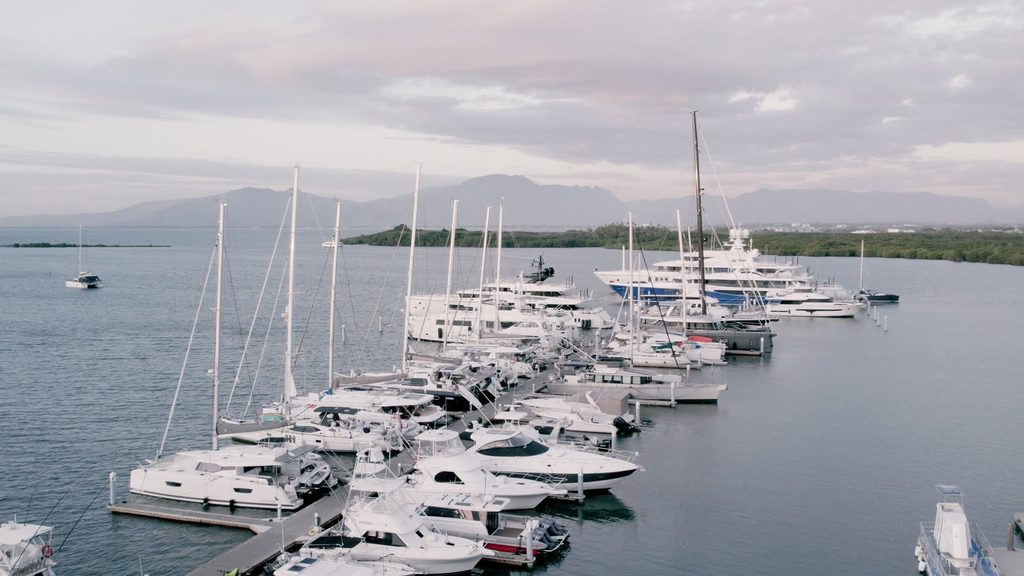
The Denarau Marina channel closes this list, and might be the starkest of the shared challenges, resting entirely on public statements promising delivery with an unambiguous timeline despite that channel being Fiji’s largest gateway for tourism marine traffic. With $5.5m allocated in October 2024, the Denarau Channel is not just a local infrastructure concern. It is a national tourism and economic risk. Unresolved dredging challenges are undermining navigational safety for a critical marine link for connections into the Mamanuca and Yasawa Islands for tourism and communities in the area — stalling high-value investment, exposing government liability, and eroding Fiji’s global reputation.
We know government revenue must expand and diversify, yet the marina’s $6m superyacht mega berth remains underutilised. The channel’s increasing shallowness from built-up silt prevents vessels up to 115 metres from entering, effectively turning away high-revenue opportunities. Each vessel denied access represents lost customs duties, taxes, crew expenditure, tourism spend and significant supply chain trickle effects. Precisely the streams Fiji needs to strengthen its fiscal position.
It would be convenient, inaccurate and unfair to treat these four cases as evidence of simple neglect or apathy. Government’s own diagnostic work points to something more structural. Both the Public Financial Management Improvement Plan and the 2025 PEFA assessment identify underspending and weak project monitoring as systemic risks. What we are highlighting is therefore not new, but a recognised pattern already flagged in public sector assessments. The harder question is why projects most directly tied to the country’s fastest-growing foreign exchange earner are not being tracked and delivered with urgency. Because when public sector support accelerates turnaround, the benefits are immediate: critical job creation, stronger tax collection, higher customs and tourism revenues, and greater private sector confidence to scale up investments. In short, faster delivery is not just about closing infrastructure gaps – it is about unlocking the multiplier effects that lift Fiji’s growth beyond the current growth ceiling we appear to be stalled at.
The cost of that gap might also be of interest, using only the marina channel risk. Fiji’s yacht sector generated an estimated $57.4m in 2025 – a 14 per cent increase on 2024’s record year of $45.5m. The $5.5m allocated to the channel that yacht traffic depends on works out to roughly five and a half weeks of that sector’s annual spending. Put another way, the private sector has already invested more in the mega berth at the end of that channel than the public sector has been asked to spend on the channel reaching it.
When the enabling piece of infrastructure costs a fraction of what the private investment built on top of it already generates in a matter of weeks, the case for prioritising it stops being a matter of goodwill and becomes a fairly simple return on investment question. And before anyone asks why the private sector has not therefore gone ahead and done the dredging themselves — the answer is also simple. Because many years ago, government saw fit to take over the channel ownership. Enough said!
None of these reflections is an argument that someone somewhere is deliberately allowing construction to proceed despite known capacity limits. This is a pattern already visible in public statements, funding announcements and dates that have since passed unremarked.
Fiji’s tourism sector is expanding at a remarkable pace that the nation’s public sector often appears blissfully unaware of, with new room supply responding to demand and airline capacity keeping pace with global markets.
The supply chains building from scratch or expanding alongside this phenomenal growth include manufacturing, construction, transport, food and beverage supplies, training institutions, bars and restaurants, activities and experiences, housing, retail, IT and engineering services.
The employment opportunities for all these follows by default. Yet this growth can only be sustained if the water, wastewater, power, and road systems beneath it are renewed on timelines that match the announcements. Across four independently documented cases, the gap between announcement and completion is widening.
These delays and the ensuing costs of lost productivity are significant. They are the very bottlenecks holding back critical deliverables that would unlock private sector investment at scale. Without timely infrastructure alignment, Fiji risks capping its economic trajectory at the current 2-3 per cent annual growth, instead of mobilising the private sector to drive the higher, more resilient growth that can be delivered.