Fiji’s youth population constitutes about 54 per cent, most of whom are in secondary and tertiary education. Of these, female participation in tertiary education is almost comparable to male counterparts.
Over the past few weeks, the public, including the youth population, has gained better insights on governance issues surrounding the University of South Pacific (USP).
Therefore, youths around Fiji and other Pacific Island countries are fully aware of the role of key stakeholders that have staged the suspension of the vice-chancellor.
I have argued on 13/06 and 17/06 that the Minister of Education, Heritage and Arts, the pro-chancellor and the Fiji Higher Education Commission (FHEC) have failed to ethically intervene and address the governance challenges at USP.
In my view, the youth population have played a critical role in the electoral victories of FijiFirst party. The minister’s lack of intervention is therefore jeopardising Fiji First’s electorate come 2022.
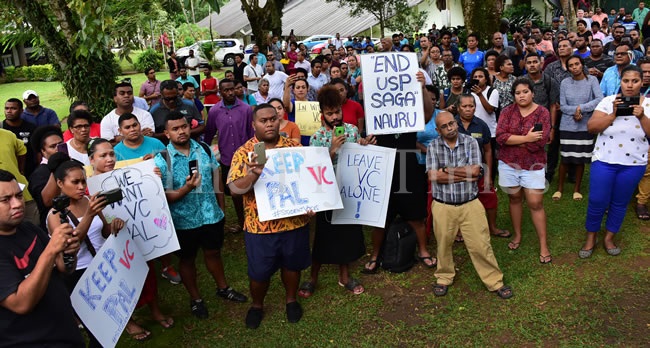
There is clear evidence to suggest that students want to see the vice-chancellor reinstated and the pro-chancellor removed.
On this basis, the youth would view the minister as having failed on both educational and political grounds.
On educational grounds, uncertainty in COVID-19 environment has put more pressure on students about continuity of quality education and support.
During this time, students need more support – many of whom are under a lot of stress because of job loss, distance from university and other social pressures.
It is important to note, that the suspension of the VC has happened one week before the final exam or assessments.
Therefore, pressure and anxiety related to examination have increased stress levels on students, many of whom are concerned about university governance more than other stakeholders.
The student protests which took place before and during examination week are a testament that students would like the council and minister to resolve the governance challenges immediately.
Similarly, on political grounds, youths have played a critical role in supporting FijiFirst party’s victory in the last election.
Yet, while the Government has witnessed student protest and is aware of their concerns, they have failed to recognise the voice of their electorate.
I have also alluded that Fiji Higher Education Commission has failed on their role. FHEC is funded by the Government.
If FHEC’s quality audit and re-accreditation processes were rigorous, some of issues surrounding the governance and management at USP may have been picked up in cyclical audit/reviews.
More worryingly, there is so far no statement by the FHEC on USP’s governance issues despite its role in regulating higher education institutions.
The key stakeholders need to address the governance issues at USP. Further failure to intervene would have significant impact on future funding and ongoing relationship with member countries.
USP is at the cross-road of either losing its renowned identity or building resilience from the current difficult experience.
Whatever transpires in coming weeks, the future of USP as a centre of academic excellence in the South Pacific is at risk.
- Mahsood Shah is a professor and Dean at Swinburne University of Technology, Australia. Readers can contact Mahsood at shah_mahsood@hotmail.com. The views expressed in this article are his own and not the views of university he works for or of this newspaper.