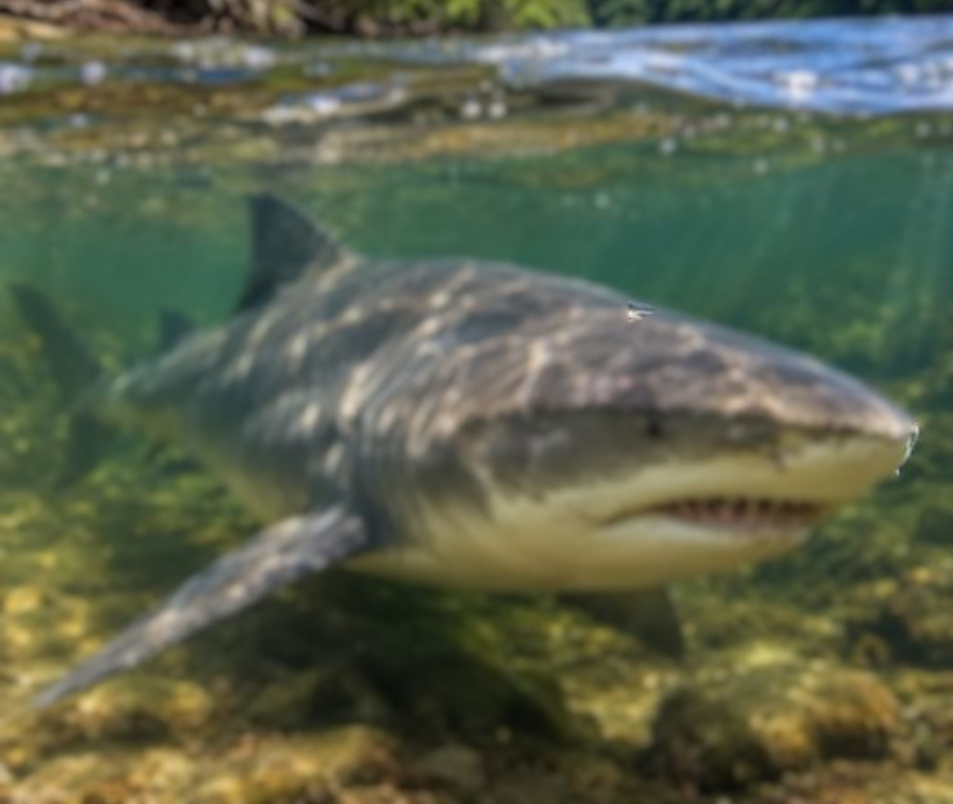
Bull sharks are expected to move further inland into Naitasiri’s rivers as their breeding season approaches, prompting the Ministry of Fisheries to urge communities to exercise caution when swimming, fishing and bathing in waterways.
The warning follows a recent shark incident in Naitasiri, as reported by The Fiji Times last week, in which a man was injured.
The Ministry said investigations into the incident were continuing and cautioned against speculation about the circumstances.
It explained that the presence of sharks in rivers such as the Wainimala and Waidina was a natural seasonal occurrence, particularly during the summer months.
According to the Ministry, bull sharks are among the few shark species capable of surviving in both saltwater and freshwater.
They can travel dozens of kilometres upstream, with verified captures recorded as far inland as Vunidawa in the Wainimala River.
The Ministry said adult female bull sharks typically leave coastal reefs and enter Fiji’s river systems between December and February to give birth.
Research conducted by the University of the South Pacific (USP) found that bull sharks dominate Fiji’s upper freshwater river systems, while critically endangered scalloped hammerhead sharks use lower estuaries and brackish waters as nursery grounds.
A survey conducted between 2016 and 2018 recorded 172 sharks across the Rewa, Navua and Sigatoka rivers.
More than 74 per cent were newborn sharks with open umbilical scars, most of which were caught during the summer months.
The Ministry said research by the Fiji Shark Lab and USP also tracked pregnant female bull sharks travelling from the Shark Reef Marine Reserve in Beqa Lagoon to the Rewa River to give birth.
It explained that the Rewa River system, including its tributaries in Naitasiri, served as an important nursery for young sharks.
Newborn bull sharks, measuring between 61 and 95 centimetres, use shallow and murky river waters for shelter from larger predators.
The river systems also provide food, including freshwater fish, eels and crustaceans.
Despite their presence in inland waterways, the Ministry stressed that shark attacks remained extremely rare.
It said local fishers had long reported sightings and accidental catches of bull sharks, particularly during the summer months.
The Ministry cited reports of bull sharks being caught in the Wainimala River at Vunidawa in December 2019, when village elders described their seasonal presence as normal.
However, the Ministry urged communities to take additional precautions between November and March, when shark activity in rivers may increase.
Residents have been advised to avoid swimming or standing in muddy and low-visibility water, particularly after heavy rain or flooding.
The Ministry also warned against wading waist-deep near river mouths and deep river bends.
People have been urged to avoid swimming near areas where fish are being cleaned, fish waste is discarded or fishing nets are being used, as blood and struggling fish can attract sharks.
Parents have also been advised to closely supervise children near river mouths, estuaries and tidal sections of rivers.
The Ministry encouraged communities to report unusual shark sightings to assist with monitoring.
It also warned against setting gill nets across river channels because they can trap and kill newborn sharks.
The Ministry said sharks played an important role in maintaining healthy river, estuarine and coastal ecosystems.
It stressed that awareness and precaution, rather than fear, were essential for communities living alongside waterways.
The Ministry said it would continue monitoring shark reports and working with relevant partners to improve public awareness and understanding of shark behaviour.