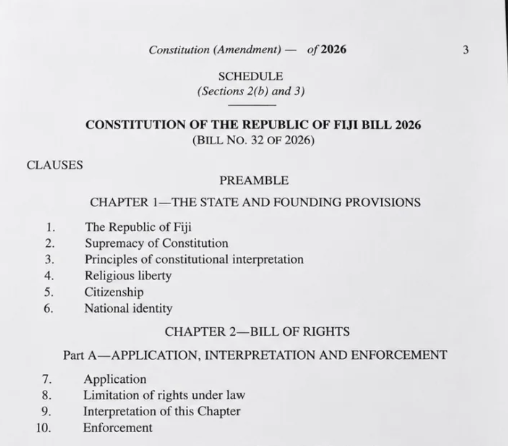
A Centre for Democracy & Dialogue analysis has warned of a potentially serious constitutional gap if Fiji’s proposed Constitution is brought into force after the current Parliament expires but before the next general election process formally begins.
The analysis by Nilesh Lal says there is no clear provision in the draft Constitution allowing the Government to simply cancel the 2027 general election and remain in office until 2028.
However, Lal identifies the period after Parliament’s term expires on December 24, 2026 and before an election writ is issued as the most problematic scenario.
“The constitutional problem is this. Section 219 applies to ‘the Parliament in existence immediately before the commencement’. But Parliament has already expired. There may therefore be no Parliament for section 219 to transition,” he states.
At the same time, section 221 of the proposed Constitution provides for the Prime Minister and other ministers under the 2013 Constitution to continue under the new constitutional arrangement.
Lal warns this could result in an unprecedented constitutional situation.
“Put simply: Parliament could disappear, while Cabinet survives,” he said, describing the period between December 24 and 31 as the “most risky”.
The analysis also questions whether the President could legally use section 211(3) to bring the proposed Constitution into force earlier than its stated commencement date of March 31, 2028.
Lal argues the provision creates a circularity because the President’s early-commencement power is itself contained in the new Constitution that does not come into force until March 31, 2028.
“There is an even simpler solution: remove section 211(3),” the analysis states.
It argues removing the provision would eliminate the uncertainty and ensure the next general election proceeds under the existing constitutional framework before the proposed Constitution takes effect.