THE woven mat is familiar to every iTaukei household.
But for Bulou Boteiova it represents far more than a traditional object.
It represents generations.
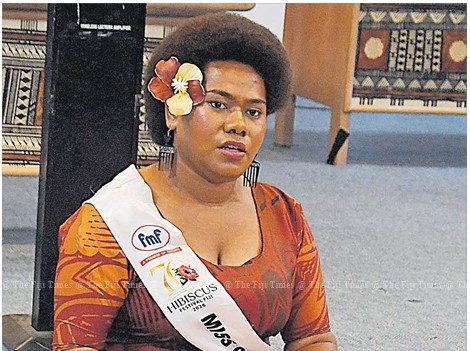
Using the private judging of the 2026 Miss Hibiscus Festival to shine a light on Fiji’s fading language and culture, the Miss Playland Fantasy sponsored Yasawa native called on every young Fijian to become custodians of the language, knowledge and traditions inherited from their elders
She used the mat – and the individual strands woven into it – to illustrate what she believes is at stake as Fiji’s indigenous language and traditional knowledge face the pressures of modernisation.
“One strand represents our ancestors, one our elders, one our generation and one our children and future generations,” she explained.
For Bulou, the strength of the mat lies in the strength of every strand.
And she believes the same principle applies to culture.
Her presentation placed a spotlight on an issue that can sometimes be overshadowed by tourism and rapidly changing lifestyles. How can the country modernise without allowing its indigenous identity to fade with it?
The answer begins with language.
Vosa Vakaviti, she argued, is not simply a means of communication. It carries history, relationships, values, stories and the iTaukei connection to the vanua.
But as English continues to dominate many aspects of education, business, government, media and popular culture, Bulou questioned whether young Fijians were becoming increasingly disconnected from the language of their own grandparents.
“Imagine a young iTaukei child growing up knowing how to speak English fluently, knowing the latest songs and trends from around the world, but struggling to understand the language spoken by their own grandparents.
“That child may know the world, but do they still know where they come from?
“For me, this is why the preservation of the iTaukei language and traditional knowledge matters.”
International issue
That concern comes at a time when the preservation of indigenous languages has become a growing international issue, while Fiji is also taking steps to strengthen the protection and revitalisation of its own cultural heritage.
In February 2025, Cabinet endorsed Fiji’s National Action Plan on the International Decade of Indigenous Languages, with the stated aim of supporting the revival, restoration and preservation of indigenous languages, including iTaukei.
Government also announced work toward an iTaukei Language Commission policy framework, signalling a more coordinated approach to strengthening the language.
Speak your language
For Bulou, such efforts are important, but preservation cannot remain the responsibility of government alone.
“Speak iTaukei at home,” is among the practical actions she encourages young people to take.
“Globalisation gives us opportunities to communicate with people around the world, and that is something we should embrace. But becoming global citizens should not mean becoming disconnected from our roots. As young people, we can make a difference through simple actions: speaking iTaukei at home, learning the meaning behind traditional words and expressions, encouraging children to speak the language, and being proud of using Vosa Vakaviti.
“We should never be embarrassed by the language that tells our story.
In fact, Bulou argues that the modern world can become one of the strongest tools for preserving culture.
Fiji’s young people are among the country’s most digitally connected generation. Rather than allowing technology to replace traditional knowledge, she believes it can be used to record, teach and promote it.
The emergence of digital initiatives such as the iVolavosa language application demonstrates how technology can become part of that effort.
The application, developed through the Ministry of iTaukei Affairs, Culture, Heritage and Arts and the iTaukei Trust Fund Board, provides digital language resources, including thousands of words and audio entries.
For a generation that increasingly learns through smartphones, putting the language into a digital space could help make it more accessible.
Living libraries
But Bulou was careful not to suggest that an application alone can save a culture.
Because language is only one strand.
Traditional knowledge is another. Fishing methods, food preparation, weaving, carving, chants, dances, ceremonies, stories and the use of medicinal plants are among the many practices passed down through generations.
And much of that knowledge has traditionally depended on one simple thing: People talking to people.
“If young people stop listening, learning, and practicing, some knowledge may eventually disappear.
“This is why our elders are not simply older members of our communities.
They are living libraries – we should sit with our grandparents and elders. Ask them about our village history, learn our traditional names, stories, customs, protocols, and knowledge. Pass that knowledge on, because when an elder passes away, we may lose more than a person. We may lose a piece of knowledge that can not easily be replaced.”
Asset for the future
The Government’s efforts have increasingly recognised that cultural knowledge also needs stronger protection.
Work has progressed on a proposed Traditional Knowledge and Cultural Expression Bill, aimed at providing greater recognition and protection for traditional knowledge and cultural expressions.
At the same time, Fiji’s Indigenous Tourism Framework for 2026–2036 has placed greater emphasis on iTaukei participation, leadership and ownership in tourism, while recognising the importance of safeguarding culture, the vanua and the environment.
These developments reflect a wider shift in how indigenous culture is viewed.
Keep it alive
For Bulou, however, the responsibility remains deeply personal – and generational.
Young people, she says, stand at a unique point between the elders who carry traditional knowledge and the children who will eventually inherit it.
They can embrace globalisation without abandoning their roots, speak English and still speak Vosa Vakaviti, use social media and still learn traditional songs, embrace technology and still respect traditional knowledge.
And they can travel the world without losing their understanding of home.
Bulou closed her presentation by referring to a lantern, to bring her message together.
It was a symbol of knowledge and cultural guidance – a light that has been passed from one generation to another.