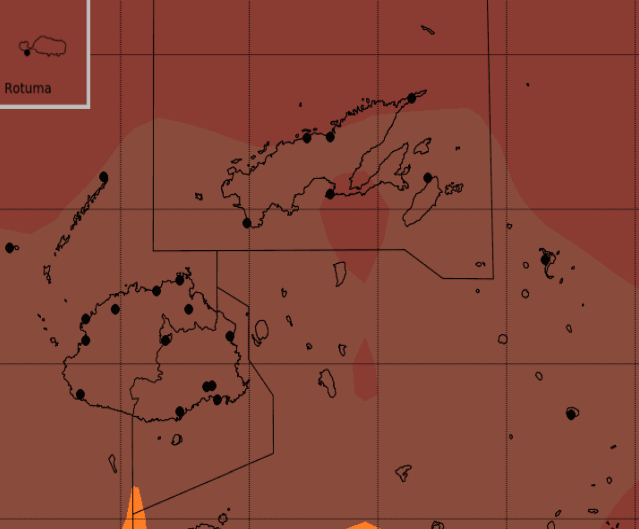
Fiji faces a prolonged period of very dry weather, with forecasters warning of a very high chance of below-normal rainfall across the country until December.
The Fiji Meteorological Service, in its Early Action Rainfall Watch issued on October 15, says very dry conditions are expected across most of the Fiji Group over the next two weeks and throughout October.
The outlook comes as El Niño conditions are underway, raising concerns about potential impacts on water supplies, agriculture and rural communities.
“For 15th to 28th October, there is a very high chance of Very Dry conditions across the Fiji Group,” the report states.
The exceptions are the southern half of Kadavu and Ono-i-Lau, where the likelihood of very dry conditions remains high.
For October, the outlook indicates a very high chance of very dry conditions nationwide, except at Makutu, where the probability is classified as high.
The forecast for October to December 2026 also indicates a very high chance of very dry conditions across Fiji.
However, the report notes that dry conditions could gradually ease as the country transitions into its traditional wet and tropical cyclone season.
“Dry conditions may start to ease with the slow onset of the typical wet season, as we transition into the TC/Wet Season.”
The Early Action Rainfall Watch identifies several water sources and agricultural crops that could be affected by prolonged rainfall deficiencies.
Over a three-month period, rainwater tanks, small streams, hand-dug wells and shallow bores are among the water sources potentially vulnerable to dry conditions.
Agricultural activities that could be affected include young sugarcane, traditional vegetables such as bele, cabbage, beans, eggplant, okra, tomatoes, watermelon, rice, yam, taro and cassava.
If dry conditions persist for six months, the potential impacts could extend to small rivers, boreholes, mature sugarcane and crops including corn, pineapple and pawpaw.
Longer-term rainfall deficiencies could affect major water storage systems, reservoirs, dams and perennial crops such as coconuts, breadfruit, mangoes, kava and bananas.
The report cautions that the severity of impacts will vary depending on island size, topography, geology and soil conditions.
The Early Action Rainfall Watch is designed to help the National Disaster Risk Management Office and disaster management agencies anticipate potential impacts and prepare appropriate responses.
The outlook highlights the importance of monitoring water availability and agricultural conditions as Fiji approaches the traditional wet season.