GROWING up in Fiji, a cup of layalaya often awaited each of us at breakfast, made by our Bubu Wati (grandmother) without fail. This ginger-like root was traditionally taken in our family for everyday ailments like colds and upset stomachs.
If we cut ourselves or grazed a knee, Bubu would crush leaves from the backyard, like wabosucu (mile-a-minute), into a remedy for the wound. In our family, wabosucu was a go-to for surface cuts and grazes and insect stings. (For a deep or slow-healing wound, see a nurse or doctor.)
Every week, we each had a bobo (traditional deep-tissue healing massage). Bubu used it to heal the injuries we’d endured that week, and to find the ones that weren’t obvious.
She’d spot a sore shoulder even if you were hiding it so you wouldn’t be kept in from playing. The bobo hurt, but we were back to 100 per cent before we knew it.
I don’t remember being sick much as a child. Whether that was the layalaya, the food, or simply being so loved, I’ll never know.
I’m not the only one though. Everyone I know who grew up here lived this way, with the same home-grown remedies that they credit with keeping them well.
The food had its own story. Bubu Wati’s husband, my paternal grandfather, hailed from Guangzhou, China. He was a gifted cook who ran a series of cafes in Suva and made sure he fed his family well.
What we didn’t realise is that this was support. Bubu Wati, who hails from Ketei in Totoya, Lau, would have laughed at the word, because support is just how we are in our families and communities. We live multi-generationally, and we show up because that’s who we are as a people.
And nowhere is it clearer than when a baby is on the way.
The women people turned to
In our communities, older or experienced women have long helped other women and families through pregnancy, birth and the weeks after. In the stories shared with me, some had a community nursing background, and others simply had the experience with their own families. They were the ones people turned to.
My maternal grandmother, our Nana Peggy, was one of those women. She was a leader in the isolated timber-mill communities where my grandfather worked, including Nadarivatu in the interior of Viti Levu in the 1940s.
She was a cook and a baker, practically a community nurse dressing wounds from accidents at the timber mill, and she helped mothers with their newborns. She taught women how to cook and care for their families, and she played the piano accordion at gatherings, to provide some fun entertainment for the community.
I can see the impact she made: I still meet people today who share fond memories of her.
I saw it again with the birth of each of my children. My parents, siblings and cousins were just there, holding the baby while I grabbed a bite to eat, settling a child to sleep, or helping with something so I could focus on what I needed to do to recover and thrive. We say it takes a village to raise a child, and by that we mean community: the relatives, neighbours, church family and friends around a family.
Where I grew up, that was never a figure of speech. People turned up, folded the washing, cleaned the kitchen, and did it without a second thought, because they knew how much the little things help.
Where a doula fits
The word doula may be new to many people here, but the care behind it is familiar. It is what the older women in my family and community did, and a doula is an extension of that community.
A family’s community knows them, loves them, and shows up for them. After 26 years in the room with families, I’ve seen how differently the first days and weeks after a baby arrives can go. Some are smooth, some are hard, some are unexpected. As a perinatal support professional, I help families navigate pregnancy, birth, breastfeeding and postpartum, standing alongside them so they’re not doing it alone.
What the research says
I’ve seen what experienced support does for mums and dads. Researchers have looked at the wider question of support too. In 2026, a review of 77 earlier reviews, covering more than 25 million women, listed not having social and family support among the factors linked to postpartum depression.
That doesn’t mean a mum surrounded by love won’t struggle. Many still do. But it fits what I saw growing up: people showed up for mums with newborns, and it mattered.
Wherever we are
Some of the families I hear from are a long way from home. For many Pacific Islanders, a sense of home follows us across any distance.
Wherever we live, it’s normal to seek people who understand us, where we come from, and who we are. So when a fellow Pacific Islander calls, I’m humbled because I know they have great options where they are.
Whoever you are, whether you are sixteen or forty, with your first baby or your fifth, with a partner or on your own: nobody in Bubu Wati’s or Nana Peggy’s care did this alone. You were never meant to either.
If you’re pregnant, about to give birth, or finding your feet with breastfeeding or postpartum life, find me on Facebook at Pacific Doula Services Pte Ltd.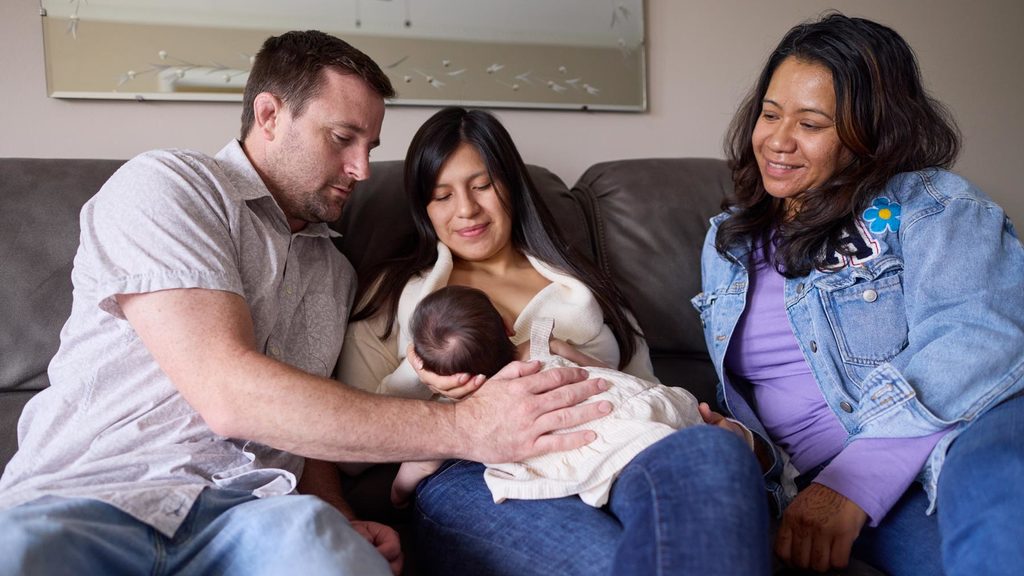
Picture: delcofamilyvillage.org