
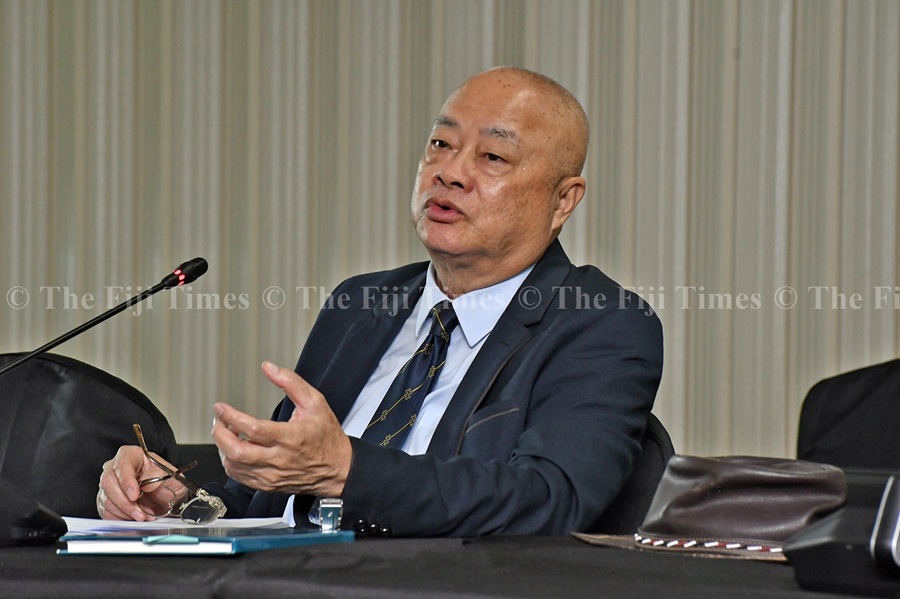
Declaring Fiji a Christian State could pave the way for religious extremism and eventually lead to a theocratic system similar to Iran. Making submissions to the Constitution Review Committee (CRC) yesterday, former attorney-general Graham Leung urged the committee to leave Section 4 of the 2013 Constitution, which declares Fiji a secular State and guarantees religious liberty, unchanged.
Mr Leung, who is also a proud Catholic, said there was a misunderstanding about what it meant for Fiji to be a secular state.
“From my understanding of the Constitution, the purpose of a secular State is to prohibit politics and religion mixing to the extent that it may be humanly possible,” he said.
“Now, secularisation is not a rejection or absence of religion. It is certainly, in my view, not a rejection of Christianity or any other religion for that matter.”
Mr Leung said those advocating for Fiji to become a Christian state may not fully appreciate the potential risks.
He said while such an arrangement may work in countries such as Tonga, which he described as culturally and religiously homogeneous, it was unlikely to succeed in Fiji.
“It’s likely to be a point of division and not a point of unity.”
Mr Leung also cautioned against Fiji becoming a theocratic State.
“The last thing we want is to end up being a theocratic State, like a country such as Iran, where the machinery of the State and the machinery of religion are inextricably linked and one in the same.”
He maintained that a secular State remained neutral on matters of religion while allowing voluntary religious observance in public institutions.
“A secular State is neutral as far as religion is concerned. It may allow voluntary religious observance within state institutions such as prayer in state schools.
“In my view secularism is not an argument against Christianity. It does not question Christian principles or indeed the beliefs of any religion.
“It is essentially a political and legal doctrine that government and religious institutions must be independent of each other and kept separate.”

