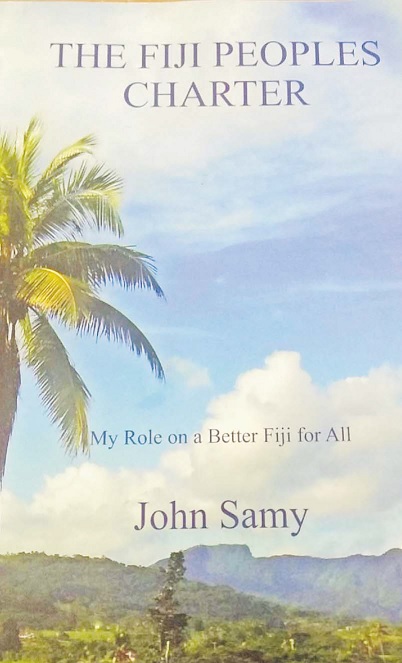
John Samy, economist and one of the brightest graduates of the University of the South Pacific (USP), has published a book — “The Fiji Peoples Charter” My Role on a better Fiji for All — focused on an event in Fiji’s history that has faded from people’s memory.
The book provides a sort of factual “torch light” for understanding the beginning of what has happened in the past 14 years.
This is the book that riveted well known columnist Nemani Delaibatiki’s attention last month, but he could not review it decently and frankly in his column, of May 19 2020, for obvious reasons.
John and I became friends when we were in the first groups of students at USP in the early 1970s.
After the 1987 coup, he and his acknowledged mentor economist, the late Savenaca Siwatibau, the first Reserve Bank Governor and first iTaukei vice-chancellor of the USP, left the country.
John became a very senior manager at the Asian Development Bank and, soon after his early retirement in New Zealand, came to Fiji.
From the ADB, he had been closely following events in Fiji that he regarded as his home.
It was to attempt to get Commodore Voreqe Bainimarama, and his Military Council on a path of progressive reforms back to a better parliamentary democracy as a unified nation, as soon as possible.
He and I as students were involved in Rev Akuila Yabaki’s Student Christian Movement (SCM) at USP and we were the first civil society NGO workers that he contacted and asked to work with him on the Peoples Charter and the National Council for Building a Better Fiji (NCBBF) that Mr Bainimarama agreed to in 2007.
For us at the Citizens’ Constitutional Forum (CCF) one reason we agreed to help John was because Mr Bainimarama had not abrogated the 1997 Constitution.
This was an opportunity for improving the Constitution through a Constitution Review Commission with broad public consultation and support of the people of Fiji. John’s concern was that of an economist, but it was broad because economics is inextricably related to other issues.
A Fiji Times editorial of May 16, 2007 stated: “The interim government’s efforts to set up a national council representative of the people is to be welcomed and has the potential to serve as concrete steps towards a return to democratic rule; the first real effort by the interim government to involve the wider community. Our people need to get this off the ground.”
In the first Consultation Document produced by the NCBBF Secretariat the following “critical questions” that needed to be addressed regarding the overall situation in Fiji were stated:
- the country was wrecked by political instability in the wake of successive coups and the overthrow of elected governments;
- the level of trust between major communities was low;
- corruption and the abuse of power had been on the rise;
- savings and investment levels were low with the economy stagnating; q both unemployment and poverty had risen sharply;
- the number of people forced to live in squatter settlements had increased, a situation made worse by the non-renewal of sugar leases;
- there was lack of access to land, both for productive and social purposes;
- the country suffered greatly from the loss of valuable skills, experience and expertise due to high rates of emigration;
- standards of service delivery in both the public sector and the level of communities had been declining; q
- overnment debt levels had been increasing; and q the poor and dilapidated state of the country’s infrastructure.
The Bainimarama government has of course tried to address some of these critical issues in the past 14 years with heavy borrowing from China.
In October 2008, a meeting had been proposed with leaders of Fiji political parties towards agreement on the reforms path spelt out in the People’s Charter and the State of the Nation and Economy Report
(SNE).
This called for early elections within six months (March 2010), return to constitutional democracy after a Constitutional Review Commission and under a different electoral system recommended by the
NCBBF (not the one we have now).
There had been a successful public consultation on the draft People’s Charter.
The Report of the NCBBF showed that of the 424,600 citizens of above 18 years that had been out reached and consulted, a total of 342,592 (80 per cent) responded in filling in the response forms.
92 per cent indicated full support for the Charter way forward, 11,300 (3 per cent) partial support with
amendments, 14,481 (4 per cent) opposed and 3938 (1.1 per cent) were undecided.
The military government rejected this transparent, accountable way forward.
The NCBBF folded, having completed its work in December 2008.
Mr Samy had at least persuaded Mr Bainimarama to continue holding meetings with leaders of political parties that included Laisenia Qarase.
I became involved in the secretariat of that process as John had returned to Auckland after refusing the offer to become Minister of Finance.
I left Mr Bainimarama’s office early in 2010 soon after I noticed that the military government had breached an agreement with the European Union that said, as a condition for aid to the ailing sugar industry, that elections should be held within six months.
There was also the formation of the National People’s Charter Advisory Council (NPCAC), a successor to the NCBBF that tried to keep alive the enthusiasm and hopes for new way for Fiji.
Only Pio Tikoduadua at the PM’s Office took the NPCAC seriously.
The book has provided an opportunity for Mr Samy to clear up many misconceptions about his role and to correct many personal and false accusations that were made at the time.
It is indeed a good book for the critics as well as serious historians because it contains all the internal papers and other communicated advice he gave to Mr Bainimarama Mr Sayed-Khaiyum, Mahendra
Chaudhry and others.
John raises many questions of immediate and long-term significance.
With a decreed constitution under which the RFMF claims to be the final guarantor of national security and the future of any group that comes to power, will Fiji ever be able to restore a people’s constitutional democracy?
This book has been published to raise funds for the NGO that John played a lead role in establishing in 2009, the Foundation for the Education of Needy Children in Fiji, FENC Fiji.
This was to help children of the poorest of the poor parents put their children through school.
John came from a very poor background and got his advances in education through the sacrifices of his parents and assistance of people unrelated to him.
Just like his mentor, the late Mr Siwatibau.
This NGO used to be part-funded with government grants of over $200,000.
FENC Fiji has lost this grant and is now desperate for support to survive.
I urge people of good will to buy this book and attend the launching.
Buy many copies as gifts to your friends and children.
- Jone Dakuvula is a human rights activist. The views expressed in this article are the author’s and does not necessarily reflect the views of this newspaper.