

Cyclones, flooding, power outages, supply chain interruptions, cyber incidents, pandemics, and global economic shocks continue to shape the operating environment for employers across sectors.
In recent years, businesses have had to navigate not only natural disasters, but also rising operational costs, labour shortages, global supply disruptions, and economic uncertainty.
These events reinforce a growing reality for the private sector: resilience is no longer about recovery after a crisis — it is increasingly about preparedness, continuity, and the ability to adapt while maintaining operations, employment, and service delivery.
In Fiji’s context
MSMEs account for approximately 82 per cent of registered businesses in Fiji and contribute an estimated 18 per cent to Fiji’s GDP.
They are also among the most exposed and vulnerable during times of disruption.
It is estimated that nearly 80 per cent of MSMEs in Fiji are affected by natural disasters each year, often facing prolonged recovery periods due to limited financial reserves, reduced access to insurance, and the absence of formal continuity planning.
The financial impact of major disasters has highlighted the scale of this vulnerability.
In 2016, Tropical Cyclone Winston caused damage estimated at more than $FJ2 billion.
In 2020, 92 per cent of businesses affected by Tropical Cyclone Yasa had no insurance cover – which significantly prolonged recovery and rebuild efforts.
Impact of disruptions on businesses
For employers, the impact of a disruption extends well beyond physical damage.
Business interruptions can affect workforce availability, supply chains, customer access, inventory, production timelines, revenue streams, and overall business confidence.
Delayed recovery can also have broader economic implications, particularly for sectors that support employment, essential services, and local supply networks.
Experience has shown that businesses with even basic preparedness measures and continuity plans are often able to recover faster, minimise losses, and maintain greater operational stability during periods of disruption.
For nearly six months, the Fiji Business Disaster Resilience Council (FBDRC), a council under the Fiji Commerce & Employers Federation, have been working alongside our partners and stakeholders to develop a practical business tool that addresses this particular challenge.
Business resilience toolkit
The Business Resilience Toolkit: Managing Disruptions & Disasters in Fiji was launched on Friday May 22, 2024, officiated by chief guest, acting permanent secretary for the Ministry of Rural and Maritime Development and Disaster Management – Mitieli Cama.
The toolkit has been designed as a practical resource to support businesses in strengthening preparedness, improving continuity planning, and enhancing recovery capability before, during, and after disruptions.
Importantly, the toolkit is not intended to be a highly technical document.
Its purpose is to provide businesses with accessible and practical guidance that can be adapted across different sectors and business sizes.
The toolkit includes:
• Preparedness and risk assessment guidance
• Business continuity planning templates
• Recovery and reconstruction planning tools
• Business impact assessment forms
• Resource mapping templates, and
• Checklists for MSMEs and larger businesses.
A key focus area of the toolkit is Business Continuity Planning (BCP).
For many businesses, particularly MSMEs, continuity planning is often delayed until after a disruption occurs.
However, even simple planning measures — such as identifying critical operations, backup suppliers, emergency contacts, essential records, and recovery priorities — can significantly reduce operational downtime following an event, and improve recovery outcomes.
The toolkit is structured around five core pillars:
1. Preparedness
2. Response
3. Recovery
4. Reconstruction
5. Parametric insurance.
Together, these pillars provide a simple framework to help businesses understand the actions required at different stages of a disruption.
An important addition to the toolkit is the introduction of parametric insurance concepts, which provide businesses with faster financial support following disaster events, triggered by predefined weather conditions.
For MSMEs, where access to traditional insurance can often be limited and delayed, faster access to post-disaster funding can play an important role in supporting cash flow, wages, supplier payments, and operational recovery.
Thank you to our developers and partners
The initiative was led by the Fiji Business Disaster Resilience Council – a council under FCEF, in partnership with the National Disaster Risk Management Office (NDRMO), with support from the United Nations Development Programme (UNDP), United Nations Capital Development Fund (UNCDF), Asian Development Bank (ADB), Connecting Business Initiative (CBi), and input from the Reserve Bank of Fiji, and contributions from businesses and stakeholders through consultations and validation workshops.
This level of collaboration is important because resilience is not solely a business issue or a government issue — it is an economic issue.
The ability for businesses to prepare, continue operating, and recover efficiently has a direct implication for employment, supply chains, community stability, and national economic activity.
As Fiji continues to navigate a complex and evolving risk environment, strengthening business resilience will remain important not only for individual enterprises, but for the broader stability and continuity of the economy.
The Business Resilience Toolkit is available to all businesses and can be found and downloaded from the FCEF website – https://www.fcef.com.fj/latest-updates/publications/.
We strongly encourage all businesses to take full advantage of this practical, purpose-built tool.
GAYLENE KAMALI is manager Advocacy & Corporate Communication for Fiji Commerce and Employers Federation (FCEF). The views expressed in this article are not necessarily the views of The Fiji Times.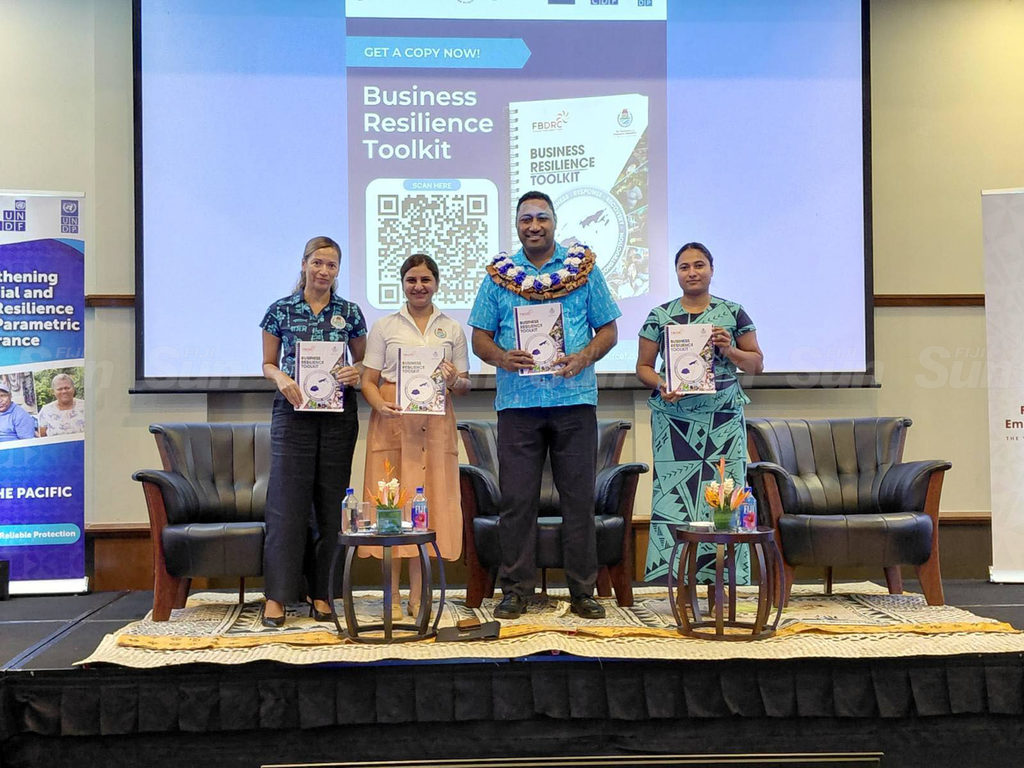
L-R: FCEF vice president Rowena Taito, FCEF manager Business Development Pricilla Ram, Ministry of Rural and Maritime Development and Disaster Management permanent secretary Mitieli Cama and Akata Taito of UNCDF. Picture: SUPPLIED / FCEF

