For many people, poor eyesight begins quietly. A child may start sitting closer to the television or struggling to read the writing on a classroom board. An adult may find road signs increasingly difficult to see or begin holding a phone farther away to read messages. An older person may notice that colours are becoming duller or that their vision is cloudy.
Often, these changes are treated as a normal part of life. But poor vision should not simply be ignored.
Globally, at least 2.2 billion people live with some form of near or distance vision impairment, according to the World Health Organization (WHO). In at least 1 billion of these cases, the impairment could have been prevented or has yet to be addressed. The leading causes include uncorrected refractive errors and cataracts.
For Fiji, the issue deserves attention because good eyesight is closely linked to education, employment, independence and quality of life.
The problem may be as simple as needing glasses
One of the most common causes of poor vision is a refractive error.
This includes short-sightedness, long-sightedness and astigmatism. These conditions occur when the shape or length of the eye prevents light from focusing correctly on the retina, resulting in blurred vision.
Presbyopia, the difficulty seeing things close up that commonly develops with age, is also extremely common after the age of 40. The good news is that refractive errors can usually be corrected with appropriate glasses or contact lenses.
The challenge is ensuring that people recognise the problem and have access to an eye examination and suitable spectacles.
WHO says uncorrected refractive error remains the leading cause of vision impairment among both children and adults. It can affect children’s academic performance and reduce productivity among working adults.
For a child, something as simple as being unable to see the board clearly can have consequences beyond eyesight. A child who cannot see properly may struggle to read, copy notes or participate confidently in class.
Ageing eyes and cataracts
As Fiji’s population ages, age-related eye conditions are another important concern.
Cataracts occur when the normally clear lens of the eye becomes cloudy. Vision can gradually become blurred, making it difficult to read, drive, recognise faces or carry out everyday activities.
According to WHO, cataracts are one of the two leading causes of vision impairment worldwide, alongside uncorrected refractive errors. Cataract-related vision loss can often be treated with surgery.
Because cataracts generally develop gradually, some people may adapt to declining vision without realising how much their eyesight has changed.
That is one reason regular eye examinations are important, particularly for older adults.
Diabetes can also put eyesight at risk
Eye health is not separate from general health. Diabetes can damage the small blood vessels supplying the retina, resulting in diabetic retinopathy. If detected early, appropriate management can help protect vision, but advanced disease can result in permanent sight loss.
WHO identifies diabetic retinopathy as one of the major causes of vision impairment and emphasises the importance of early detection and timely treatment.
For people living with diabetes, controlling the condition and attending recommended eye examinations are therefore important parts of protecting their sight.
High blood pressure and other chronic health conditions can also contribute to eye problems, making routine health care important for protecting vision.
Children and the changing way we use our eyes
Another area receiving increasing international attention is myopia, or short-sightedness. Children today spend considerable amounts of time on phones, tablets, computers and other devices. However, it is important not to blame screens alone. WHO notes that increased time indoors and prolonged near-work activities are associated with myopia, while spending more time outdoors may help delay its onset or slow its progression. Encouraging children to spend time outdoors, take breaks during prolonged near work and have their eyesight checked when problems arise can therefore be useful habits.
Parents should pay attention to signs such as children sitting very close to screens, squinting, frequently rubbing their eyes, experiencing headaches or struggling to see objects at a distance.
Why regular eye checks matter
Perhaps the biggest problem is that many eye conditions do not cause obvious symptoms in their early stages. A person can feel healthy while an eye condition is developing. By the time noticeable vision loss occurs, some conditions may already be advanced.
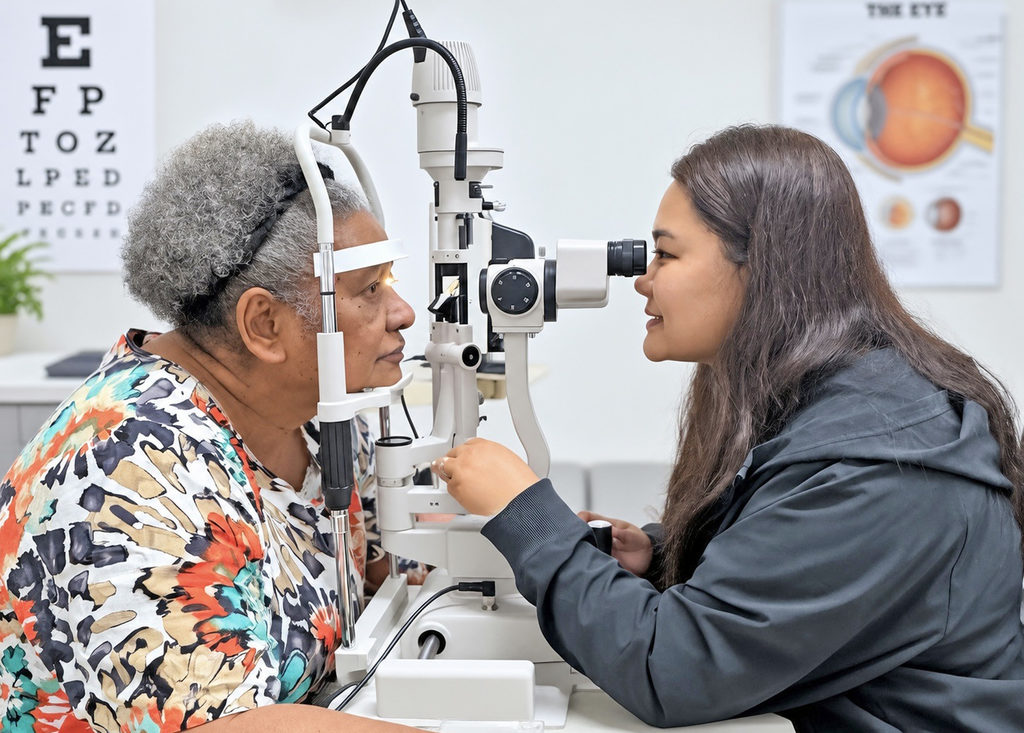
Regular eye examinations can identify refractive errors and other eye conditions and allow treatment or management to begin earlier. WHO states that timely detection and appropriate care can prevent or reduce the impact of many forms of vision impairment. Eye care is particularly important for people with diabetes, older adults, children experiencing difficulties at school and anyone noticing changes in their vision.
Protecting a precious sense
For Fiji, the message is straightforward: blurred vision should not simply be accepted as part of getting older or spending too much time on a phone.
Some vision problems can be corrected with glasses. Some, such as cataracts, can be treated surgically. Others can be managed more effectively when detected early.
The first step is recognising that changes in eyesight deserve attention.
A routine eye check may take only a short amount of time, but it can reveal problems that otherwise remain unnoticed.
Our eyes help us learn, work, travel, communicate and enjoy the people and places around us. Protecting them should therefore be regarded not as a luxury, but as an important part of maintaining our overall health and independence.