
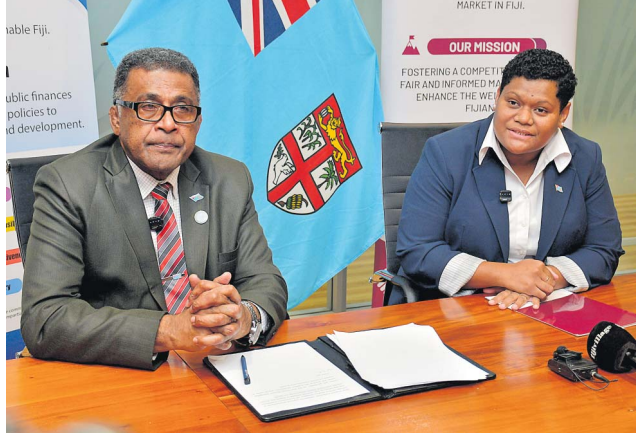
Government will absorb an estimated $4million a year in electricity costs for more than 50,000 low-income households after the Fijian Competition and Consumer Commission (FCCC) approved a 5.91 cents per kilowatt-hour interim fuel surcharge for Energy Fiji Ltd (EFL) yesterday.
FCCC CEO Senikavika Jiuta confirmed the surcharge would take effect from May 26.
Finance Minister Esrom Immanuel said households earning below $30,000 annually would be protected from the increase, while the subsidy would also be extended to micro, small and medium-sized businesses with annual turnover below $30,000.
“So none of these customers will bear any additional cost,” he said.
Currently, subsidised customers pay 17.67 cents per kilowatt-hour compared to the normal residential tariff of 34.01 cents.
Mr Immanuel confirmed Government already spends about $10million annually on electricity subsidies.
However, he added that residential customers earning above $30,000, along with commercial and industrial users, will face higher power bills as EFL passes on the surcharge.
Ms Jiuta explained that a household with an average monthly bill of $68 is expected to pay almost $12 more, while businesses with bills averaging about $2049 could see increases of around $295 a month.
Ms Jiuta noted that EFL initially sought an 11-cent surcharge increase and had warned that without fuel cost recovery, power rationing would take place.
“Without some level of fuel cost recovery, the ability to maintain a reliable and stable electricity supply throughout the country would become increasingly challenging,” she said.
She added that a comprehensive and rigorous assessment process was undertaken before approving the interim increase, balancing consumer protection with the need to maintain reliable electricity supply.
Mr Immanuel described the situation as a “war-induced fuel price crisis”, saying rising fuel costs were placing enormous pressure on EFL, Fiji Airways, bus operators, and other fuel-dependent sectors.
“We must choose between high electricity prices or the risk of electricity shortages and disruptions, which would be much more costly and painful.”

