Last week, we looked into how teachers from overseas came to Fiji at a time when the country needed more people in its classrooms.
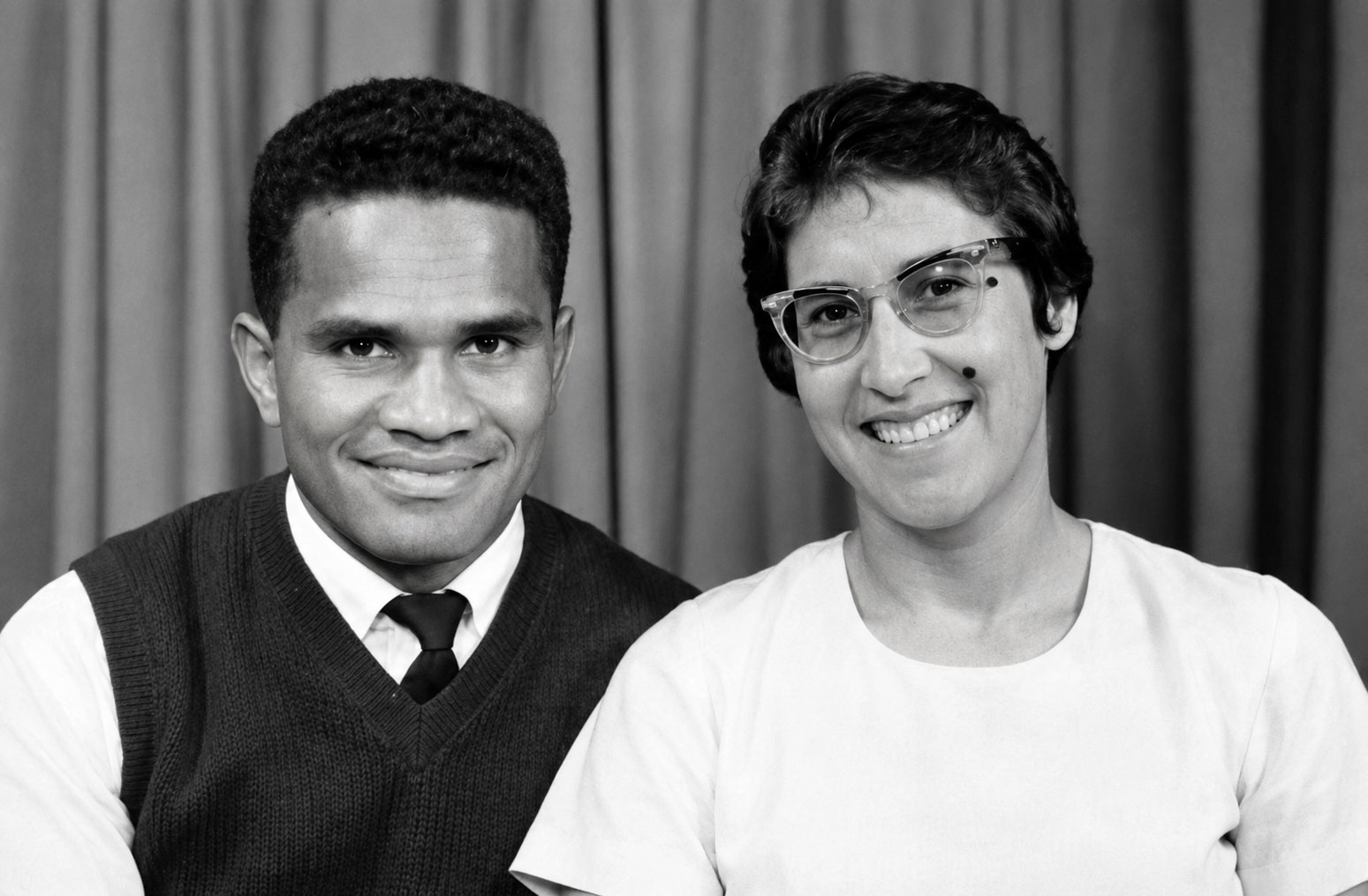
Among them was Wendy Lay, a young Australian teacher who gave up her plans to travel to Europe and instead chose to teach in Fiji.
Wendy had come to Fiji to teach.
She did not come expecting to stay.
She certainly did not come expecting to marry a Fijian minister and raise a family here.
But that is what happened.
Her life changed after she met Peceli.
The first time they met, there was no romance.
Wendy was walking along a path during a Methodist youth camp when she met the young Fijian.
His name was Peceli Ratawa.
She introduced herself.
Someone heard her name as “Wedewede”.
Peceli laughed.
He explained that it meant scratching around like a chicken.
Wendy already had another childhood joke about her name.
She had been called “Lay-eggs”.
Peceli told her that he was a minister.
He also told her that he was married and had a baby.
The following day, Wendy gathered some of her dresses and made a parcel for him to take to his wife, Ateca.
It was a small act of kindness.
At the time, Wendy had no idea how much the family would later mean to her.
The next year, she saw Ateca and the baby at an Independence celebration at Albert Park.
Then tragedy struck.
Ateca died four days after giving birth to her second daughter.
Peceli was left with his children.
For Wendy, the tragedy was a reminder that the Fijian life she was learning about was not only colourful and beautiful.
It also had hardship and loss.
A year later, Wendy and Peceli met again at a Christian camp in Lautoka.
This time, something was different.
“There was a spark between this smiling young Fijian man and me. So as it happens, we were in love.”
They married at Wesley Church in Lautoka.
For Wendy, marriage meant entering a world that was much bigger than two people.
She was joining a family. She was joining a culture. She was becoming part of Peceli’s community. She knew that she had a lot to learn.
Her words are simple.
“Our wedding had been two days earlier, actually New Year’s Eve, and now I realise that I have a whopping lot to learn.”
That learning became part of everyday life.
Wendy was an Australian woman. Peceli was a Fijian man.
Their families had different backgrounds. Their customs were different.
Even the way they understood marriage was shaped by their own experiences.
Peceli’s mother had to accept a white woman into the family.
Wendy imagined what she might have thought.
“There is a great distance to leap.” But there was also understanding.
“In every generation there are changes.”
That sentence is important because it shows the changes taking place in Fiji at the time.
The country was moving towards independence. Old customs were meeting new ones. Christian marriage existed alongside traditional practices. Different communities were living closer together.
And people were learning to adapt.
Wendy was doing exactly that.
“I have remained an Aussie woman but I adapt.”
She did not stop being Australian.
Instead, she learned how to live in Fiji.
She learned from Peceli’s family. She learned from her neighbours. She learned from her students. She learned from the communities around her.
Her new life also brought her into contact with different religions and cultures.
She had already lived among Indian families in Suva. She had listened to Muslim prayers. She had attended Fijian church services. She enjoyed Indian music.
Now she was married into a Fijian family.
The differences did not disappear. But they became part of her everyday life.
Marriage also brought children.
Wendy and Peceli eventually had three boys — George, Robin and Andrew.
The children grew up surrounded by the extended family.
One of Wendy’s memories shows just how different family life could be from what she had known in Australia.
When Andrew was born at the Labasa Hospital, he weighed more than nine pounds.
His cousin Samisoni was born only a few days later.
When Wendy was away teaching, Peceli’s sister Evia breastfed both babies.
They became known as Bibi and Bebe.
For Wendy, this was part of life in a large family.
Children were not always cared for only by their parents. Aunts, uncles, grandparents and cousins were involved. People helped one another.
This was also part of what Wendy later described as a life of sharing and mutual help.
But there was another side to family life.
Tradition remained important.
When her first son was born, Wendy kept his dried umbilical cord in a matchbox.
“It looked like a small coiled brown sea-shell.”
In the Fijian tradition she described, the child’s cord was planted under a tree.
Peceli’s father and an English doctor travelled towards Kauvadra.
They asked permission from the chief and elders. They brought kava and a whale’s tooth and were accompanied by guides.
They had to follow the proper protocol before entering the area. For Wendy, it was another lesson.
The country she had first encountered as a young teacher was becoming a country she understood through family.
And family was teaching her about tradition.
It was also teaching her about grief.
Wendy’s former teaching colleague, Phyllis Furnivall, died in a shocking incident. The death affected Wendy deeply. She questioned her faith.
She had believed that people who devoted their lives to helping others would somehow be protected.
Peceli gave her a different answer.
“Humans have weaknesses, we call it sin, and dreadful things happen. Also, accidents and illnesses. God does not stop bad things from happening.”
Then he added: “We just need to be vigilant, as much as we can.”
Peceli understood loss. His first wife, Ateca, had died only four days after the birth of their second daughter.
There had been no doctor or nurse with her in the Highlands of Navosa.
For Wendy, marriage was teaching her things that no classroom could. She was learning about grief. She was learning about family. She was learning about faith. And she was learning about the responsibilities that came with being part of a Fijian family.
Her life with Peceli also took them into different communities.
They travelled along rough roads for pastoral visits. They visited homes in sugarcane areas. They drank chai made with tea, powdered milk, cinnamon, cardamom, ginger, cloves, black pepper, vanilla and sugar.
These were ordinary experiences, but they were slowly changing Wendy.
She was no longer looking at Fiji from outside. She was living it.
And the country around her was changing too. Fiji had gained independence in 1970.
The years around independence were full of hope. Wendy remembered the atmosphere as optimistic. She remembered walking through an area surrounded by golden cane fields and beaches.
“It was an optimistic time.” But the optimism did not mean there were no problems.
Land was one of the biggest issues. Families were thinking about what would happen to their land. Farmers were thinking about their leases. Fijians were thinking about ancestral land. Indo-Fijian farmers were thinking about the future of their farms.
Wendy began to see those questions more clearly.
Peceli’s own family had land in the Labasa area. Eventually, he decided that he needed to return to Labasa to help his relatives.
It was late 1971. The decision would take Wendy out of the world she knew.
She had been a teacher. She had been living in towns. She had a home. She had her piano. Now she was going to live much closer to the land.
There would be no regular Methodist Church income.
The family would depend more heavily on what they could grow, earn and develop.
For Wendy, there was one painful part of the move.
Her piano could not go with them. “I cannot take my piano so gave it away to the Dilkusha church people.”
“I was devastated.”
The piano was more than an object. It represented the life she had known. Music had always been important to her. She had taught music.
She loved different forms of music. Now she had to leave the piano behind.
But she was also entering another important part of Fiji’s history.
Her husband’s family was trying to regain land as leases expired. That would take them to Vatuadova.
There, Wendy saw a completely different side of Fiji. She lived without electricity.
She would share life with relatives.
She would teach while also helping the family. She would see Indian cane farmers working nearby.
She would hear different languages. She would experience life that depended more directly on the land.
And she would learn that land in Fiji was not simply about where a house stood.
It could be about family. It could be about history. It could be about the future.
For the young Australian teacher who had once wanted nothing more than to see Paris, the next chapter would be far from the galleries of Europe.
It would begin on a cane farm near Labasa.