
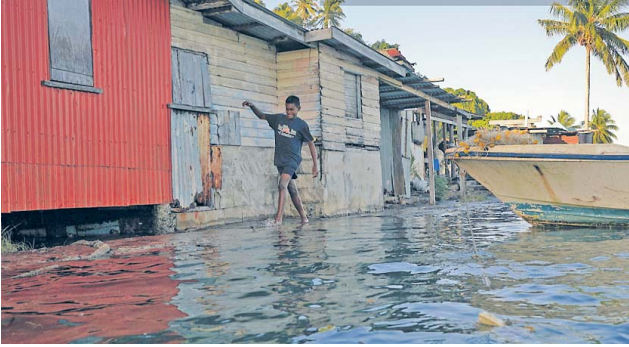
LAST month at the UN General Assembly, we reached a landmark moment. The international community adopted the Sea Level Rise Declaration, the first time all UN member states have decided on a shared approach towards sea level rise.
For many, sea level rise is an abstract concern. For others, it is an existential threat. The Pacific Island Countries face the loss of homes, livelihoods and, in the starkest cases, their entire land. The declaration recognises this growing threat and the significant environmental, development, economic and legal challenges faced by those most vulnerable to rising seas.
We are proud to have played a collaborative role in shaping this declaration. We worked closely with the countries of the Pacific, other small Island Developing States, as well as Australia and Cabo Verde as drafters to help build a text that is balanced and science-based, reflecting the priorities of countries on the frontline of climate change while remaining consistent with international law.
This declaration builds on work we have long supported, including co-sponsoring Vanuatu’s successful campaign for an International Court of Justice advisory opinion on climate change. It also builds on the UK’s own recent commitment on continuity of statehood made by Rosie Winterton, UK Minister for the Pacific. Our starting point is to continue to recognise a state, notwithstanding the loss of some or all of its land to rising sea levels.
Words matter, but so does funding on the ground. At the Pacific Islands Forum in Palau, Minister Winterton announced an additional £10million ($F31.5million) in funding over the next three years to support the Pacific Resilience Facility, building on the UK’s long-standing partnership with the region as an original PIF Dialogue Partner, and now as a formal Strategic Partner following this year’s Forum.
At the United Nations General Assembly, we’ve also seen further commitments on this issue. UK Foreign Secretary Ed Miliband stressed the need to pool information on risks and become better at managing shocks. And the UK also took action – pledging £330million ($F984million) to the ninth replenishment of the Global Environment Facility, and committing to join a major new ocean science program, led by the EU, to better forecast extreme weather and climate events.
Sea level rise is not a distant, future problem. It is happening now, and will accelerate regardless of progress on emissions. That is why this declaration, and the practical support that sits alongside it, matter together, protecting the rights, identity and dignity of those most affected, while laying a shared foundation for the harder work still to come.
During this summit season, as we look ahead to the Pre-COP in Fiji and Tuvalu and COP31 in Türkiye, we know it’s an important moment for shaping global outcomes on climate. It’s a moment where we will continue to stand with our partners in the region and delivering on the UK’s commitment to the region. It means doing our part at home to tackle emissions by expanding renewable energy. And engaging at all levels for positive change across multilateral fora to turn words into action for a safer, more prosperous future for all.

