In 1983, as a 13-year-old 4th Form (Year 9) student at Natabua High School, I found a fictional novel titled “Things Fall Apart” by Chinua Achebe, a Nigerian author.
The title of that famous fictional novel is appropriate for how under the stewardship of the Prime Minister the Constitution (Amendment) Bill No. 32 of 2026 is being fast-tracked.
In a clear signal of how things will fall apart, the PM warned this week that those Cabinet Ministers who follow directive of their parties and vote against the Bill will lose their ministerial positions. This warning was obviously directed at the Social Democratic Liberal Party (SODELPA) and the National Federation Party (NFP).
When asked to comment on the PM’s statement, one of the ministers told a news media that following or not following the directive of their respective party made no difference as a minister would lose their ministerial job. In other words, vote no and you are out of Cabinet. Vote yes and you are out of Parliament.
PM’s warning has no effect
I CAN’T speak for SODELPA. They surely have the rules and guidelines in their party’s constitution on how to deal with a MP who is a SODELPA member and doesn’t follow the party directive.
But I can surely comment on the stance taken by the NFP in my role as the party’s general secretary, empowered to enforce the NFP management board and working committee decisions.
The warning by the PM, plus comments by minister Lynda Tabuya on her Facebook page, aimed at the parties saying it was fair that the ministers would be fired for following directives issued by the respective parties is a veiled attempt at getting the parties to overturn their directive.
This will never happen as far as the NFP is concerned. As a 63-year-old party, our principles have, are and will never be shirked. We will not bow down to threats and warnings. The fact that the NFP is not only Fiji, but the South Pacific’s oldest political party is a testimony to our existence as a principled fortress.
Several political parties have come and dissipated into thin air because their political fortunes revolved around individual leaders. The parties became dysfunctional and died when their leaders disappeared or exited politics.
Undoubtedly, some parties currently in existence will suffer the same fate. One only has to recall what happened to the once mighty FijiFirst that functioned only for 10 years despite winning two general elections, raising record funds and ruling with an iron-fist.
One thing is clear, the PM’s warning and Minister Tabuya’s comments are a sign of desperation because 66 per cent of parliamentary majority is essential for the Bill to pass and then progress to a National Referendum. Sixty-six per cent of the current 53-Member of Parliament is 36 votes. Without NFP and SODELPA, the current number is 31 and the Bill will lapse.
Party directive
The directive issued to the four members of the NFP’s parliamentary caucus is abundantly clear. They must vote no. Not even abstain. Section 63(h)(i) of the 2013 Constitution authorises the party to expel Members who defy a directive. It states:
(h) votes or abstains from voting in Parliament contrary to any direction issued by the political party for which he or she was a candidate at the time he or she was elected to Parliament, without obtaining the prior permission of the political party; or
(i) is expelled from the political party for which he or she was a candidate at the time he or she was elected to Parliament and—
(i) the expulsion was in accordance with the rules of the political party relating to party discipline.
Therefore, a member has no choice whatsoever to defy the party directive.
A member must remember having taken an oath of allegiance to abide by all lawful party directives. He or she does not have the right to decide whether or not to follow the directive after studying the Bill during its 3rd Reading in Parliament, but simply vote no.
Being removed as a minister by the PM for following the party directive earns respect for a member amongst the rank and file of the party and voters, instead of losing a ministerial portfolio after being expelled by the party for defiance.
Flawed process
The Report of the Fiji Constitution Review Commission (FCRC) was tabled in Parliament on September 22. Together with the report was a draft constitution prepared by the FCRC.
The process started on the wrong footing right from the start. A Cabinet sub-committee started to draft a Bill.
There was no need for this. It was illogical to bring in a new Bill altogether, despite claims that the Bill contains 75 per cent of provisions of the review report. And the PM put the cart before the horse buy moving the first and second readings of the Bill saying this was in conformity to sections 159 and 160 of the 2013 Constitution that defines procedures on constitutional amendments.
The logical way after the tabling of the report together with FCRC’s draft constitution would have been to form a bipartisan special parliamentary committee on the constitution by way of a motion in Parliament. Like any other parliamentary committee, this special committee should have been given a time frame to scrutinise both the FCRC report and the commission’s draft constitution and report back to Parliament during the November Parliament sitting (which ended on Friday).
The Bill coming out of the scrutiny of the special committee should then have been read for the first and second times during the sitting which ended yesterday in compliance with sections 159 and 160 of the 2013 Constitution.
This would have probably achieved the support of the opposition. Then genuine public consultations should have been held throughout the country.
The consultation should not have been merely a cosmetic exercise to go and just listen to people make submissions, but involve interaction in the form of questions and answers to clear misconceptions.
And before the start of this process, the Bill should have been published in vernacular languages as well. Its salient features should have been published, broadcast and televised in English, Vosa Vakaviti and Hindi.
Unfortunately, none of this happened. Instead, Parliament, by way of a motion by the PM, approved the extension of consultation until late November with Parliament sitting again from November 30 to December 4 during which the 3rd Reading of Bill No. 32 will take place.
The die is cast
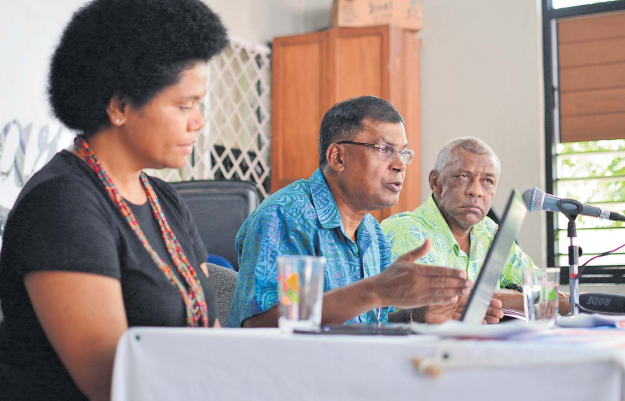
As announced by the NFP leader Professor Biman Prasad, both during a press conference on October 31 and again in Parliament on Monday, November 2, NFP’s decision not to support the fast-tracked process is irrevocable. So is the directive by the party’s management board and working committee to its four members to vote no when the Bill is read a third time.
Make no mistake. The NFP has always opposed the 2013 Constitution. It is a party policy contained in our 2014 and 2018 elections manifestoes as well as the vision document for the 2022 elections.
But we will not be a party to endorsing a process that involves replacing the 2013 Constitution with a fast tracked and equally imposed new constitution. That is not how to pursue politics in the national interest and ignore transparency, accountability and good governance.
A constitution belongs to the people. Not a political party, not any government and not any individual leader.
If some think it is their divine right to go ahead despite widespread legitimate concerns, they do so at their own peril.
And that is when things will really fall apart.
KAMAL IYER is a former journalist and the general secretary of NFP. The views expressed herein are his and not of this newspaper.