The Fiji National Provident Fund (FNPF) statement (The Fiji Times, October 12) only adds to the confusion FNPF has created in its callous handling of the 2011/12 pensioner debacle.
The statement does little to substantiate or justify FNPF’s position and adds to the mystery of the FNPF stance against its pensioners in resisting their legitimate claims. It is full of half-truths.
The statement adds confusion by introducing new players into the picture in the form of “legacy pensioners”. Who are they? FNPF needs to explain.
Most importantly the statement is silent on pensioner claims of broken contracts and the mystery of the Government guarantee. Both are key to resolving this dispute with the 1370 surviving pensioners.
FNPF is obstinately silent on the broken contracts issue. Clearly FNPF broke the contract (or agreement) it had with pensioners when it reduced their pensions in 2012.
All pensioners had signed an FNPF Form when they initially registered for a pension. This form stated “this cannot be altered or changed” a clear precise statement that all understood, except it seems FNPF.
FNPF ignored this contract in implementing the 2012 reforms. FNPF must clarify its position on the broken contracts. Why would it prefer an illegal unilaterally imposed Military Decree 51 to the solemn written contract freely entered into between it and the affected 2011/12 pensioners?
Interestingly, the statement is also silent on the Government guarantee that was put in place to support FNPF by the then Government in forming FNPF way back in the 1960s. It seems this was withdrawn when the reforms came into force in 2011. Why?
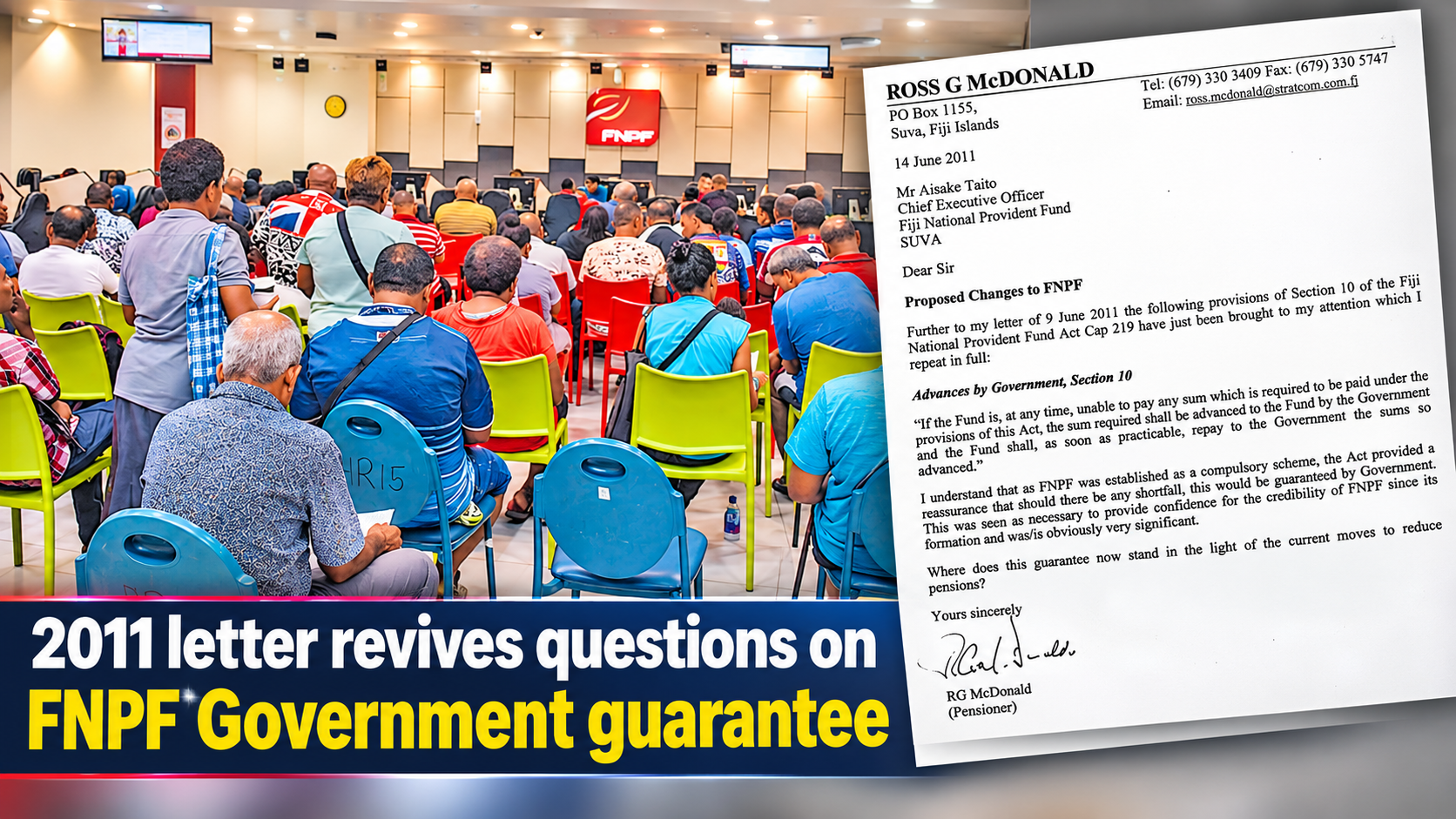
Pensioner Ross McDonald wrote to the fund in 2011 (see copy letter) querying FNPF on the guarantee. He never received a response from FNPF and is still waiting!
The Government guarantee is in the following terms In Section 10 of the original FNPF Act:
“If the fund is, at any time, unable to pay any sum which is required to be paid under the provisions of this Act, the sum required shall be advanced to the fund by the Government and the fund shall, as soon as practicable repay to the Government the sum advanced.”
Why didn’t FNPF ever invoke this guarantee, when dealing with the 2011/12 pensioners? Is it because it was always able to pay them, or was it easier and simpler to claim unsustainability before payment was required?
It should be remembered that back in the 1960s when FNPF was formed offering a generous 25 per cent pension scheme, it was known this expected return was exceptionally high and could not be continuously achieved, if ever?
FNPF needed time to build its wealth, so the then Government put in place the guarantee to give confidence to those early members that their pensions were safe. Quite simply if FNPF could not pay, Government would!
And this worked well for 50 years or so until the previous military government withdrew the guarantee and imposed Decree 51 which stopped anyone from taking FNPF to court or suing on pension debts. This is why the Burness case could not proceed back in 2012 because of the hasty action by the previous government.
Why would government or FNPF seek to prevent a court case going ahead if it was confident that it would win the case on its merits? Conversely, why would anyone allow a court case to proceed if it was sure the case would succeed unless it was summarily stopped in its tracks.
The illegal military regime did dirty work for FNPF who were clearly complicit after the imposition of Decree 51. It meekly complied claiming: “that’s the Law…”.
The effect of the withdrawal of the government guarantee and imposition of Decree 51 is that Government no longer had to support FNPF under the guarantee, while under Decree 51 no one could sue FNPF for pension debt. This left pensioners, hung out to dry, with no guarantee and no recourse against FNPF for debt!
A reasonable conclusion is that the underlying scenario was to free the Government of potential major FNPF debt and the FNPF safe against legal action for pension debt? Interesting?
In answer as to who pays the $700m or more realistically the Minister of Finance’s figure of $582m that he would have been given by FNPF – $372m in backdated pensions and $210m in future liabilities.
As both the former government and FNPF were complicit in devising this outrageous scheme to deprive pensioners, the Government and FNPF must share equally the cost of reimbursing pensioners.
Under the convention that governments are responsible for previous government’s debt, the current Government is liable for 50 per cent of the debt due to pensioners.
FNPF must also pay its 50 per cent share. It has more than sufficient funds in its unqualified balance sheet to absorb this payment. Its reserves and provisions are not protected against creditor action. FNPF can decide for itself how it handles this payment in its accounts.
In all this, pensioners are thankful to the present Coalition Government which heeded our call and assisted some pensioners by restoring reduced pensions to their original levels. Vinaka vaka levu.
In summary is this all a Machiavellian plot by the former government to ram through the reforms and avoid potential FNPF debt while still protecting FNPF under Decree 51 that stops pensioners taking legal action against FNPF? Of course, the current Government is also protected from potential FNPF debt by the lifting of the guarantee!
All interesting thoughts. Rest in peace Dewan Chand, our struggle continues.