Two weekends ago, The Fiji Times and Fiji Sun readers were thrown a deceptive two-page article, with very selectively chosen statistics, to propagate half-truths, while ignoring fundamental facts about the 2012 Pensions, the Pension Buffer Fund and the Robbery.
The FNPF (with author names not given) argued falsely that restoring the pensions of the 2012 Pensioners would require a subsidy from General Members. But the reality is the opposite.
Restitution would be from the ignored pension buffer fund which, according to former FNPF CEO Lionel Yee, was originally set up by the Fiji Parliament in 1975, and whose enormous balances have been used by the FNPF all this time.
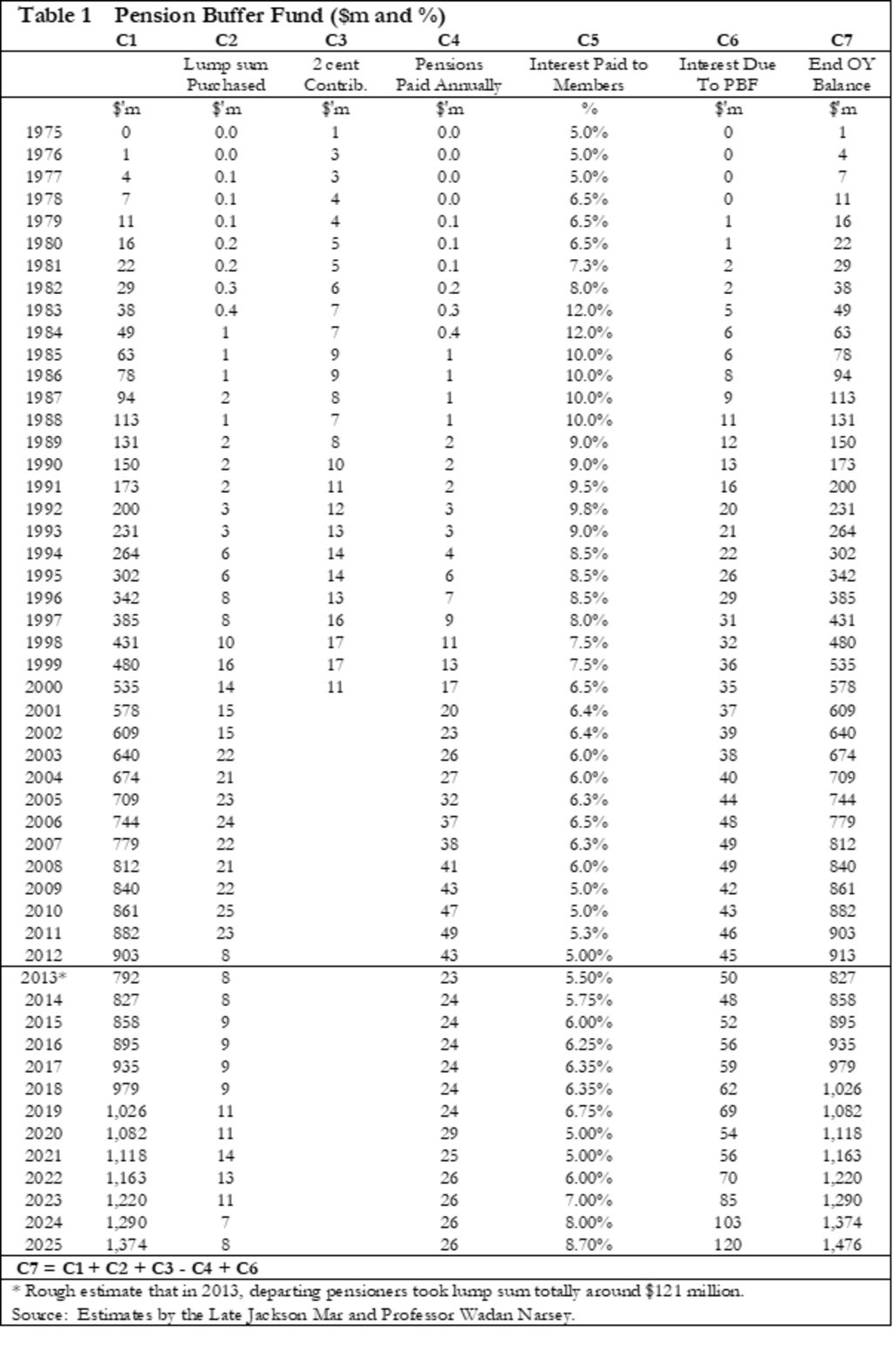
My Table 1 here shows that this Pension Buffer Fund, if properly maintained, would have easily paid all the pensions which FNPF had itself legally contracted to pay through the FNPF 9NOP forms offered by FNPF itself, for signing by the 2012 Pensioners.
I have little doubt that a Court of Law, if allowed to adjudicate, would find that these contracts were illegally broken by FNPF in 2012 and should be restored.
Which is why the FNPF Statement also totally ignored that the Bainimarama Government illegally imposed Decree 51, that threw out the legal challenge mounted by the late David Burness in 2012 through lawyer Dr Shaista Shameem (with an Affidavit prepared by me and Lionel Yee).
Why has the FNPF not ever requested the Rabuka Government to throw out Decree 51 (with the same speed they threw out Bainimarama’s Media Decree) so that the Courts could resolve this matter for good?
Why indeed have all the FNPF Statements and Annual Reports ignored the one clear evidence of the total failure of the 2012 Restructuring and all the costly FNPF advertisements in the media: that 98 per cent (98 out of every 100) FNPF members who reach age 55, refuse to take the pension option. They take their FNPF savings and run because after that 2012 Robbery, they do not trust the FNPF Management and Board.
I give here that graph which I have given before on the collapse of the pension take up rate which FNPF reports cunningly refuse to show (though once it did.).
But first my acknowledgement that some pension annuity rates (PAR) in 2012 were indeed “too high”, should never have been offered by the Fiji Parliament, but they did.
Yes, some pension annuity rates were too high
I acknowledge again (as I have done before), that some pension annuity rates of between 15 per cent and 25 per cent offered in 1999 were too high on economic and actuarial grounds.
For example, those pensioners on 25 per cent annuity rates received their entire balances in four years, and gained enormously if they survived long enough. But again, many on 15 per cnet annuity rates, died before they got their full lumps sums back.
But it is a historical FACT that these relatively high rates (15 per to 25 per cent) were approved by the 1999 Parliament when Sitiveni Rabuka was Prime Minister.
May I point out that in 1999 as an opposition MP (and NFP’s shadow finance minister) I had advised Parliament to reduce the pension annuity rate immediately from the existing 25 per cent to 15 per cent. But the Fiji Parliament chose not to take my advice (all there in the Hansard records).
Nevertheless, I have suggested to FNPF, the Minister of Finance and the Prime Minister, a compromise (a monthly cap to restored pensions of $5000 a month – or lower) while fully restoring the low income pensions.
I point out that FNPF in 2012 unilaterally increased the lowest pensions using some $67million of the proceeds of that 2012 robbery, even though the FNPF Act did not allow differential treatment of pensioners or members.
Should the Pension Buffer Fund be considered the law’
Why do the FNPF management and board in their propaganda statements ignore the historical fact that the pension buffer fund was set up by the Fiji Parliament in 1975, precisely to pay pensions and receive the lump sums of those choosing the pension option. Was the PBF therefore “law”?
Of course the 2 cent injection from 1975 to 2000 was not particularly “fair” as it called on all the Members for contributions even if they did not eventually choose the pension option. BUT again, it was decided by Parliament, which in 2000 also stopped that 2 cent injection when it was recognized that the PBF had become sufficient to pay the pensions.
Former CEO Lionel Yee in his sworn affidavit for the Burness Case stated: “I can state that the pension obligations of all pensioners became the obligations of the FNPF board as trustees as a whole, and to avoid debate or disputes on where the sources of payments were coming from, I recall there was a decision to put the pension buffer fund and its annual compound earnings into the general reserves from which all future pension obligations were to be paid from”.
Note Mr Yee stated clearly “the pension buffer Fund and its annual compound earnings were placed into the general reserve from which all future pension obligations were to be paid from”.
FNPF itself has acknowledged (FT-April 14, 2026) that these funds were invested like all other funds in FNPF’s possession. FNPF clearly received the accrued interest income.
In an email to the FNPF board chairman Ajit Kodagoda (of June 27, 2011) Lionel Yee pointed out clearly: “Succeeding actuaries stated that the general reserves should be credited with the same rate of interest as that credited to members accounts annually from the annual earnings of the Fund. The pension liability of all existing pensioners then was adequately covered by the general reserves (which included the buffer fund) built up over the years”.
But deviously, FNPF management chose not to credit the PBF with interest, the way all other funds were.
FNPF annual reports show annually from 2005 to 2011 that there was a pension buffer fund whose balances kept reducing because interest income was not being credited to it.
Instead in 2011, the FNPF put out totally false propaganda to allege that the PBF would run out of funds by 2025
Then the 2012 Annual Report blandly noted “To effect the new scheme, the old pension business was terminated”. Really?
Then also very strategically and deviously, to make sure that the public forgot about the “pension buffer fund”, the FNPF annual reports began to show the existence of a “pension retirement fund”. But even that disappeared in due course.
What should the PBF have become?
My Table 1 here (calculated jointly by myself and the late Jackson Mar) shows how the PBF would have grown to if properly maintained with credited interest from 1975 when it was established by Parliament and the 2-cent injection stopped in 1999, but interest accumulating every year.
Paying all the pensions, receiving all the lump sums of new pensioners, and crediting the PBF annually with interest, the PBF would have amounted to $903m by 2012, far more than ever needed to pay all pensions owing then (estimated by FNPF actuaries to be around $500m then) and into the future.
By 2025 it would have amounted to a massive $1,476m (yes, more than $1.4billion), far more than needed to pay all the pension obligations, with huge amounts left over.
So the historical fact is that the funds allocated by Fiji Parliament to the pension buffer fund have been used by the general members all this time, contrary to the claims in the recent 2 page articles by FNPF.
The FNPF forms 9NOP were lawful contracts
It is reprehensible that the recent 2-page FNPF articles (and all their public statements) again fail to acknowledge that it was FNPF itself which offered the 2012 Pensioners their pensions, stipulated in dollar amounts, on FNPF Forms 9NOP. Which forms the pensioners signed in good faith.
Former FNPF board member Mr James Raman in a newspaper Opinion piece (FT- June 21, 2011) pointed out to the FNPF management that the relatively high annuity rates were never an issue because “pensions were paid under a legally binding contract entered between FNPF and the pensioner… [to change it ex post] would have been illegal”.
Shauna Tomkins and Stephen Mascon, FNPF Actuaries Promontory Financial Group (Australasia) stated in their 2011 Report that while new pensioners annuity rates could be changed, existing pensioners annuity rates would be difficult to change “under contract law”.
The Blaxland Report (AESOP) proposed a reduction for new pension contracts only, not existing ones.
Note that soon after the 2012 Robbery, the FNPF issued a “Key features statement” which showed the reduced pension annuity rates of 8.7 per cent for new retirees, but stated (guiltily I suggest) that should FNPF change the pension annuity rates in the future on the advice of actuaries, the new rates would apply only to new pensioners, not to old.
Legal contracts are defined if a concrete offer is made and accepted by both parties, for a defined consideration (in $), understood by both parties to be binding (and not a casual social promise).
Any decent court of law would conclude that these signed 9NOP forms represented legal contracts which FNPF itself offered and were accepted by thousands of pensioners.
How dare the FNPF then unilaterally tear up these contracts which FNPF management and boards very conveniently now have amnesia about.
Ignoring our Offer of compromise
While there have been some high income pensioners who are probably not in need, the largest number are like Ronnie Chang whose plaintive letters have appeared often in the media, who are living from hand to mouth because their returned lump sums ran out all too soon.
I believe that FNPF could look after these low income pensioners easily using the Pension Buffer Fund especially with a compromise I suggested.
On the 22 June 2026 I wrote to the FNPF board chairman (Daksesh Patel) and copied to the Minister of Finance and the Prime Minister, requesting basic anonymous data on the 2012 Pensioners (numbers and pension levels) so I could suggest a concrete compromise solution which would restore all the low income pensions, while placing a monthly cap on the high income 2012 pensioners.
The FNPF, without any explanation, declined to give any data at all, while today they selectively trot out statistics that suit their ruthless refusal to correct the wrong that was done in 2012.
A few years ago, FNPF statements came under the byline of middle management officer Millie Low, but none today signed by board chairman (Daksesh Patel) or the FNPF CEO (Viliame Vodonaivalu). So much for their mission statement of “accountability”.
Sad ending for elderly pensioners
The sad ending to this story is that while the FNPF refuses to even consider some compromise solution that looks after the low income pensioners, every week some of them pass away, including from our own 2012 Pensioners Core Group.
Last year the late Jackson Mar, the fighter who collaborated with me in collecting our FNPF statistics (like that in Table 1 here in this article) passed away without seeing any justice.
I dedicate this article to the late Dewan Chand (also a courageous member of our 2012 pensioners core group and frequent Letter to Editor writer) who sadly passed away on the 14th of October 2026. May he rest in peace.
Others in the 2012 pensioners group, like Professor Vijay Naidu (chairman of core group), Ross MacDonald (former chairman), Matt Wilson, Daniel Fatiaki, Libby Reade Fong, Ronnie Chang and others, soldier on.
n PROFESSOR WADAN NARSEY is a well-known economist and public commentator and author. He is a member of the 2012 Pensioners’ Group. The views expressed in this article are personal to him and not necessarily the views of The Fiji Times.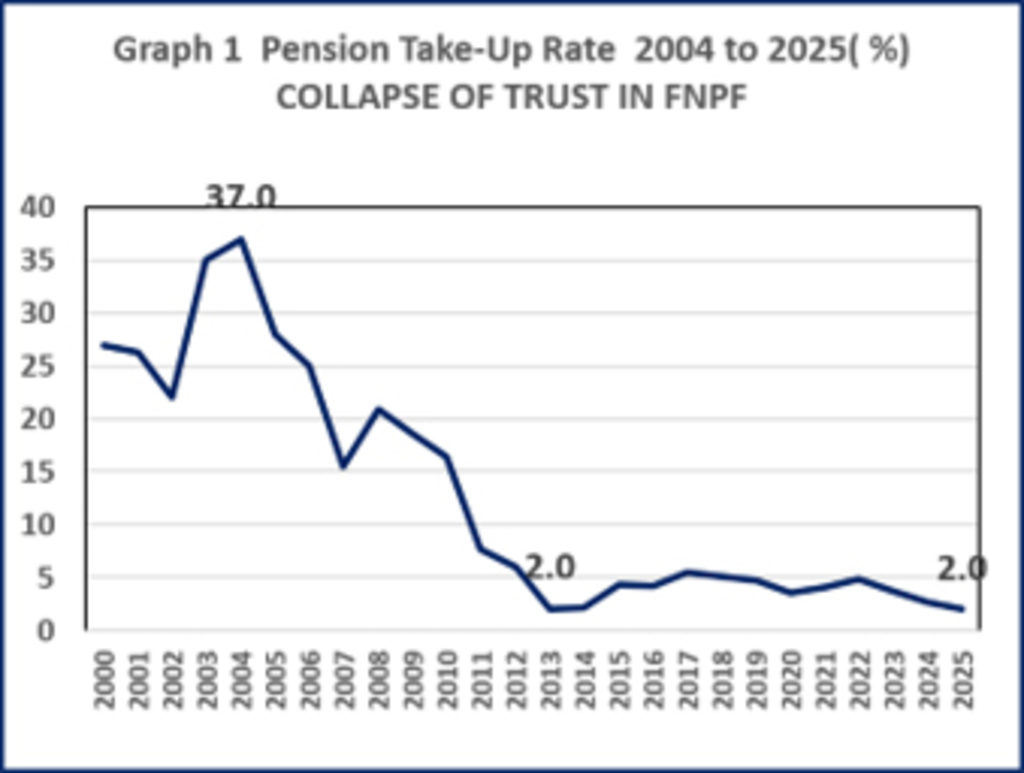
Picture: SUPPLIED
Picture: SUPPLIED