
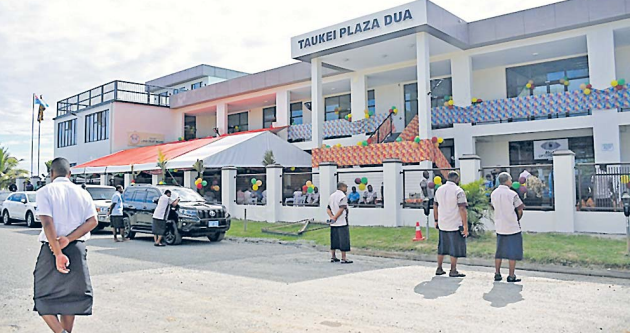
A recent iTaukei Land Trust Board advertisement caught my attention. It was advertising retail and office space at Taukei Plaza Dua in Lautoka. Above it was TLTB’s vision: “To Excel in Land Services and the Economic Empowerment of our Landowners.”
There is nothing inherently wrong with TLTB owning commercial property, but many organisations can own and manage buildings.
TLTB has a more distinctive challenge: How do we protect communal iTaukei landownership while turning that enormous asset into productive economic power for the people who own it?
TLTB itself defines its core business around sustainable land development and identifies empowering landowners to leverage iTaukei land for wealth creation among its roles. So the issue is not the mandate. It is how we measure whether that mandate is succeeding. TLTB should be judged not only by how effectively it administers iTaukei land, but by how effectively it turns economically viable land into productive use — and productive use into lasting wealth for its owners.
Leasing is not utilisation
THE first distinction is fundamental: Land Ownership ≠ Land Leasing ≠ Productive Utilisation ≠ Landowner Wealth. A lease tells us that land has been legally made available. It does not necessarily tell us how productively that land is being used.
m Alongside asking how much land is leased, we should ask how much of the economically viable land administered by TLTB is actually being productively utilised
Fiji’s agricultural lease regulations already recognise this principle through progressive cultivation requirements for suitable agricultural land.
Why not make productive utilisation a much more visible measure across TLTB’s wider development mandate?
m A public iTaukei Land Utilisation Dashboard could classify suitable land broadly as: Protected or Reserved | Productively Utilised | Leased but Underutilised | Idle but Commercially Viable | Under Development
Not every hectare should be commercialised. Land needed for customary purposes, future generations, environmental protection and other community needs must remain protected.
The objective is not maximum development. It is sustainable productive use of economically viable land that communities choose to make available.
And one headline indicator could tell us a great deal: How many economically viable hectares moved from idle or underutilised land into productive use this year?
Utilisation is not necessarily landowner wealth
But that answers only half the question. Suppose a hotel, farm, factory or solar project makes a piece of land highly productive. Economic activity has increased, but has economic empowerment of the landowners increased proportionately?
m The next question must therefore be:
m How much of the value created on iTaukei land is retained by the people who own it?
m The conventional pathway is often: Land g Someone Else’s Enterprise g Rent
There is nothing inherently wrong with that model. In many circumstances, secure rental income may offer landowners the best balance of return, certainty and risk. But it should not be the only model available.
Where commercially appropriate, another pathway is: Land g Landowner Participation g Enterprise g Equity + Profits + Assets
m The principle is simple: Protect ownership of the land while expanding landowner ownership of the economy built upon it.
m Depending on the project, that could mean: Lease | Lease + Royalty | Lease + Equity | Joint Venture | Landowner Enterprise
Not every project requires equity. Not every landowning unit should operate a business. Some landowners will reasonably prefer rent.
Economic empowerment should mean expanding commercially viable choices, not replacing one dominant model with another.
m And the safeguard should remain clear: Protect the land. Put commercial risk in the enterprise.
From landowner to economic participant
TLTB is already moving in this direction.
It has established a Landowners Empowerment Division and already provides pathways for joint ventures and landowner equity participation.
So the question is no longer whether these ideas belong within TLTB’s mandate.
n The more useful questions are: How widely are these pathways being used? What prevents more landowners from using them? How can successful models be standardised and scaled?
TLTB does not need to operate hundreds of businesses itself.
m Its distinctive role can increasingly be to: Identify gPackage g Connect g Facilitate
Identify commercially viable land and opportunities. Help package projects into investable propositions. Connect landowners with professional management, finance, technical expertise and markets. Facilitate structures that protect the land while allowing its owners to participate more fully in the economic value created from it.
Professional managers can manage businesses. Professional boards can govern them. Landowners can own them.
Where a viable landowner enterprise can be created, the first institutional question should be whether TLTB can enable the owners to own the opportunity.
Change what we measure
This brings us back to measurement.
TLTB should continue reporting leases, rents, royalties and distributions. Those numbers matter.
But there is an important distinction.
n Administration
Land Administered gLeases Issued g Rent Collected g Rent Distributed
n Economic empowerment
Land Utilised g Landowners Participating g Enterprises Surviving g Wealth Accumulating.
Both matter.
The first tells us how effectively land is being administered.
The second tells us what that land is doing economically for its owners.
A simple Landowner Economic Empowerment Scorecard could therefore focus on three outcomes.
n UTILISATION — How much viable land became productive?
Measure hectares activated, underutilisation reduced and time taken to move viable land into productive use.
n PARTICIPATION — How much are landowners participating in the economic activity created on their land?
Measure operating landowner enterprises and joint ventures, survival, scale and landowner equity.
n WEALTH — How much value is reaching and accumulating with landowners?
Measure rent and royalties, but also profits, dividends, productive assets, equity and sustainable employment.
m One indicator would be particularly revealing: What proportion of landowner economic returns comes from rent, and what proportion comes from ownership of productive assets and enterprises?
m Another would expose institutional bottlenecks: How long does an identified land opportunity take to reach commercial operation?
What gets measured eventually influences what gets managed.
If success is measured mainly through leases and rent, institutional effort will naturally optimise leases and rent.
If TLTB also measures utilisation, participation and wealth creation, attention will increasingly organise around those outcomes.
What is the land doing for its owners?
m Taukei Plaza Dua was never really the issue. The important words were above the advertisement: “Economic Empowerment of our Landowners.”
TLTB already has the right ambition on paper and some of the machinery required to pursue it.
The next step is to make productive utilisation, landowner participation and wealth creation as visible and measurable as leases, rents and distributions already are.
m The progression should increasingly become: Land Ownership g Productive Utilisation g Landowner Participation g Wealth
m Which leaves one accountability question:
m After decades of administering the bulk of Fiji’s land, how much productive wealth has that land created for the people who own it; and
m how do we multiply that over the next decade?
That question cannot be answered by lease and rent statistics alone.
Don’t measure only how much land TLTB administers. Measure what that land is doing for the people who own it.
SUNIL CHAND is an engineer and reform strategist with over 30 years of senior leadership experience across manufacturing, regulation and higher education, including strategic and operational roles at Fiji Industries Ltd/Pacific Cement (1994–2003), FCCC (2007–2009) and USP (2010–2019). The views expressed herein are his own and not those of this newspaper.

