The Fifth Plenary Session of the 20th Central Committee of the Communist Party of China (CPC) was held in Beijing from October 26 to 29. The Plenary Session deliberated and adopted the Resolution of the Central Committee of the Communist Party of China on certain major issues concerning persevering with full and rigorous party self-governance, setting out plans for further strengthening party self-governance in the new era and on the new journey. Held in the year marking the 105th anniversary of the founding of the CPC and the beginning of China’s 15th five-year plan for economic and social development, the session demonstrated the CPC’s firm commitment to strengthening its own development and guiding Chinese modernisation through high-quality party building.
ONE important reason why the CPC has been able to unite and lead the Chinese people in achieving remarkable development is its longstanding commitment to strengthening governance, confronting problems head-on, correcting mistakes and continuously improving its governing capacity. I would like to share with friends from all walks of life in Fiji some thoughts on how the CPC drives forward national development by strengthening its own governance.
Strengthening the party’s self-governance ensures proper exercise of power and effective performance of duty.
The plenary session set out plans to:
enhance party members’ commitment to the party’s principles;
ensure the proper exercise of power;
build a capable workforce of officials;
combat corruption; and
improve oversight mechanisms.
At the heart of these efforts are three pillars:
n Public officials must be honest and accountable;
n the exercise of public power must be subject to effective oversight; and
n policies must be effectively implemented.
We need to strengthen the management and capacity building of officials. Government policies ultimately depend on officials for their implementation. In the past, large numbers of people in China’s rural areas lived in poverty. Some remote communities faced difficulties such as poor transport links, inadequate infrastructure and limited opportunities for employment and income growth.
To address these challenges, more than three million party members and officials were assigned to work in villages across the country during China’s campaign against poverty.
Working alongside local residents, they explored ways to promote development, support agriculture and local industries, improve infrastructure and help implement policies on education and healthcare.
Through their sustained efforts, they helped poverty-stricken communities solve practical problems. China’s experience shows that effective policy implementation requires not only sound planning, but also a capable workforce that understands local conditions and knows how to resolve issues.
We need to continuously combat corruption to safeguard the people’s interests. Corruption diverts public resources, undermines people’s interests and distorts fair market competition. China cracks down on corruption, including major corruption cases and misconduct that directly affects ordinary people, in accordance with the law and party regulations. At the same time, China continues to strengthen oversight of the exercise of power, ensuring that it operates within institutional constraints.
The fight against corruption is not simply about punishing violations of laws and discipline. It is also about protecting public assets, protecting people’s interests and maintaining a fair environment for businesses.
We need improved oversight mechanisms to prevent the abuse of power. The session underscored the need to strengthen oversight of how party and government agencies at all levels, and their leading officials, perform their duties and exercise their power.
Clear responsibilities, standardised decision-making procedures and stronger supervision and inspection can help close loopholes in the exercise of power and forestall problems such as the misappropriation of public funds and the ineffective implementation of public projects.
Full and rigorous party self-governance provides a strong guarantee for Chinese modernisation.
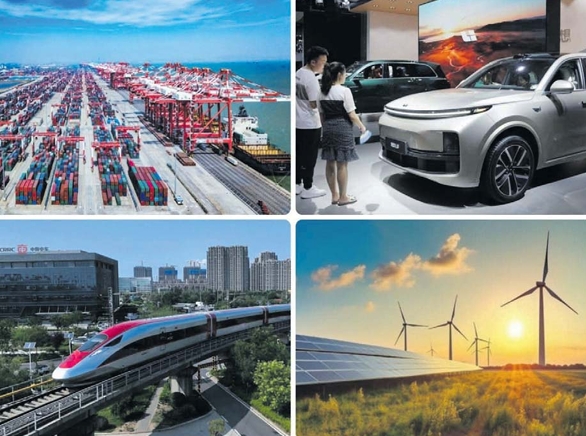
Under the strong leadership of the CPC, China’s economy has continued to demonstrate resilience and vitality in the face of challenges. In 2025, China’s GDP reached $US20.4trillion ($F 46.7t), with year-on-year growth of 5 per cent. Per capita disposable income rose by 5 per cent in real terms. Emerging industries such as new energy vehicles and robotics continued to expand.
Advances in areas including innovative medicines and new crop varieties brought tangible benefits to the people.
These achievements are owed to reform and opening up, scientific and technological innovation, market vitality and the collective efforts of hundreds of millions of people. They are also underpinned by the strong political safeguards provided by full and rigorous party self-governance.
The CPC continues to improve the system governing the exercise of power, ensuring that policies are effectively implemented and that the benefits of development are shared more widely and fairly among the people.
These efforts help create a clean political environment and a sound climate for growth, providing strong support for high-quality economic and social development.
China’s experience in poverty alleviation offers a clear example. Millions of party members and officials worked in rural communities to develop local industries, improve infrastructure and create more opportunities for people to increase their incomes.
As a result, China historically eliminated absolute poverty, lifting nearly 100 million rural residents out of poverty and removing all 832 designated poverty-stricken counties from poverty.
This achievement was made possible by economic development and enabling policies across various sectors. It also testified to the importance of effective organisation and co-ordination, capable officials and the efficient allocation of resources in overcoming development challenges.
China provides new momentum through its development for mutually beneficial co-operation with other countries.
As the world’s second-largest economy, China has contributed around 30 per cent of global economic growth for many consecutive years, making it an important engine and stabilising force for the global economy.
More and more political parties and people with far-sighted vision around the world have been drawing inspiration from China’s development experience.
In recent years, the CPC and political parties of Fiji and other Pacific Island Countries have held the China-Pacific Island Countries Political Leadership Dialogue six times, in the spirit of mutual respect and equal footing.
The dialogue has provided a platform for in-depth discussions on strengthening exchanges and co-operation and on promoting regional peace, stability and prosperity. Hundreds of representatives of Fijian civil servants and political parties have visited China to learn about its experience in economic growth, rural revitalisation and social governance.
These exchanges have helped support economic and social development of Fiji, and further strengthened the friendship between our two countries.
The Chinese market offers endless opportunities for Fijian products. China has been the second-largest trading partner of Fiji.
In 2025, bilateral trade reached $US652million ($F1494m), rising by 22.1 per cent year on year, and exports from Fiji to China totaled $US73m ($F167m), an increase of 162 per cent.
In China’s development, Fiji enjoys access to the vast and promising market, and opportunities for cooperation in technology, human resources and industry.
Recently, construction commenced on the China-aided Vunikura Jetty. Preparations have been underway for the Vanua Levu Road Upgrade Project. Once completed, these projects will help enhance transport connectivity, facilitate movement of people and goods, and create better conditions for the development of tourism, agriculture, fisheries and local businesses.
To run the country well, we must first run the party well; only a party that is thriving can make our country strong. By maintaining the strong capacity for self-purification, self-improvement, self-renewal and self-enhancement, a political party can better fulfill its responsibility to steer national development and improve people’s well-being.
China stands ready to maintain close exchanges with friends from all walks of life in Fiji, deepen mutual understanding of each other’s development path and governance philosophy, and expand practical co-operation across various fields. Together, we can move forward more sustainable development through higher-standard governance, improve people’s livelihood through more robust development, and build an even brighter future for the China-Fiji comprehensive strategic partnership.