
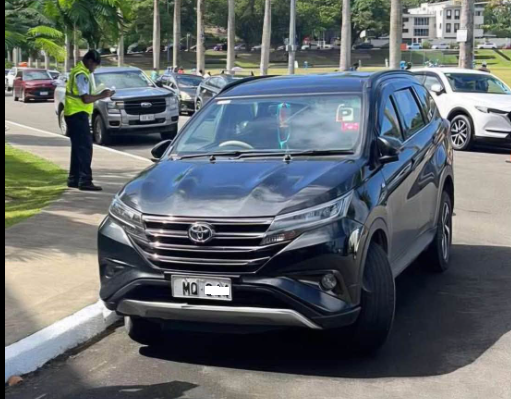
Members of Parliament are not above parking rules or other lawful requirements within the parliamentary precincts, says Minister for Forests and Fisheries Alitia Bainivalu.
Bainivalu made the comments on social media in response to Opposition MP Jone Usamate, who accused police of overreach after receiving a parking ticket while attending to parliamentary duties.
“Parliamentary privilege does not mean that Members of Parliament are above parking rules or other lawful requirements within the Parliamentary precincts,” Bainivalu said.
She said that after seeing a photograph circulating on social media showing where Usamate’s vehicle had been parked, the incident appeared to be a case of an officer carrying out their duties rather than police interference.
“Hon. Jone Usamate, having now seen the photo circulating on social media showing where the vehicle was parked, this appears less like a case of ‘police overreach’ and more like a police officer simply doing their job,” she said.
Usamate had earlier criticised police after receiving the ticket, saying he had been parked within the parliamentary precincts while carrying out the work he was elected to do.
Bainivalu rejected that argument and instead questioned whether Usamate’s vehicle had the required Parliamentary Vehicle Pass clearly displayed.
“The simple question remains: Was the Parliamentary Vehicle Pass clearly displayed on the dashboard at the time the vehicle was fined?” she asked.
“If the required pass was not displayed, how was the police officer expected to know that the vehicle belonged to a Member of Parliament and was authorised to park there?”
Bainivalu said police officers had a responsibility to enforce the law and maintain order and should be permitted to perform those duties without individual enforcement actions automatically becoming political disputes.
“Our police officers have a responsibility to enforce the law and maintain order,” she said.
“They should be allowed to do their work without every enforcement action being turned into a political argument about the separation of powers.”

