
THERE is a call for all citizens to be called Fijians to unite the country, while indigenous people are designated as iTaukei by the Methodist Church in Fiji and Rotuma (MCIF).
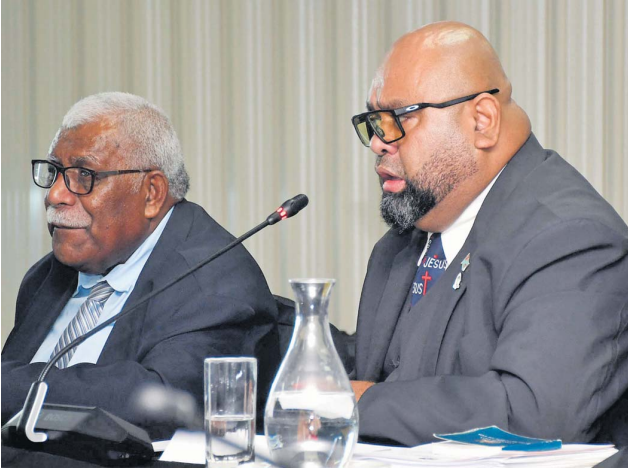
Presenting before the Constitution Review Commission in Suva yesterday, Methodist Church legal presentative Simione Valenitabua said their submission aimed to foster national unity across all races and religious denominations while emphasising the importance of a shared identity.
It is a matter of national unity, and it brings all races, all denominations, all people of Fiji together as we stand as one people, Fijians, says Mr Valenitabua.
“The differentiation will be the indigenous iTaukei,” he said.
“Although a minority of the division submitted that Fijians be left to the indigenous Fijians and for others to be Fiji Islanders, as was in the 1997 Constitution.”
“We ask the commission through wider consultation to weigh and then submit to Parliament whatever the majority feel should be the position, but the position of the church is that all citizens be Fijians.”
Plea to protect religious freedom
THE Fiji Council of Churches has made a plea to protect religious freedom, demanding the nation’s secular status does not silence faith in public life.
The council strongly opposed repealing Section 4 of the 2013 Constitution yesterday during a Constitution Review Commission consultation at Suvavou House in Suva.
Led by His Grace Archbishop Peter Loy Chong, the submission affirmed that while Fiji must remain a secular State, this status should never exclude religion and its activities from the public sphere.
The council threw its full support behind Section 4 alongside Section 22, which guaranteed every person the right to freedom of religion, conscience, and belief.
Archbishop Loy Chong said the church must remain entirely free to participate and contribute to national debates, advocate fiercely for social justice, defend vulnerable members of society, and proclaim the gospel across the nation.
He further emphasised the church’s ultimate duty is to serve the most high rather than any political entity.
“We affirm Section 22 protecting freedom of religion and we also affirm Section 4 that Fiji remain a secular state,” Archbishop Loy Chong said.
“Secularism should never require the exclusion of religion from public life.
“The church serves the Kingdom of God rather than the interest of any political party or government.”
Turning to human rights, the Archbishop highly praised constitutional protections for the less fortunate and people living with disabilities.
He welcomed the ongoing inclusion of essential socioeconomic rights, explicitly highlighting education, healthcare access, housing, food security, water sanitation, and social security safety nets.

