Fiji and Tuvalu are hosting key Pre-COP31 engagements this week, bringing global climate discussions directly to the Pacific.
More than 3000 delegates including global climate decision-makers have converged in Fiji and Tuvalu, ahead of COP31 in Antalya, Türkiye, providing an opportunity to build momentum for negotiations while showcasing Pacific leadership, perspectives and climate action.
Pre-COP focuses on the major issues including accelerating climate action, keeping 1.5°C within reach, improving access to climate finance, supporting Paris Agreement implementation and ensuring the energy transition is fair and leaves no one behind.
As Fiji’s national employers’ organisation, the Fiji Commerce & Employers Federation (FCEF) is representing the interests of the private sector and employers. This role is strengthened through FCEF’s affiliation with the Pacific Islands Private Sector Organisation (PIPSO) and the International Organisation of Employers (IOE).
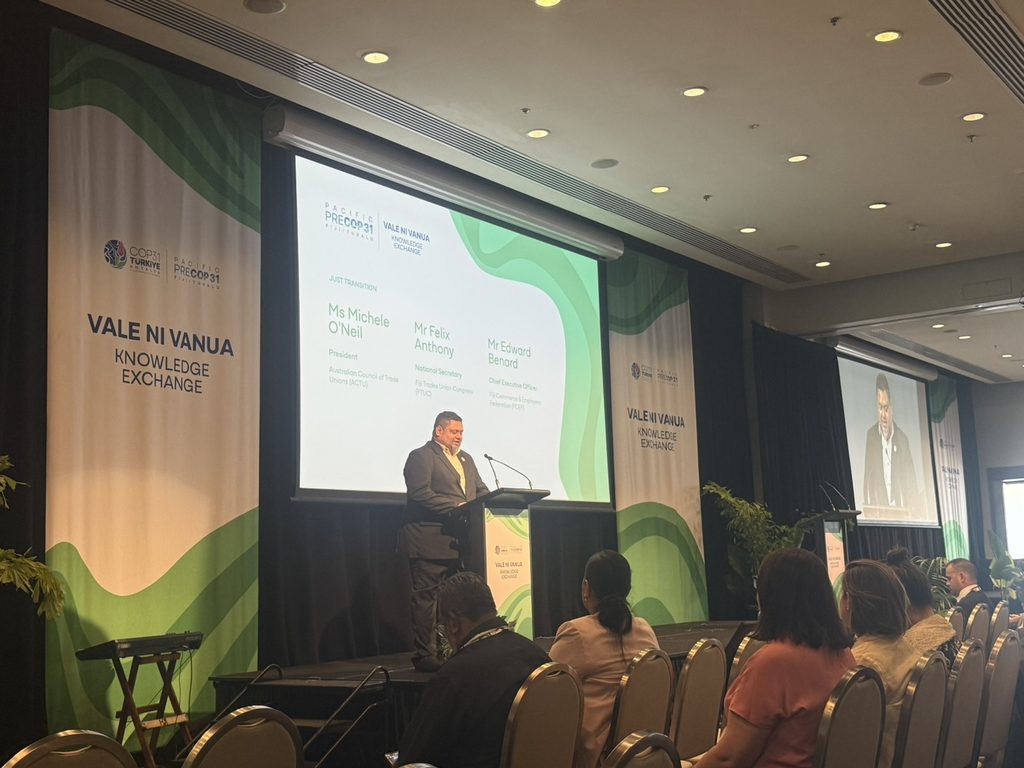
At the opening plenary, FCEF chief executive officer Edward Bernard called for greater attention and faster progress towards low-carbon economies, with decent work, enterprise resilience and sustainability at the centre of climate action.
Climate action and business continuity
For employers, the transition to a low-carbon economy is not only a climate-policy matter. It is also a business-continuity issue.
Businesses rely on stable infrastructure, utilities, transport networks, supply chains, communications and a skilled workforce. Climate-related disruptions to any of these systems can affect production, revenue, employment and the delivery of essential goods and services.
The transition will also influence how businesses invest, operate and plan for the future. Enterprises may need to improve energy efficiency, adopt cleaner technologies, change production processes and respond to new reporting or regulatory requirements.
Those that plan early will be better placed to manage costs, maintain operations and respond to changing expectations from regulators, investors, customers and communities.
There are also opportunities. Greater energy efficiency can reduce operating costs. New technologies can improve productivity. Climate-resilient products, services and infrastructure can create new markets and employment.
The objective should be to accelerate the transition while ensuring businesses have the information, skills, finance and implementation time required to remain operational and competitive.
Fiji understands the cost of disruption
Climate change is already a lived reality for Fiji and the Pacific.
Tropical Cyclone Winston resulted in more than 14.4 million lost working days and approximately $351.45 million in lost personal income. These figures demonstrate how a major disaster can move quickly from physical damage to economic disruption.
The consequences can be especially severe for micro, small and medium enterprises. Many MSMEs have limited savings, small workforces and less access to affordable finance. Even a short interruption can place significant pressure on their survival.
Strengthening business continuity is therefore essential to protecting employment, household income and Fiji’s wider economic stability.
Building resilience before disruption
FCEF established the Fiji Business Disaster Resilience Council (FBDRC) following Tropical Cyclone Winston in 2016, with support from the Pacific Community and the United Nations Development Programme.
The Council provides a platform through which the private sector can contribute to disaster preparedness, response and recovery. Its recognition under the National Disaster Risk Management Act 2024 reflects the importance of including businesses in national resilience arrangements.
Ongoing support from the Connecting Business initiative has strengthened cooperation between businesses, Government, development partners and humanitarian organisations.
More recently, the Council launched the Business Resilience Toolkit with support from the United Nations Development Programme and the United Nations Capital Development Fund.
The toolkit provides practical guidance to help MSMEs identify risks, prepare continuity plans, respond to disruptions and recover more effectively. It also recognises the needs of businesses led by women, young people and persons with disabilities.
Business-continuity planning can help businesses protect their people, records, equipment and supply chains while reducing the time required to resume operations.
This same approach should guide the transition to a low-carbon economy: identify the risks early, understand the likely effects and prepare businesses and workers for the changes ahead.
Employers are central to implementation
Much of the transition will be implemented within workplaces. Businesses will introduce new technologies, invest in equipment, test new business models and change how goods and services are produced.
Employers will need to assess how these changes affect operating costs, workforce requirements, productivity and future investment. Workers will need to learn new systems and adapt to changing roles.
Constructive engagement with employers is essential. Practical business information can help decision-makers understand how proposed measures may affect different industries and business sizes. It can also help identify realistic implementation periods, training requirements and areas where financial or technical support may be needed.
Early engagement creates an opportunity to develop policies that achieve climate objectives while supporting enterprise resilience, competitiveness and employment.
Skills will support continuity
Skills are one of the most important links between climate ambition and implementation.
Employers worldwide identify skills gaps as the single biggest barrier to transforming their businesses to low carbon, and the gap is widening rather than closing.
Yet, social partners remain on the margins of climate planning: only 14 per cent of the latest Nationally Determined Contributions (NDCs)ii explicitly mention employers’ and business organisations, and 11 per cent workers’ organisations.
Fiji’s National Skills Gap Assessmentiii identified 95 occupations that employers find difficult to fill locally. Electricians ranked fourth among the skills lost by businesses, joinery and carpentry seventh, and engineers ninth.
These occupations are important for disaster reconstruction, renewable energy, energy-efficient buildings, resilient infrastructure and the installation and maintenance of new technologies.
Workforce planning must therefore form part of Fiji’s climate and business-continuity planning.
Employers, Government, trade unions, education providers and training institutions can work together to identify future workforce requirements and align training with actual industry demand.
Greater investment in technical and vocational education, apprenticeships, workplace training and reskilling will help businesses retain capability while preparing workers for emerging opportunities.
Access to finance and practical support
For many businesses, particularly MSMEs, the cost of energy-efficient equipment, resilient infrastructure or new technology may be difficult to meet without suitable financing.
Improved access to climate finance should therefore extend beyond large national projects. It should also support businesses that need to strengthen their facilities, protect supply chains, adopt cleaner technology or improve their ability to recover from disasters.
Businesses will also need clear information and practical guidance. A policy may establish the direction of travel, but enterprises must understand what is expected, when changes will take effect and how they can comply.
Taking Fiji’s experience to COP31
Fiji and FCEF will be featured in the IOEs Skills for the Green Transition report, which will be launched at COP31 in Antalya.
This will carry Fiji’s private-sector experience beyond Pre-COP31 and into the wider international climate discussion.
It will also showcase the practical steps already being taken through business-resilience planning, skills research and cooperation between employers and national and international partners.
Protecting progress through collaboration
FCEF supports accelerating the transition towards low-carbon economies. The transition must be supported by evidence, meaningful consultation and practical measures that protect business continuity, decent work and livelihoods.
Businesses need clear policies, accessible finance, relevant skills and sufficient time to adapt. Workers need opportunities to build new capabilities and move into emerging roles. Policymakers need reliable information about the operating realities of different industries.
These needs are connected and can be addressed through continued collaboration.
For Fiji, a just transition is one that strengthens our ability to withstand disruption while creating the conditions for businesses to continue operating, investing and employing people.
Accelerating climate action and protecting business continuity are not competing objectives. With early planning and cooperation, they can reinforce each other and support a more resilient, productive and sustainable economy.