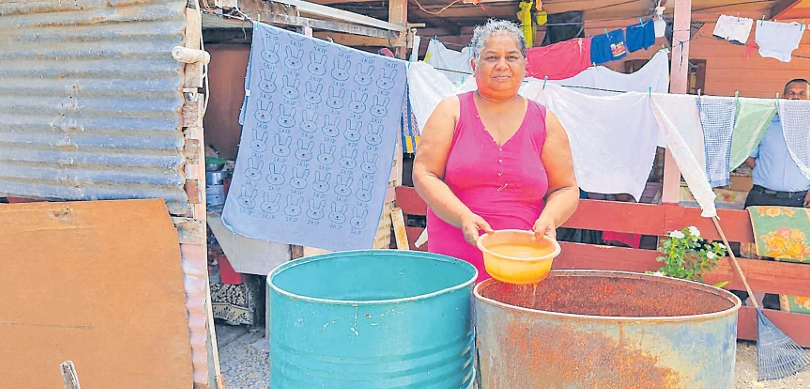
Villages run dry!
The El Niño drought is creating havoc and pushing Fiji’s water supplies to breaking point, with some villages and outer islands running completely dry as emergency water carting demands surge. For us in the Central division, we are blessed to receive water, but other parts of Fiji are going through a lot as ordinary citizens are facing a water crisis. The El Niño is intensifying and could get worse by next month. The government must brace for the worst and strategies must be put in place. The reports and stories published in The Fiji Times present a bleak outcome as far as water is concerned. Wake-up call! Rajnesh Ishwar Lingam Nadawa, Nasinu
Monasavu warning
Dangerously low water levels at Monasavu and the continuing dry conditions are a serious warning about Fiji’s energy security. When our hydropower supply is under pressure, we become more dependent on imported fuel to keep the lights on. With the sunshine available to Fiji, we should be moving faster to harness solar energy. Solar power, supported by battery storage and a stronger electricity network, should play a much greater role in securing our electricity supply. El Niño has been forecast, and the risks to hydropower have been recognised. Preparations and renewable energy projects have been announced. But have we done enough, early enough, to protect our people and economy? So what now? Noleen Billings Savusavu
Kalavata craze
Kalavata has become an accepted part of the tradition and culture of the country, as firmly established as cake cutting and salusalu. Nobody questions it anymore, and that is exactly why it is worth asking what it is really for. Is the idea of the kalavata to show that the people wearing it are united, or is it because it makes them all look silly? Unity is the usual explanation, but a group can be united without dressing identically. Matching outfits do not make a team, a family or a government any more united than it already is. Perhaps it is a bit of both: united in silliness. And if the tradition survives because people are willing to look silly together, that is not a flaw. It may be the strongest argument for it. Jan Nissar Sydney, NSW, Australia
About relevance
It seems the way things are going in the political arena, like they are travelling in a boat swaying from one side to the other and moving forward at a slower pace. Political candidates travelling in this boat are also being swayed by different political ideologies, some have remained steadfast, some have abandoned the ship, and some cling on for survival to remain relevant. New political candidates that have boarded the same boat have also got into the feeling of vouching I will do this and that or we will do this and that. The power behind a candidate to remain in that boat is from the people of Fiji, so as a politician do not continuously jump ships but remain relevant to the people of Fiji. Juki Fong Chew Nadawa, Nasinu
Fijian at heart
I don’t blame Tahir Ali of Hamilton, New Zealand, for your letter FT 21/11/26. This is not a “racist” debate, because it was not and it is not about race identity, in my view. In fact, I am certain, it was initiated as a political tool and was undemocratically endorsed in the 2013 Constitution, without the iTaukei, the founding people of Fiji, the indigenous people’s consent. “Fijian” had been their ethnic identity and it is not a race identity or a national identity, for that matter. Is Aborigine the national identity of Australia? Is Maori the national identity of New Zealand? Is American Indian the national identity of the US? Why Fijian? Indian is a “nationality” of India, as it refers to legal belonging to India, not an ethnic group. What then has been the sole reason for the UN Declaration on the Rights of Indigenous People? Does it not protect their culture, language and identity? Let alone lands and resources. When covetousness has been politically manipulated, I am certain, the motive is “unrestrained desire”, to acquire a specific thing, others own. Do I need to spell it out? Samu Silatolu Nakasi
Eat to survive
The Fiji Times news on El Nino crisis (FT 13/11) is everyone’s concern. Consumers have a role to play fighting with such crisis. Let’s stop polluting our environment and work towards saving the same at all cost. This should also help us to save Fiji tourism and the sugar industry, that are our main source of economic development. God bless Fiji — save natural resources. Tahir Ali Hamilton, New Zealand
Vested interest
The G-11 gang (formerly part of the FijiFirst mob) who are now vying for a PAP ticket for the next election know which side their bread is buttered in the prevailing political climate in the country. It’s all about their own vested interest. That’s why they had joined the current Rabuka-led Coalition Government in the first place after being lured with ministerial portfolios and perks. Please correct me if I’m wrong. Rajend Naidu Sydney, Australia
Vehicle wash
Since we are facing a severe, nationwide water shortage, how is it that car wash companies are still operating? Asking for a friend. Sobo! Wise Muavono Balawa, Lautoka
Unforgiveable!
Yesterday morning, (24/11), I heard the road grader some streets away — it turned up at our circle at about 1.30 in the afternoon. The grader, a monster yellow roller, thundered twice around our road shaking the ground, likely undermining building foundations, and kicking up dust which naturally, blown by the prevailing south easterly in the area, goes right into our houses, up our noses, and into our lungs. These graders have been rumbling around Pacific Harbour’s roads, every month or two, for several years now and it seems obvious that frequently grading and regrading our side roads costs way more than sealing them. A tar-sealed road will last 25 years with a possible reseal after 10-13 years, depending on weather and traffic conditions. Bad as that is, is the fact that preceding the grading roller was a water truck spraying water onto the road. Don’t we have a water shortage — especially in the north? Unforgiveable! Sue Cauty Pacific Harbour
Turning to crime
Ever wondered why some people turn to crime? Why do some people turn to crime while others, despite experiencing poverty, abuse, hardship and terrible childhoods, grow up to become responsible, compassionate and law-abiding citizens? It’s a question worth asking, particularly as communities around the world grapple with rising concerns about crime, violence and antisocial behaviour. The reasons are rarely straight forward. Poverty, unemployment, family breakdown, childhood trauma, domestic violence, drug addiction, peer pressure, even corruption by people in positions of power and authority and a lack of opportunity can all contribute to criminal behaviour. For some, crime becomes an escape from despair and desperation. For others, it offers a sense of belonging, power or financial reward. And there are some who revert to crime as a result of their rebellion towards those in authority because they’ve lost respect for those in charge who appear, in their minds, to be fleecing the populace. So crime for them becomes a justified response to their frustration and loss of respect for the powerful. But let’s not overlook another uncomfortable truth: not all crime is born out of hardship or rebellion and revenge. Greed, entitlement, dishonesty and the pursuit of power can be equally powerful motivators. And herein lies an important distinction. Understanding why people commit crime doesn’t mean excusing what they do. For example, was the Decree 51 saga that embroiled old age pensioners considered an abuse of power and office? Was it corruption? And could examples like this contribute to people’s perception that those in power don’t really care about ordinary folk and are abusing their position to defraud ordinary citizens? Personal circumstances can influence behaviour, but individuals must also accept responsibility for their choices. Victims deserve justice, communities deserve protection and those who break the law must face appropriate consequences. But if people are “seen to be getting away with criminal conduct by holding positions of trust”, it can have far reaching consequences and repercussions. Take the case of old age pensioners who’ve been allegedly defrauded by an illegal decree enforced by an allegedly illegal regime: how come this has never been rectified? Why have people allegedly gotten away scot free from their involvement in something that’s defrauded thousands of old age pensioners? Same could be said for the perpetrators of the treasonous coups — how many of these people have gotten away Scot free thanks to the immunity clause? And how about those who got clean away after the collapse of the National Bank of Fiji? How many of the perpetrators and those who never paid back their debts have gotten clean away? Can you see a pattern here? In the eyes of people, the rich and powerful are getting away with crimes against the country, the poor and vulnerable. So some people resort to revenge and rebellion by following a life of crime. It’s their “payback”! Doesn’t make it right. But that’s how some people roll. Perception can become a powerful motivator for people saying, “Stuff it! I don’t care anymore! I’m going to do the same as what these people are doing!” It doesn’t make it right. But this can happen sometimes where people buck the system and rebel against authority because they see people in power abusing their privileged position. However, perhaps society needs to look beyond all of this and look beyond punishment and ask a more challenging question: What are we doing to prevent people, particularly our young people, from turning towards crime in the first place? We need those in power to execute their roles with honesty and accountability and integrity. We need stronger families, better education, positive role models, meaningful employment, early intervention and rehabilitation that genuinely works. We can’t police our way out of every social problem, just as we can’t solve crime by simply making excuses for criminal behaviour. The answer lies in balancing compassion with accountability, prevention with justice and opportunity with personal responsibility. Ultimately, a safer society isn’t measured only by how many criminals we put behind bars, but also by how many people we help avoid a life behind them. Surely, that’s a conversation worth having including the conversation about why so many people have gotten away from facing the full brunt of the law for their involvement in white collar crime. Colin Deoki Australia