Sukuna Bowl thriller
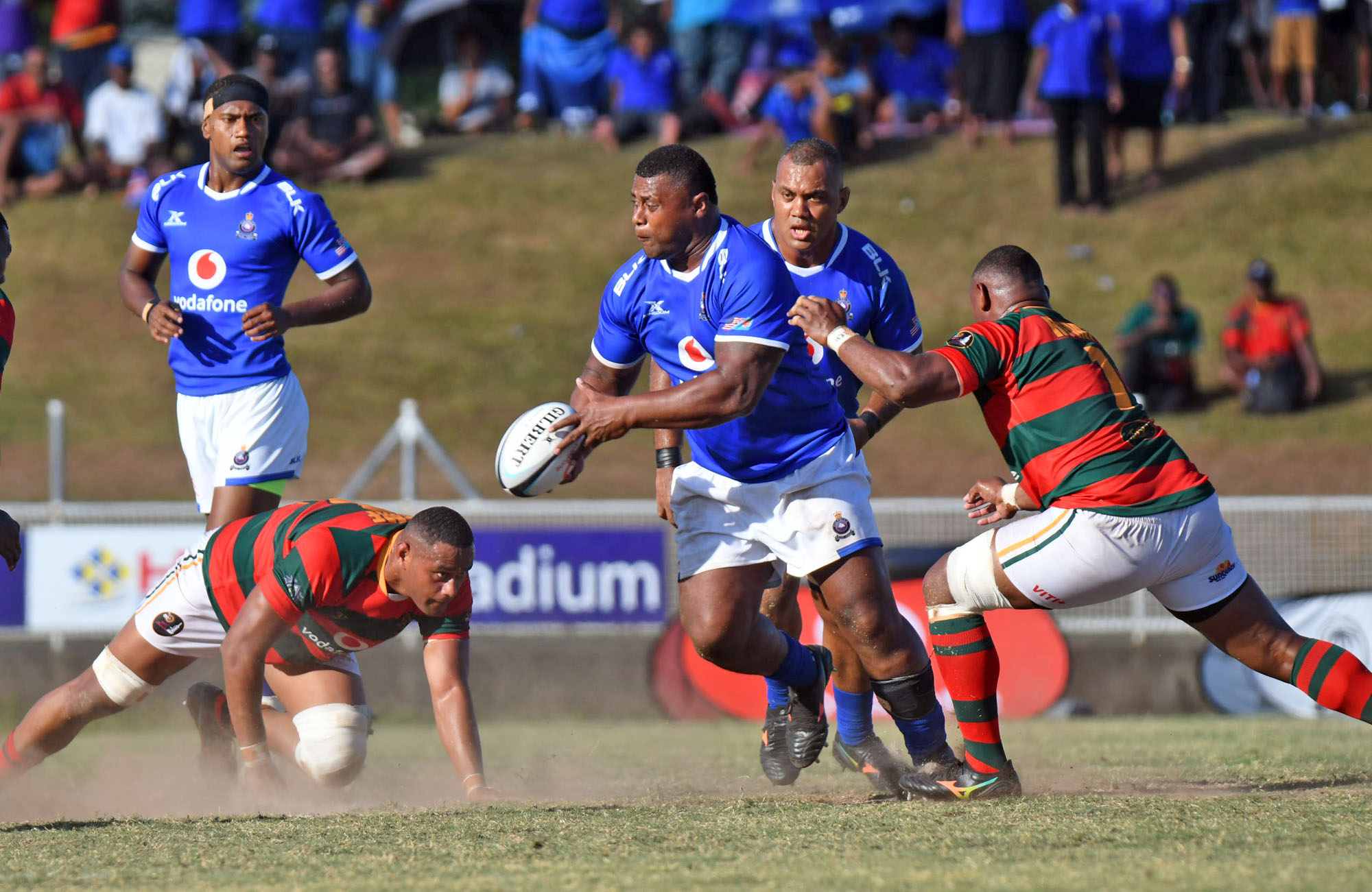
Army’s discipline, camaraderie and dedication was tested against Police’s resilience and persistence. Past battles between the Forces lived up to expectations, and this year’s torrid clash unveiled excitement and thrills. Down memory lane and in 2020, Police won the FMF Rise Fiji Rise Sukuna Bowl, defeating Army 32-8. The following year, Army edged Police 18-17 in a thriller of a rugby match. Police led 17-10 at half-time. In 2022, the FMF Sukuna Bowl travelled to Nasova after Police won 19-11. In 2023, the closely contested clash lived up to expectations as Police retained the Vodafone Ratu Sukuna Bowl Challenge following an 11-all draw against a strong Army side. In 2024, the Shop N Save Police Blues retained the Ratu Sukuna Bowl title in dramatic fashion, edging out Army 20-19 in a thrilling showdown, adding a third year to their winning streak. Leading 10-6 at half-time, the Police put up a determined and courageous effort, and in front of their passionate fans, they defended their line to retain the title. The battle of the Forces thrilled the Friendly North last year. The defending champions made a massive and bold statement as they delivered a masterclass performance to overpower Army 26-10. Police’s tactical superiority and unyielding and ferocious defence shut down Army’s arsenal. They contained Army’s fast-paced rugby and weathered the intense pressure. Both sides played their hearts out, but the experienced players for Police took charge and they came out victorious. Good game management and maintaining the high level of intensity proved crucial for Police. The stage was set for the battle on Saturday afternoon. Fans poured out in numbers to support both teams. As I conclude, I congratulate Army for winning the elusive football title, ending an eight-year drought. The goal by Gabriel Matanisiga was a class. Great feat, team Army! RAJNESH ISHWAR LINGAM Nadawa, Nasinu
Here, we go neutral
We do realise that the good stuff we pen on these pages actually get picked up by the important people, and some of our opinions are used to ask questions, answer questions at public forums, write policy, make speeches and pretty much help in governance. We do realise how important it is to maintain neutrality when providing the much needed critique to decisions, policy and matters of national importance. Political preferences must be confined to the ballot booth. Here, we go neutral. Donald Singh Nausori
El Nino effects
The PM has declared a National State of Disaster (FT 19/11/26). I do not recall any such declaration since Fiji’s independence. Only within the past 30 years, I remember our water distribution system’s gradual deterioration from bad to disastrous, as it is today. The WAF has already been in a “chaotic” stage and the El Nino just fanned the flames, in my view. Even if drought lingers, water supply should not have been rationed. In fact, it all boils down to poor management of freshwater sources and treated water storages, in my opinion. Fiji, I am certain, has four major surface water systems in Viti Levu and four in Vanua Levu, with potential groundwater. It will be incomprehensible for Fiji’s residents to be continuously denied such a basic necessity, in my opinion. There are certain countries, I am certain, that do not have such surface water sufficiency and yet, enjoy peaceful availability. It is not what we possess, but how we manage it that matters. Samu Silatolu Nakasi, Nausori
Missing grant money
I read with interest the case where a former director of finance with Ministry of Education, Heritage and Arts was acquitted of abuse of office and general dishonesty charges after FICAC failed to prove its case beyond all reasonable doubt (FT 19/11). It was alleged that the accused improperly managed the $20,000 Chinese Embassy grant and failed to submit the required acquittal for the expenditure. In his defence the accused maintained that his actions had the permanent secretary’s approval and the cash was kept in his office drawers to show the donor the funds were ready for use. But when he returned from overseas leave he found his drawers open and the money was gone. According to him the office keys were also held by other staff. It is not my intention to repudiate the accused’s testimony or the findings of the court. However, I believe there are standard procedures stipulated under the financial regulations for the safe storage of cash. Normally such large amount of money should have been secured in a vault for safe keeping and not in the draw. Secondly, why was the cash not handed over to any staff before the accused proceeded on leave? The other option was to deposit the money in the bank. Therefore, I am at a loss to understand as to why these procedures were not followed. The bigger question remains: what happened to the $20,000? SELWA NANDAN Lautoka
Resistance to Indo-Fijian PM
A man from Macuata has asked why there is resistance to an Indo-Fijian becoming prime minister. It is a fair question, and it deserves an honest answer. In a nation whose citizens are equal before the law, no one should be judged unfit to lead because of their ancestry. When a candidate is opposed not for their policies, record or character but for their ethnicity, the technical term for that is racism. Unless someone can offer a reason that does not rest on race, the conclusion stands. The contradiction is stark for those who oppose a prime minister because of race, yet sit in church each Sunday. Every Christian teaching holds that all people are created equal in the eyes of God. Those who preach love of neighbours, but practise prejudice are not defending their faith; they are betraying it. Sadly, this attitude is not confined to the pews. Such people hold the highest offices in the land and lead civil society bodies, where their example gives prejudice respectability. Those entrusted to uphold equality are instead standing in its way, and every day it goes unchallenged, the betrayal continues. Jan Nissar Sydney, Australia
Land, genocide and rugby
Land and investment
The recent proposal to bring State and freehold land under iTaukei ownership understandably caused concern. The Prime Minister’s statement that the proposed transfer cannot be implemented provides reassurance. But investment confidence can be shaken much faster than it can be restored. A lawyer can check a title today. A buyer also needs confidence that those rights will be respected tomorrow. Freehold accounts for only about 6 per cent of Fiji’s land area, according to the National Development Plan, compared with approximately 90 per cent customary land and 4 per cent State land. That small share provides private ownership without a lease expiry date. Subject to Fiji’s laws, owners can sell, pass property to their children and offer it as security for finance. iTaukei individuals and families also purchase freehold land. These rights protect all owners across our communities. Secure ownership encourages investment in homes, farms and businesses, supporting employment, suppliers and economic activity. When investment is delayed or lost, the effects extend beyond property owners. This also matters for national debt. Investment can expand production and taxable income, helping Government fund services and meet debt obligations. Responsible public financial management remains essential, but undermining investor confidence makes that task harder. Historical grievances deserve respect. Accounts of ancestral land exchanged for goods of little lasting value remain painful. TLTB records that the colonial Land Claims Commission rejected or reduced many early European claims, while recognised claims formed the basis of freehold titles. That process does not mean every injustice was resolved. Specific grievances deserve examination through evidence and lawful processes. Present owners may also have purchased generations later, in good faith, using their savings. Acknowledging historical wrongs and respecting lawful ownership today are responsibilities we must uphold together. Recognising freehold’s value does not mean customary land should be sold. A sale brings a payment but permanently transfers ownership. Fair leases, business ownership and carefully negotiated partnerships can instead help customary owners retain their inheritance while earning continuing returns. Secure leasehold also supports investment. Fiji benefits when customary owners, freehold owners and leaseholders all have dependable protection. The current Constitution protects customary ownership, freehold tenure subject to stated exceptions, and lease rights. Government should consistently reaffirm its commitment to lawful land rights. Protect iTaukei land. Respect lawful freehold ownership. Strengthen lease security. Help landowners receive fair returns. These goals can work together-for the security and prosperity of the nation and all of Fiji’s people. Noleen Billings Savusavu
Genocide against Rohingya
I refer to The Fiji Times article “Top UN court finds Myanmar committed genocide against Rohingya” (Reuters/ FT 21/11/26 ). I recall former UN High Commissioner for Human Rights Zeid Ra’ad al-Hussein had at the very outset of Myanmar’s 2017 military crackdown against the Rohingya a “textbook example of ethnic cleansing” in September 2017, before later warning that the violence could amount to genocide. The November 19, 2026 International Court of Justice ( ICJ ) ruling that Myanmar committed genocide vindicates what former UN Human Rights commissioner Zeid Ra’ad al-Hussein had alerted the world community about a decade earlier. It is, however, never too late to make the formal finding of genocide against the rogue Myanmar regime. Rajend Naidu Sydney, Australia
Get the Dubai 7s trophy
The 2025/26 HSBC SVNS WRSS circuit is water under the bridge. Fiji started well and was the only team to have featured in every semi-final. After finishing third in Dubai and Cape Town, where we won the bronze medal after defeating France 24-7 and 26-19 respectively, Fiji won the Singapore 7s, beating France 21-12. The boys finished second best in Perth and New York losing to South Africa 21-19 and 10-7 respectively, and settled for a bronze medal in Vancouver after beating Australia 29-10. Fiji finished second best with 104 points, two behind champions South Africa. However, we had a difficult outing in the World Championship Series, where the boys lost 24-17 in the quarter-final to Argentina at the 50th anniversary of the Hong Kong 7s. Fiji finished fifth after beating Australia 26-10. At the Valladolid 7s in Spain, Fiji lost 14-12 to hosts Spain in the final pool match but thrashed arch rivals, the All Blacks 7s 40-0 in the quarter-final. The boys went down 21-14 to Australia in the semi-final and 28-17 to Argentina in the third-place play-off. In Bordeaux, our performance went from bad to worse as the boys finished sixth after losing 17-14 to the USA. Fiji finished sixth overall with 36 points, 16 behind South Africa. Missed tackles were a huge concern. Our boys looked tired and couldn’t execute the basics of 7s. The Dubai 7s starts next weekend at The Sevens Stadium, where Fiji faces the All Blacks 7s, Spain and France. If we perform the way we did last season, we will not make it from the pool, considering we have three giants in our pool. Kolinisau needs assistance and there is no better person than current Ra coach Sireli Bobo, an industrious finisher on the 7s pitch and one who has proved his credentials with Ra. FRU, please let’s utilise Bobo’s expertise! Rajnesh Ishwar Lingam Nadawa, Nasinu