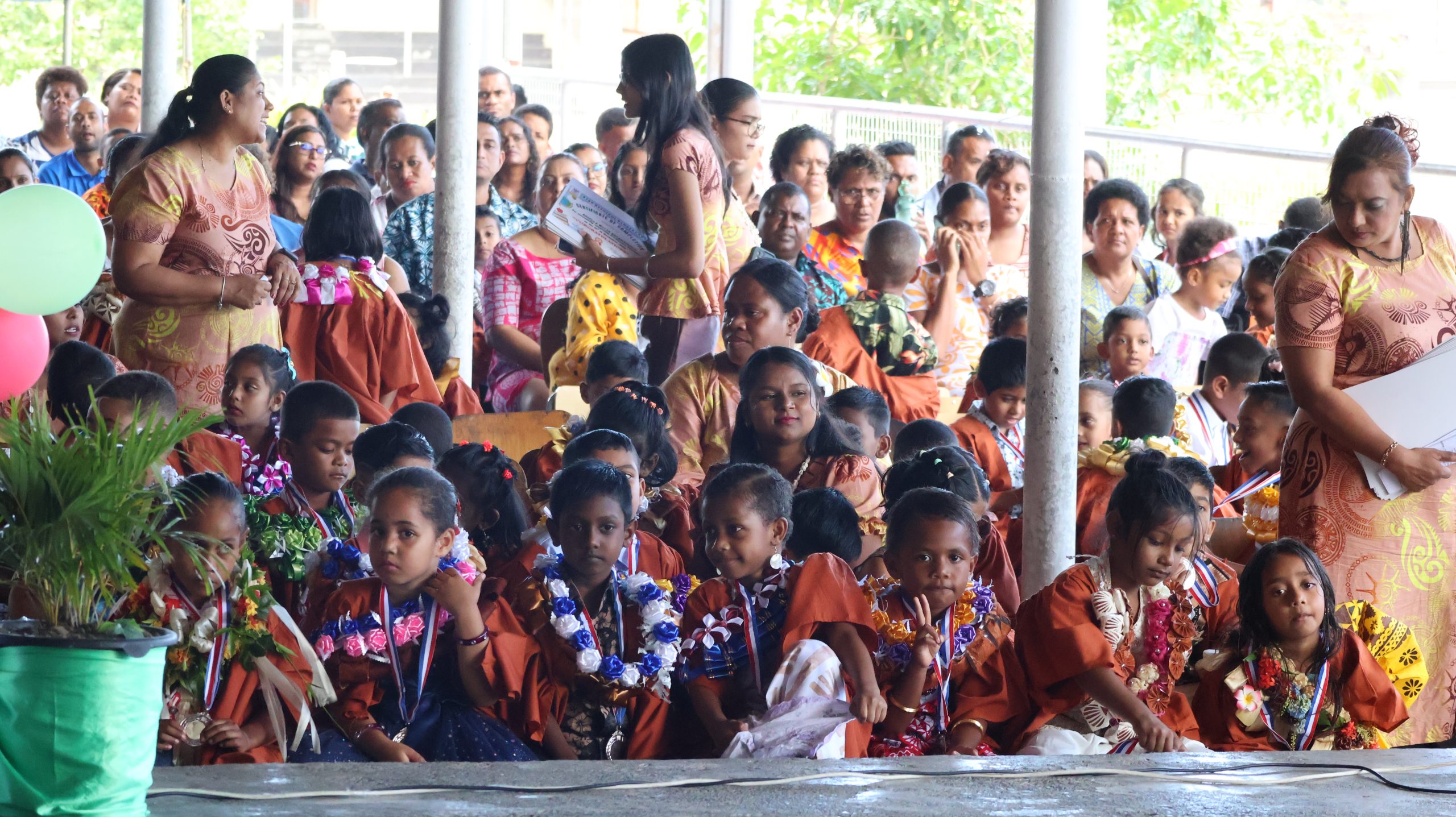
Pre-primary graduation ceremony
The pre-primary graduation ceremony is significant. It celebrates a child’s completion of their first year of formal schooling, builds and boosts self-confidence, eases the transition into elementary school, honours progress and strengthens the bond between the school and community. Our editor-in-chief, Fred Wesley, was at Rishikul Primary School in Nasinu yesterday to grace their pre-primary graduation ceremony, and I found these lines from his speech inspirational, “The Fiji school system must continue to evolve to meet the needs of a changing world. We need children who can think independently, ask questions, solve problems, communicate effectively and appreciate the importance of knowledge. We need to nurture creativity, and we need to nurture confidence. We must encourage children to become curious about the world around them, rather than simply memorising information to pass an exam. And we must never forget that every child learns differently. Some children grasp concepts quickly. Others need more time, more attention and different approaches. That should never become a reason to give up on a child. Our responsibility is to ensure that no child is left behind simply because the system has failed to recognise how that child learns.” Thank you, Wesley, for the powerful speech to the graduates, who put up a brave performance and looked adorable in their graduation gowns! Rajnesh Ishwar Lingam Nadawa, Nasinu
Four terms?
I am writing to express my views regarding the ongoing concerns over poor academic results reported across most schools in Fiji. To address student and teacher fatigue, I believe the Ministry of Education should strongly consider transitioning to a four-term school year model. Under this proposed structure, the academic year would be divided into four distinct 10 week terms. A two-week break between the first three terms, followed by a six-week break at the conclusion of term four, would provide ample and balanced time for both students and teachers to rest, recover, and prepare effectively. Continuous classroom instruction stretching over thirteen to fourteen-week marathon terms often leads to severe burnout and diminished focus for everyone involved. Shorter, structured learning blocks interspersed with regular intervals of rest would help maintain academic momentum, minimise learning loss, and ultimately improve overall educational outcomes. It is time we look at innovative structural reforms to better support our schools and safeguard the well-being of our students and educators. Edward Kumar Lautoka
Faith, ethnicity and politics
Fiji will only move forward when we stop building political parties around ethnicity and religion. Politics is a ruthless, “must-win” game where players twist words to disguise deception as truth. When we drag our culture and faith into that arena, we cheapen them both. We must heed the timeless command to “give to Caesar what belongs to Caesar, and to God what belongs to God”. Left out of partisan games, the iTaukei and all other ethnic groups will naturally prosper together. Kept independent of politics, religion can remain a pure beacon of light across our land. Likewise, the Great Council of Chiefs must remain a strict advisor on iTaukei welfare and the vanua, completely aloof from party politics. Let politicians play their games alone while the public watches with eagle eyes. They will stop playing dirty the moment they realise a united majority is holding them accountable. If we keep letting them weaponise our race and faith, they will continue to manipulate us unchecked. Paula Kaloukocei Levuka, Ovalau
Rowdy students
On Tuesday, November 17, 2026, at approximately 3.20pm I boarded a bus from a Votualevu bus stop to go towards Nadi Town. At the back of the bus there were several extremely noisy high school students. They joked, laughed, shouted and screamed as if they were in their village rara. Talk about proper manners and behaviour in public. Upbringing such ill-mannered students must be addressed for a better Nadi. It was rather a shameful experience to witness such poor behaviour in public transport. It is sad. The problem must be addressed by all concerned. Such behaviour cannot be tolerated. Parents and teachers must act soonest. Ronnie Chang Nadi
Workers, road, education
Authenticity questions
Bangladesh has reportedly put forward a series of requests aimed at making it easier for its citizens to secure employment, obtain work permits and take up jobs in Fiji. The requests were recently made by Bangladesh’s Labour and Employment and Expatriates’ Welfare and Overseas Employment Minister Ariful Haque Chowdhury to Fiji’s High Commissioner to India, Jagannath Sami. While our immigration department works on the requests, there has to be heightened scrutiny of the documents provided by some of the incoming workers. Some of those reference and certificates look generically produced upon careful examination. While most of the incoming workers are highly skilled and have high productivity standards, some are still found lacking. The whole process has to be fair to the companies that bring in people to fill the gaps that locals are either unable to or unwilling to fill. Bangladeshi workers have helped keep several businesses afloat no doubt. They show up at work and actually do the job. Better scrutiny would greatly help though. Donald Singh Nausori
Isomorphic mimicry
Higher education institutions can tick every box and still miss the point of education. A recent Times Higher Education article, “Bangladesh’s Quality Regime Is Crushing Its Higher Education”, exposes the troubling distance between institutional compliance and meaningful learning. The article questions a quality-assurance system that prioritises bureaucratic requirements over intellectual inquiry. This reflects isomorphic mimicry, where institutions imitate successful systems without developing their underlying capabilities. Fiji should take heed. Building more schools, expanding universities and increasing enrolments are worthwhile achievements, but do they necessarily signify educational progress? Education must extend beyond infrastructure, accreditation and qualifications. Its essence lies in cultivating independent thought, creativity, ethical judgement and practical competence. It should empower individuals to question assumptions, challenge complacency and contribute meaningfully to society. Otherwise, we risk perfecting the appearance of educational excellence while neglecting its substance. Dr S. Ram Drasa Vitogo, Lautoka
Respect has no vehicle size
One concerning behaviour I have noticed on our roads is the attitude of some drivers towards motorists in smaller vehicles. At times, drivers of larger vehicles seem to intimidate or bully those in smaller cars, while in other situations, drivers of smaller vehicles display the same behaviour towards larger vehicles. We must remember that road rules and responsibilities apply equally to everyone, regardless of the size, value or type of vehicle they drive. A driver operating a truck, bus, SUV or small hatchback is equally accountable under the law. When road incidents reach the courts, drivers are judged based on their actions and the evidence, not simply on the size of their vehicles. Having a bigger vehicle does not give anyone greater authority on the road, nor does driving a smaller vehicle give someone the right to be careless or disrespectful. Our roads are shared public spaces, not places to demonstrate power, pride or superiority. Every driver deserves respect and consideration. Let us remember that road safety is a shared responsibility. Good driving is not measured by the size of your vehicle, but by your attitude, patience and respect for other road users. Shamal Chand Kuku Village, Nausori
Bold and beautiful
After the resounding midterm election defeat of the Republicans, a reporter asked Trump to his face “How does it feel being a loser?” Now that’s what we call bold and beautiful journalism. It exposes the self-styled American emperor with no clothes/golden garment. Rajend Naidu Sydney, Australia
Top boxer
Congratulations Nishant Dev on extending your unbeaten record to an incredible 8–0! Your sensational third-round stoppage of American boxer Sona Akale in Los Angeles marks another proud moment for Indian boxing. This victory is more than another win on your record. It is a rare and inspiring achievement for India on the global professional boxing stage, where Indian fighters continue to build a stronger presence. Competing internationally, remaining unbeaten, and delivering such a commanding finish are a testament to your dedication, skill, and fighting spirit. India has celebrated remarkable success in amateur and Olympic boxing, and performances like yours help carry that legacy into the professional arena. Every victory brings greater visibility to Indian boxing and gives young athletes another reason to believe they, too, can compete with the best in the world. As the Fighting Pride of India, you carry not only your own ambitions into the ring but also the hopes of countless fans cheering you on from home. Your journey shows what courage, discipline, and relentless hard work can achieve. Congratulations once again, Nishant! Keep raising the bar, making your country proud, and inspiring the next generation of Indian fighters. We look forward to the exciting chapters ahead. Suresh Chand Nadi
The timing
Vinaka PM! What a timing? State of Natural Disaster. When we are in the middle of the cyclone and rainy season. I understand. After all, did anyone die? Kirti Patel Lautoka
Advice to lawyers
Offering fatherly advice to new lawyers, Chief Justice Salesi Temo “warned them against making money their priority during the early years of legal practice” (FT 18/11). That’s good advice. I believe money making can become the priority in later years of legal practice when the right corporate and other influential connections have been cultivated. Rajend Naidu Sydney, Australia