El nino-driven drought
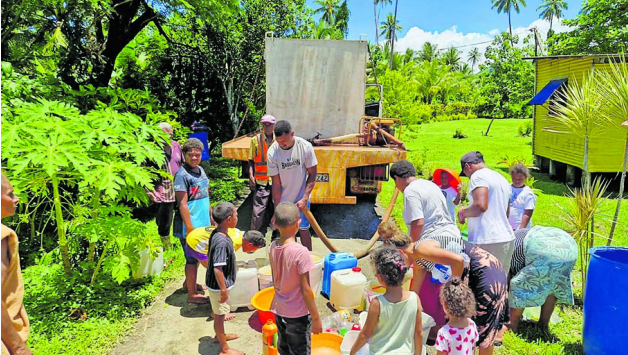
With our beloved Fiji at the crossroads amidst the growing crises from drugs, poverty and rise in cost of living and housing, HIV/AIDS, youth crime and vandalism, race tensions and drugs, the water crisis is taking its toll on thousands of Fijians daily.
Humans, animals and the vegetation are suffering because of the prolonged drought and lack of rain. Fiji’s water sources are at critical levels, threatening access to a necessity. I’m thankful to the Ministry of Agriculture for launching six new initiatives for farmers that will cover emergency water supplies, livestock feed, planting materials and household food security.
The growing pressure prolonged by dry conditions are severely affecting farmers, their families and livelihoods.
The declining water availability is resulting in crop losses, reduced farm incomes, stock feed shortages and deteriorating pastures.
It’s time for action and not words. On the other hand, Fijians must brace for water shortages, water cuts and water rationing.
Let’s act now and not complain when these happen. Necessity is the mother of invention — let’s pay heed to this adage! Ro Filipe Tuisawau, the Minister for Public Works, has warned Fijians to prepare for the worst, and this warning must not fall on deaf ears as water levels at the Vaturu Dam are deteriorating rapidly.
We must prepare for possible water shortages and take steps to conserve water. I echo the sentiments shared by Hon Filipe Tuisawau (FT: 13/11), “Families need to work on their individual family plans.”
Rajnesh Ishwar Lingam Nadawa
Stop playing politics with land
The recent submission presented under the SODELPA banner before the Parliamentary Special Committee — calling for all land in Fiji, including freehold land, to be returned to the iTaukei — is a deeply disappointing display of shortsighted politics.
Even with the party later scrambling to distance itself from those remarks, the damage is done. It exposes a familiar, manipulative tactic used by politicians to stir emotions and fish for votes.
Before demanding more land, we must look honestly at our own back yard. Vast areas of iTaukei land across Fiji sit idle and unproductive. Worse still, in many of our own communities, we struggle with theft — where people steal yaqona and cassava from each other’s plantations.
What is the logic in demanding more land when we are failing to cultivate, protect, and respect what we already hold?
Furthermore, freehold land was legally purchased at great financial cost by our vasu and fellow minority citizens who have invested their lives, sweat, and savings into building this nation alongside us.
Threatening their security is not leadership; it is divisive and unjust.
We must remember a fundamental truth: when we leave this world, we do not take a single inch of land or qoliqoli with us. We are merely temporary caretakers, and we take only our souls when we depart.
It is time to reject this greedy, regressive mindset. Leave freehold land alone —the land has eyes, and true stewardship begins with responsibly using what is already in our hands.
Paula Kaloukocei Levuka, Ovalau
Misplaced applause
Dr Prashneel Goundar has aptly responded to and shot down Rajnesh Lingam’s glorification of George Speight (FT LTE 13/11).
It seems Lingam is struggling with conscience issues. I mean, you can’t seriously be taking your hats off and lavishing praise on anyone and everyone.
His glorification of Speight was indeed over the top, but I wasn’t surprised. A meaningless medal versus a nation ruined by the medalist.
His sentence is still active, postponed though. Come on Lingam.
Donald Singh Nausori
Forgive and forget
Rajnesh Lingam is absolutely spot on (FT 14/11).
Let’s forget the dark history of coups and pardon those responsible for violently overthrowing democratically elected governments. After all, what could be more Christian than forgiving those who committed such acts in our supposedly secular Fiji?
May I also request members of the Hindu faith to practise the same spirit of forgiveness towards those who disrupted their Diwali prayers and celebrations by demanding sweets, pelting homes with stones and unleashing racial abuse when their demands were refused?
Let us also forgive those who hurled firecrackers at moving vehicles, vandalised properties belonging to Hindus and engaged in other acts of unruly, intimidating and unchristian-like behaviour on Diwali night.
In Fiji, the famous process of matanigasau and the familiar mantra of “moving forward” have become part and parcel of our national culture. We have coups, followed by apologies, church services, grand feasts and public displays of repentance. Eventually, everything is sasa broomed under the carpet and everyone is expected to move on.
The events of 1987 and 2000 were no different. Decades later, some of the key coup conspirators are still glorified, garlended and regarded as heroes by sections of society.
But here is the question, does forgiveness mean abandoning accountability? Can we continue to excuse violence, racial intimidation and the overthrow of democracy simply because someone eventually seeks forgiveness?
By all means, let us forgive and forget. After all, that seems to be the convenient Fijian way, forgive the perpetrators, forget the victims and move on as though nothing ever happened.
And then we wonder why Fiji continues to remain a third world nation struggling with political instability, economic stagnation, poverty, high crime rates, the drug pandemic and a culture where liability appears to be optional.
Truly the Fijian way.
Nishant Singh Lautoka
A cart before the horse
It’s definitely a cart before the horse situation when you make and pass legislative changes (new electoral laws) before the Constitution itself is passed.
The Constitution — as the mother of all laws — lay out the policy guidelines, so to speak, from which enabling legislations are made to operationalise those constitutional provisions.
Perhaps, this “back to front” situation can be “normalised” if these particular legislations, each comes into force on a date after the Constitution itself comes into force, which presumably will be on March 31, 2028.
What you always want to ensure is that any legislation that comes into force, must always comply with the related parent constitutional provisions.
It’s always harder when things are done back to front !
Edward Blakelock Pacific Harbour
Same difference
I saw a headline in Saturday’s The Fiji Times (page 44) which states — Crime falls, theft rises.
Crime is a general term used to classify offences like theft, burglary, rape, indecent assault etc.
Therefore, I believe despite what the headline states, the difference is the same.
Juki Fong Chew Nadawa, Nasinu
Workplace safety and training
Every employer in Fiji has a responsibility to ensure the health and safety of all workers in the workplace.
While shopping at a supermarket, I witnessed something that genuinely concerned me. Two young female employees were climbing a ladder to remove and bring down stock from the top shelves.
Watching them made me wonder: Have they received the proper Occupational Health and Safety (OHS) training?
Are they using the correct safety equipment?
And if one of them were to fall and suffer an injury, would all the necessary workplace safety measures have been followed?
It is heartbreaking to think that workers often put themselves at risk simply to carry out their daily duties and earn a living.
A company might count its profits every day, but it must never overlook the safety of the people who help it operate.
Imagine an employee going to work in the morning, expecting to return home safely to their family, but an avoidable workplace accident changes everything.
Sad eeh?
NAVNEET RAM (TD) Lautoka
Play with pride and passion!
The Fiji Water Flying Fijians have had a disappointing start to this year’s Nations Championship, losing all their matches (39-24 to the Welsh Dragons, 73-8 to England’s Roses, 333-17 to Scotland’s Bravehearts and 54-17 to the Les Bleus at the Groupama Stadium in Lyon).
The Flying Fijians have a lot of work on their plate and Jake White and his coaching panel need to rectify the weaknesses exposed by France, one which was kicking away possession aimlessly, heading to next year’s RWC 15s.
Ireland will be a different beast at home. They thrashed Argentina 42-12 and in front of their home fans, will be a tough nut to crack.
Ireland is the only team participating in the Six Nations Championship that Fiji hasn’t beaten.
Hence, this massive test at a jam-packed Aviva Stadium, where we will face a passionate Irish crowd, is everything to play for!
From that 8-0 win at Buckhurst Park dating back to 1976, Ireland has won all the Test matches versus Fiji: 16-15 in 1985, 44-8 Fiji in 1995, 64-17 in 2002, 41-6 in 2009, 53-0 in 2012 and 35-17 in 2022.
The closest Fiji came to beating Ireland was in 2017 at the Aviva Stadium, but we lost 23-20.
At the same venue, Fiji and Ireland last met in 2024 and the hosts hammered Fiji 52-17.
Head Coach Andy Farrell has named a powerful and exciting squad, with Tadhg Beirne to lead Ireland out alongside some big Irish names in Jamie Osborne, Bundee Aki, Tommy O’Brien, Jamison Gibson-Park, Andrew Porter, Ronan Kelleher, Tadhg Furlong and Josh van der Flier.
The battle will be tough. Our boys need to make the tackles count, keep hold of the possession, and make use of set-pieces and try-scoring opportunities.
They must play their hearts out, play with pride, determination and passion and keep the game flowing. Toso Viti!
Rajnesh Ishwar Lingam Nadawa, Nasinu
Neighbours jailed
Neighbours jailed for robbing elderly woman (FT 14/11/26).
What a crying shame!
The two men who ransacked the neighbours home while she was away wouldn’t have known about the biblical command “love thy neighbour as thyself”.
If they knew, they wouldn’t have done such a lowdown thing.
Rajend Naidu Sydney, Australia