
Traffic lights RONNIE CHANG MARTINTAR, NADI THE traffic lights at the junction to Mount Saint Marys and Queens Road remain totally extinguished following the tragic accident which claimed the young innocent life of a Virgin Australia flight attendant. This intersection is often chaotic pre/after school days and on Sundays from about 7am and just after 10am. Some police traffic personnel is definitely needed. Duty official can help override traffic signals to speed up traffic flow, in my humble view. I share my observations, respectfully. It is common public knowledge speeding by two vehicles caused a taxi to veer out of control impacting on this innocent deceased young lady. She suffered extensive injuries — hard to describe. There is no news about the two drivers since. God rest her soul. The Martintar stretch of the Queens Road is today notorious for much speeding and “show off younger drivers”. Can Namaka police offer some assistance, please? There is not enough law enforcement personnel, even at random, to maintain noticeable deterrent presence. Our culprit drivers take full advantage. Several other Martintar traffic lights often do not work. Something is apparently wrong to keep them fully operational.
Absence of traffic controllers SURESH CHAND NADI A TRAFFIC controller is urgently needed to manage the flow at the Raniga St/Andrews Road junction, which becomes heavily congested during the morning peak hours. This junction lacks proper road markings, leaving drivers uncertain about who should stop or give way, creating chaos and confusion. It’s baffling that such an important intersection remains unmarked Additionally, the absence of oversight from the Fiji Roads Authority (FRA) and local police is concerning, as their intervention is essential to address this issue. The lack of traffic controllers at other key junctions exacerbates the problem, causing stressful and tense situations for motorists. Immediate action is required at hotspot areas such as the temple end roundabout, Market Rd/Queens Road junction, the junction before Nadi Bridge, Narewa Road/Queens Road junction, and possibly near Nadi Muslim College’s roundabout. Deploying traffic controllers at these critical points would significantly ease traffic flow, reduce friction among drivers, and ensure a smoother commute for everyone. It’s unfortunate that the town authorities seem to be neglecting these critical issues and showing little interest in addressing them. One has to wonder who can guide them on how to manage a town’s affairs in a more professional manner.
Catching up with the Turks JAN NISSAR ISTANBUL, TÜRKIYE LAST year, I had made plans to visit Iran at this time, however, due to the war I had to change my plans. I came to Istanbul, Türkiye instead. The 22-hour flight went over some of the most dangerous airspace like Afghanistan and Iran after a brief stopover in Kuala Lumpur. This is my second visit to Türkiye. My first was almost exactly 30 years ago in May 1996. The country has changed a lot for the better in that time. It is always good to catch up with the Turks who are descendants of the Jan Nissaries, the elite troops of the Sultans in the Ottoman Empire and after whom I am named. What is even more fascinating is the history of this country which is inextricably tied to the Roman Empire before the Ottomans took over. It has a rich history in the development of both Christianity and Islam. Constantinople (now Istanbul since the takeover by the Ottomans) was once the capital of the Roman Empire, so it was the centre of the world at one point. With such a rich history, there are endless things to see and do. I have a special interest in ancient history and ancient structures. The abandoned trip to Iran was to visit Persepolis. Türkiye is very developed now and there is not a single piece of trash in sight. The roads and public toilets are just the best. It had 60 million visitors last year. Ancient architecture stands side by side with modern buildings. The people are not only very friendly and welcoming, they are all very good looking as well. And then I will be coming to “Little Israel” soon. Need I say more?
Aboriginal judge RAKESH CHAND SHARMA NADI On January 1, 1901 six British colonies united to form the Commonwealth of Australia. After 125 years, Justice Louise Taylor will be the first Aboriginal woman in Australia to be appointed to a superior court. Australia is supposed to be a highly progressive nation.
Too many errors RONNIE CHANG MARTINTAR, NADI IT was not a good home match for the Fijian Drua. Luck saw us through at Churchill Park 24 – 22. It was absolutely silly not to take three vital points in the final minutes. We must not be so complacent. Take the points please. The Drua committed far too many errors. We take the win. Commiserations Western Force.
Shared commitment TAHIR ALI HAMILTON, NEW ZEALAND THE Prime Minister Sitiveni Rabuka speaks from heart that our strength has always been in our diversity, unity and our shared commitments to the common ground (FT 31/3). This is the time to forgive, forget and reconcile for future generations. “Caring together is the beginning, keeping together is a progress, working together is a success.” – Henry Ford. Onward march together. God bless Fiji.
Know thy history RAJEND NAIDU SYDNEY, AUSTRALIA AN Ancient Greek aphorism advices humanity to “Know thyself“. In the public discourse on whether or not to adopt the name Fijian exclusively for iTaukei (indigenous Fijians) it would be insightful and instructive for us to know our history and how it has shaped modern day Fiji. It does not help in the discourse to have many who are ignorant of our history.
Car runs red light, man falls off! DONALD SINGH NAUSORI IT’S 2am Sunday, and we have just returned from a wedding in Sigatoka, and grabbed that double big Mac at Laucala just before they shut shop, before driving home. Approaching the Makoi lights, a white station wagon suddenly pulls out from the Hansons side running a red light and swerves left at speed onto King’s Rd. The car boot lifts open and out falls on the road something. I am some 40 metres behind, and we realise that something that lay sprawled in the middle of the road is a man! Yes, he was apparently sitting in the boot section of a five-seater wagon. So they ran a red light, turned left at speed and the boot lid opened, throwing that illegal passenger out. We watched with total shock. It was not a You- Tube video but real. The bloke was likely intoxicated. The car stopped at the bus bay immediately and a few more intoxicated individuals ran towards the guy on the road. He got up, and limped, then ran to the side of the road and to the car, laughing. This is where the scene sends chills down my spine. What if I was close to that car and had run over that illegal passenger lying on the road? I would be in trouble. If there are CCTV cameras in the area, maybe the Total bowser or that phone repair shop, the authorities carry out and do some investigations. I have not invested in a dashcam so I don’t have footage.
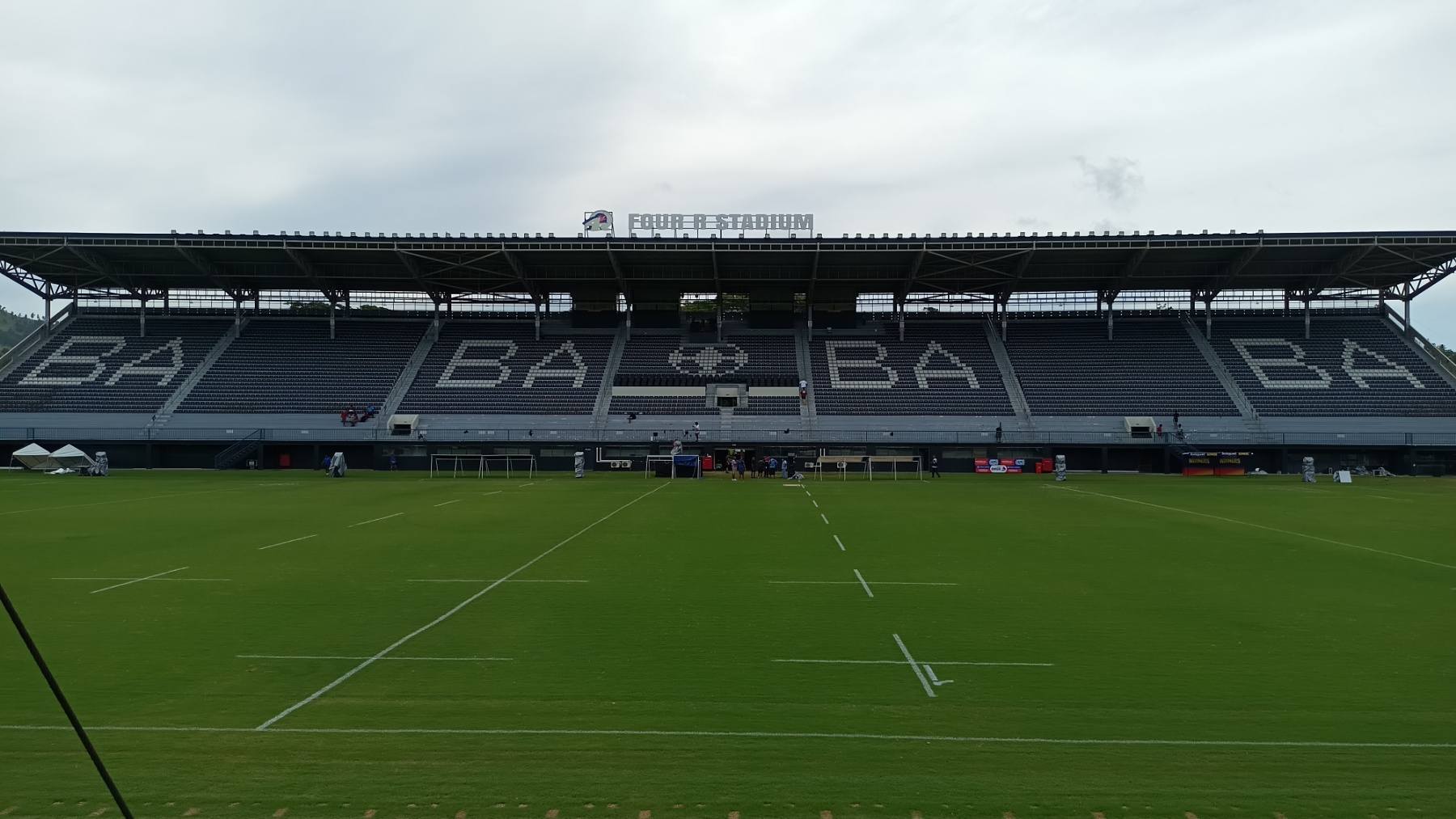
Govind Park A. SHARIFF SHAH SAVUSAVU HAD the opportunity to play at the above stadium after 16 years. Definitely rolled back the years. The hype and the publicity that this stadium received upon completion was out of this world. But when one goes there in person like me, surely it’s not impressive at first sight. The damaged changing rooms, the leaking toilets. The damaged, twisted and warped doors, its locks. The falling divider walls, the showers without shower heads. The fair face block walls with terrible finishing, perimeter drainage all blocked. The main drain behind the main stands all blocked, and it gives a very bad look. Certainly, this was done in a rush. It certainly will come back to haunt the relevant authorities. Mark my words. The Govind Park before was a delight. This new one will be a disaster in a year or two. Mark my words.
Viti and Vitian PAUL GERAGHTY USP, SUVA YOUR correspondent Vijay Madhavan (10/4/26) proposes we change the name of this country to Viti and use the adjective Vitian. This is not a new proposal. When the botanist Berthold Seemann published the account of his visit to Fiji in 1862, he entitled the book ‘Viti: an account of a government mission to the Vitian or Fijian Islands in the years 1860-61’, believing that it was more courteous to give the group the name which the people themselves use. But very few followed his lead, as the Tongan-derived name Fiji had become the accepted English name. Some observers expected the name Viti to be resumed on Fiji gaining independence in 1970, but it never happened. One theory was that the string of dots over the last three letters is aesthetically pleasing, and good for the tourist trade. Starting from the 1980s, the outstanding scholar and former director of the Fiji Museum, Fergus Clunie, used the name Viti and the adjective Vitian in his writings, in the museum journal Domodomo and other publications, presumably out of similar feelings of correctness to those of Seemann, but his was still largely a voice in the wilderness. Nevertheless, I note that both Viti and Vitian have been used increasingly by writers of Letters to the Editor (too many to name) over the past 20 years or so, and even by your esteemed self!
Unity in diversity AREKI DAWAI SUVA REGARDLESS of who we are, we all have red blood with basically the same anatomy of a being form in the likeness of the Architect of the universe (Christian belief). So, why would a name (Fijian) that was referred to by an English explorer has some of us stuck with it that has made some think “it’s our name, only for us”. I bet even when the book of life (Judgement day) is open, we will merely be recognised only as gentiles while the name Fijian I believe will be lying six feet under. Anyway, unless members of the GCC have brown blood and are from the mythology creature Chimera, then perhaps a small talanoa session under the mango tree could be summoned again. “Our ability to reach unity in diversity will be the beauty and the test of our civilisation” Mahatma Gandhi.

